

16 Oct 2026
I want to start with something that happened to a writer I know personally. She spent eight months on a nonfiction book about grief and healing, something deeply personal, something she had poured real emotional energy into. When she finished it she was so relieved and so eager to get it out that she did not slow down enough to research her options properly.
She found a company online that looked professional, had a nice website, used words like “traditional quality” and “full service publishing,” and she signed a contract and paid just under three thousand dollars. Six months later she had a book. The cover looked generic. The interior formatting had spacing issues she could see immediately. The so-called marketing support turned out to be a single press release sent to a list nobody reads.
Buried in the contract she had signed was a clause giving that company distribution rights to her book for seven years. She could not easily move it, change the cover, or adjust the pricing without going back through them.
That story is not rare. It happens to thoughtful, intelligent people every single year because finding the best book publishing service is genuinely hard when you are new to the industry and excited about finally getting your manuscript out into the world. This guide is about how to avoid exactly that situation.
Why this decision is harder than it looks
The market for publishing help has exploded over the last decade. There are now hundreds of companies offering some version of assistance to authors who want to get their books published. Some of them are excellent. Some are predatory. And a significant number sit in a grey area where they are not quite scamming you but they are also not delivering anywhere near the value they imply.
The language is designed to confuse you
Part of what makes choosing difficult is that the industry uses terminology in inconsistent ways. One company calls itself a hybrid publisher. Another calls itself a full service publishing house. A third describes itself as an author services platform. These labels do not have regulated definitions. A company can call itself whatever it wants regardless of what it actually does or how it treats authors.
Finding the best book publishing service for your specific situation means cutting through that language and looking at what a company actually delivers, what it costs, and what other authors genuinely experienced working with them. Many private publishing companies do not offer that transparency and they are banking on the fact that most new authors will not notice until it is too late.
New authors are specifically targeted
The companies that operate exploitatively know exactly who their customer is. They know that a first-time author who just finished a manuscript is emotionally invested, eager, and often does not yet understand how publishing works. Their sales processes are designed around that vulnerability. Urgency tactics, flattery about your work, vague promises about bookstore placement and media attention, these are not accidents. They are deliberate strategies.
The warning signs that should stop you cold
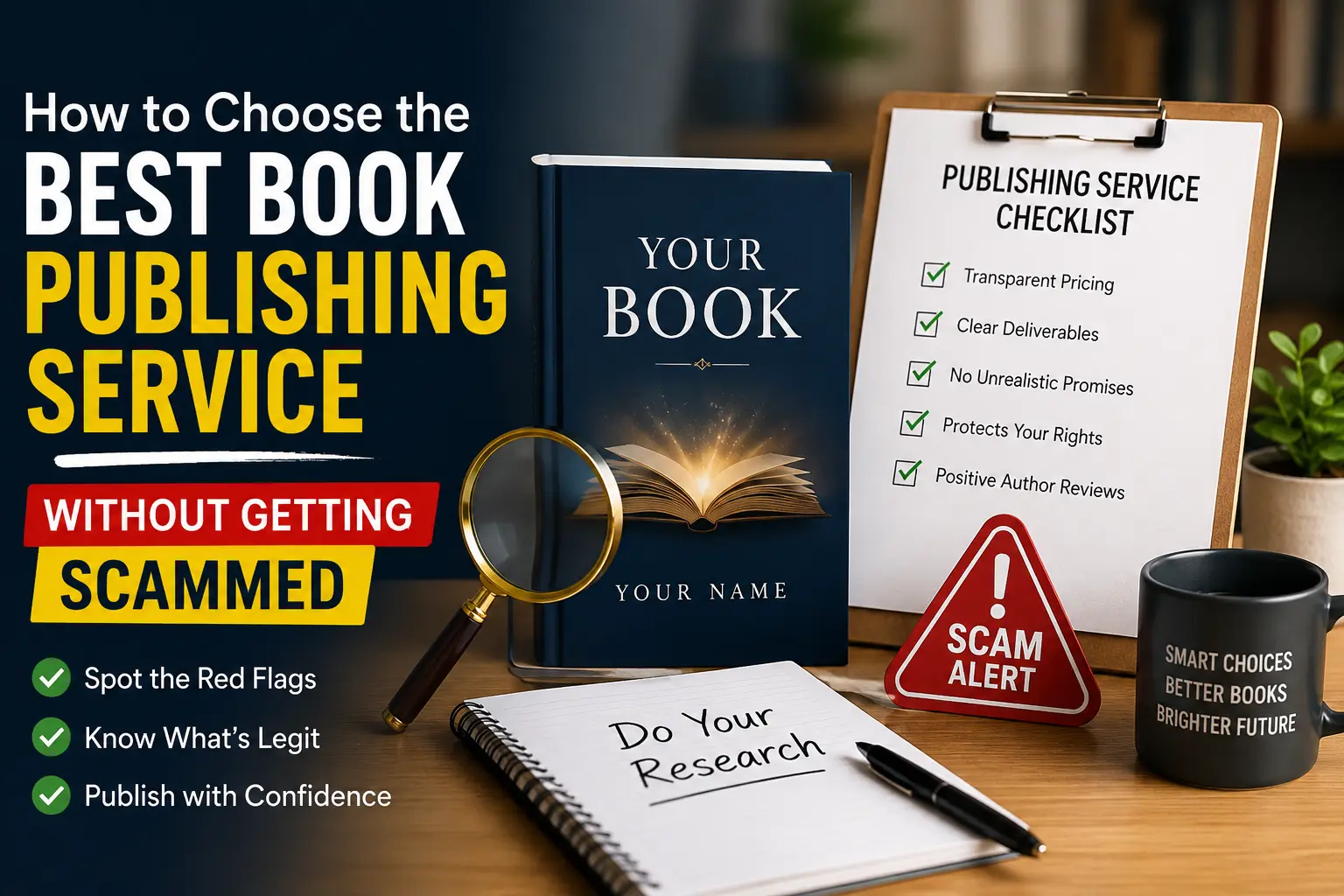
Before we get to what good looks like, let me walk through the red flags that should make you pause and do more research before you hand over any money.
Red flag 01
They contacted you first
No best book publishing service worth its reputation hunts for authors through unsolicited outreach. If someone found you first, treat it as a sales call.
Red flag 02
Pricing is hidden until you are invested
Requiring a phone call before revealing prices is a sales technique. Legitimate services show their rates publicly on their website.
Red flag 03
They promise impossible things
No service can guarantee bookstore placement, bestseller status, or a specific number of sales. Anyone promising this is misleading you.
Red flag 04
The contract asks for your rights
Watch for distribution rights, exclusivity periods, or reversion clauses. You wrote the book. A service provider has no reason to hold your rights.
What legitimate publishing services actually look like
Now for the other side of this. Because there are genuinely good options out there and knowing what they look like helps you find them.
Transparent pricing and clear deliverables
A trustworthy publishing service tells you exactly what you are buying. Cover design means a specific number of concepts, a specific number of revision rounds, and delivery in formats suitable for both print and digital. Formatting means a finished interior file that meets the technical requirements of the platforms you are distributing on.
The best book publishing service you can find will always show you its terms before asking for your commitment. That kind of transparency is what separates companies genuinely trying to help authors from ones trying to extract money from them.
They keep your rights
A service provider formats your book, designs your cover, and helps you distribute it. They do not own any part of it afterward. Their job ends when the deliverables are complete and their ongoing involvement in your book should be completely at your discretion. Any company that frames rights retention as unusual is not operating in your interest.
They have a verifiable track record
You can look up the books they have published. You can find those books on Amazon, check the production quality, look at whether they have actual readers and reviews, and assess whether the covers look competitive in their genres. A company with a genuine track record is not hard to verify. A company that talks about their experience in vague terms without pointing to specific titles probably does not have the track record they imply.
How to actually research a publishing service
Knowing the theory of what to look for is one thing. Here is the practical process for actually doing the research before you spend a single dollar.
Start with independent author communities
The indie publishing world has a strong culture of sharing information and warning each other about bad actors. Writer Beware is a website maintained by the Science Fiction and Fantasy Writers of America that specifically tracks predatory publishers and publishing services. The Absolute Write Water Cooler forum has years of threads about specific companies. Reddit communities like r/selfpublish have active members who share real experiences.
Before you spend money with any company, search their name in these communities. Not on their own website. Not on a review site that might be curated. In spaces where authors talk to each other honestly.
Ask for references and actually follow up
A legitimate publishing service should be willing to connect you with authors who have used them, not just point you at testimonials on their site but actually give you contact information for real clients you can reach out to with questions. Ask what went well, what did not, whether the deliverables matched what was promised, and whether they would use the service again.
Compare the contract against industry standards
The Alliance of Independent Authors publishes guidance on what reasonable publishing service contracts look like. Their website has resources specifically about what terms are acceptable and what terms should be dealbreakers. Running any contract you are considering against that guidance before you sign is one of the most valuable hours you can spend.
Services worth paying for vs ones worth skipping
Not all publishing help is created equal and some parts of the process genuinely benefit from professional support while others you can handle yourself for significantly less.
Worth every penny
- Professional genre-specific cover design
- Developmental editing
- Line editing and proofreading
- Interior formatting by an expert
- ISBN procurement and distribution setup
Probably not worth it
- Press release packages
- Generic social media promotion
- Catalogue listing services
- Bundled marketing support
- Any guarantee-based upsell
The DIY path is more viable than they want you to think
Platforms like KDP give authors a genuinely accessible path to publication without paying a middleman. Free formatting templates, clear documentation on every technical requirement, and a publishing process that takes hours rather than months are all available to anyone willing to learn the basics. When people ask me how to find the best book publishing service I always tell them to start by understanding what self-publishing actually involves because that knowledge helps you evaluate any paid service far more clearly and sometimes you realize you do not need one at all.
A simple framework before you sign anything
When you are looking at a publishing service and trying to decide whether it is legitimate, run through these five questions before you commit to anything.
Your pre-signing checklist
1
Can I find the pricing on their website without talking to anyone first?
2
Do I keep full rights to my book after the work is done?
3
Can I find books they have published and verify the quality myself on Amazon?
4
Have independent authors in writing communities spoken positively about them?
5
Does the contract have a clear end point after which they have no ongoing claim to my work?
If the answer to any of these is no or “I am not sure,” that is not necessarily a reason to walk away automatically but it is absolutely a reason to get clear answers before you pay.
Your manuscript survived the writing
The publishing services industry has genuinely good options in it. Finding the best book publishing service for your book requires doing the research that predatory companies are hoping you will skip. Clear terms, published rates, no rights grabs, no unsolicited outreach. Hold any company you consider to at least that standard and you will be in a much stronger position to make a decision that serves your book and your career rather than someone else’s revenue target.
📚 Keep Reading — Related Guides
🔗 Are Book Publishing Services Worth It?
🔗 Amazon Book Publishing Services: Everything Authors Need to Know
🔗 Self Publishing vs Traditional Publishing: Which Makes More Money?
🔗 How to Publish a Book on Amazon and Reach More Readers
🔗 10 Things to Look for Before Hiring a Book Publishing Company