



07 Sep 2026
I spent three years writing my first manuscript. Three years of early mornings, skipped weekends, and more coffee than I want to admit. And when I finally typed the last sentence, I genuinely believed the hard part was behind me.
I was so wrong.
What followed was a completely different kind of struggle, one that nobody in any writing course or author forum had ever properly prepared me for. The cost of publishing a book is one of those topics that writers avoid because it feels awkward, like admitting you walked into something without doing your homework. But I am going to be straight with you because I needed this conversation three years ago and nobody was having it.
Why Nobody Talks About Publishing Costs Honestly
There is this strange unspoken agreement in writing communities to not discuss money. Writers will happily spend hours talking about plot structure, rejection pain, and word count goals. But actual numbers? Actual budgets? That stuff gets avoided like it is somehow beneath the craft.
Traditional publishing trained people to think this way because it absorbed the financial side in exchange for a large cut of your earnings and most of your creative control. So writers grew up thinking publishing costs were someone else’s problem. Then self-publishing exploded and suddenly the bill landed directly in front of the author with no warning.
I learned this the uncomfortable way.
Traditional Publishing vs. Self-Publishing: The Cost Is Never Zero
People assume traditional publishing means free publishing. You get a deal, someone else handles production, money comes in. That story is missing a lot of pages.
Even on the traditional path you will likely spend money before you ever get an offer. Query letter consultants, developmental editors to strengthen your manuscript before submission, proposal writers for nonfiction. And the advance you eventually receive, if you receive one, is not a gift. It is a loan against future royalties that most debut authors never fully earn back.
Self-publishing is where the numbers stop hiding. When writers ask me about the cost of publishing a book independently, I tell them to think honestly about three levels: the bare minimum route, the professional route, and the full launch approach. Each one produces a different book and a very different experience in the market.
Breaking Down Every Major Cost Category
Editing: The Expense You Cannot Skip
If there is one area where writers cut corners and later wish they had not, it is editing. I have watched this happen in writing communities more times than I can count. Someone puts real money into a gorgeous cover and then pays almost nothing for editing, and six months later they are confused about why the reviews mention pacing problems and unclear motivations.
In 2026, a developmental editor for a full-length novel charges somewhere between $1,500 and $5,000 depending on their experience and your manuscript length. This is not a proofreader. This is someone who tells you whether your story actually works at a structural level.
After that comes line editing for sentence flow and clarity, roughly $800 to $2,500. Then copyediting for grammar and consistency at $500 to $1,500. Then proofreading, your final check before the book goes out, around $300 to $800.
For a standard novel you are looking at a floor of $3,000 just for editing, and that assumes you find good people at their lower rates.
Cover Design: First Impressions Decide Everything
Readers absolutely judge books by covers. This is not a romantic myth, it is just how buying decisions work, whether someone is scrolling Amazon at midnight or standing in a bookstore.
A professional cover designer in 2026 charges $300 to $1,500 for a front cover, more if you need a full print wrap with spine and back. Premade covers from design marketplaces can cost as little as $50 but you give up exclusivity and often quality. In genre fiction especially, cover conventions are so specific that a weak cover will quietly kill your sales no matter how strong the writing is.
I used a cheaper option on my first book. The sales data was not subtle about how that went.
Formatting and Interior Design
Once editing and cover are done, the inside of the book needs to look right too. Ebook formatting can be handled with tools like Vellum or Atticus, though Vellum itself costs around $250 as a one-time purchase. Print formatting is more involved and hiring someone typically runs $150 to $500. Books with heavy visual elements like cookbooks or illustrated nonfiction climb higher.
ISBN and Copyright Registration
In the US, Bowker is the only official ISBN provider and the pricing is genuinely painful. One ISBN costs $125. A pack of ten is $295. If you are building a small imprint and planning multiple books, buying in bulk is the only logical move.
Copyright registration costs around $65 online and while it is not legally required, it gives you the ability to pursue real damages if someone steals your work. Worth it.
Marketing and Launch Costs
This is where the cost of publishing a book either stays manageable or completely runs away from you. Marketing has no ceiling and it is easy to spend a lot while accomplishing very little.
At minimum, an author website runs $100 to $300 per year. Email tools like ConvertKit add $0 to $50 monthly depending on list size. A NetGalley listing for advance reviews costs around $450. Paid advertising through Amazon Ads or BookBub adds more on top of that depending on how aggressive your launch strategy is.
A realistic launch budget for an independently published book in 2026 sits somewhere between $500 and $3,000 if you are being thoughtful about it.
What Does the Full Picture Actually Look Like?
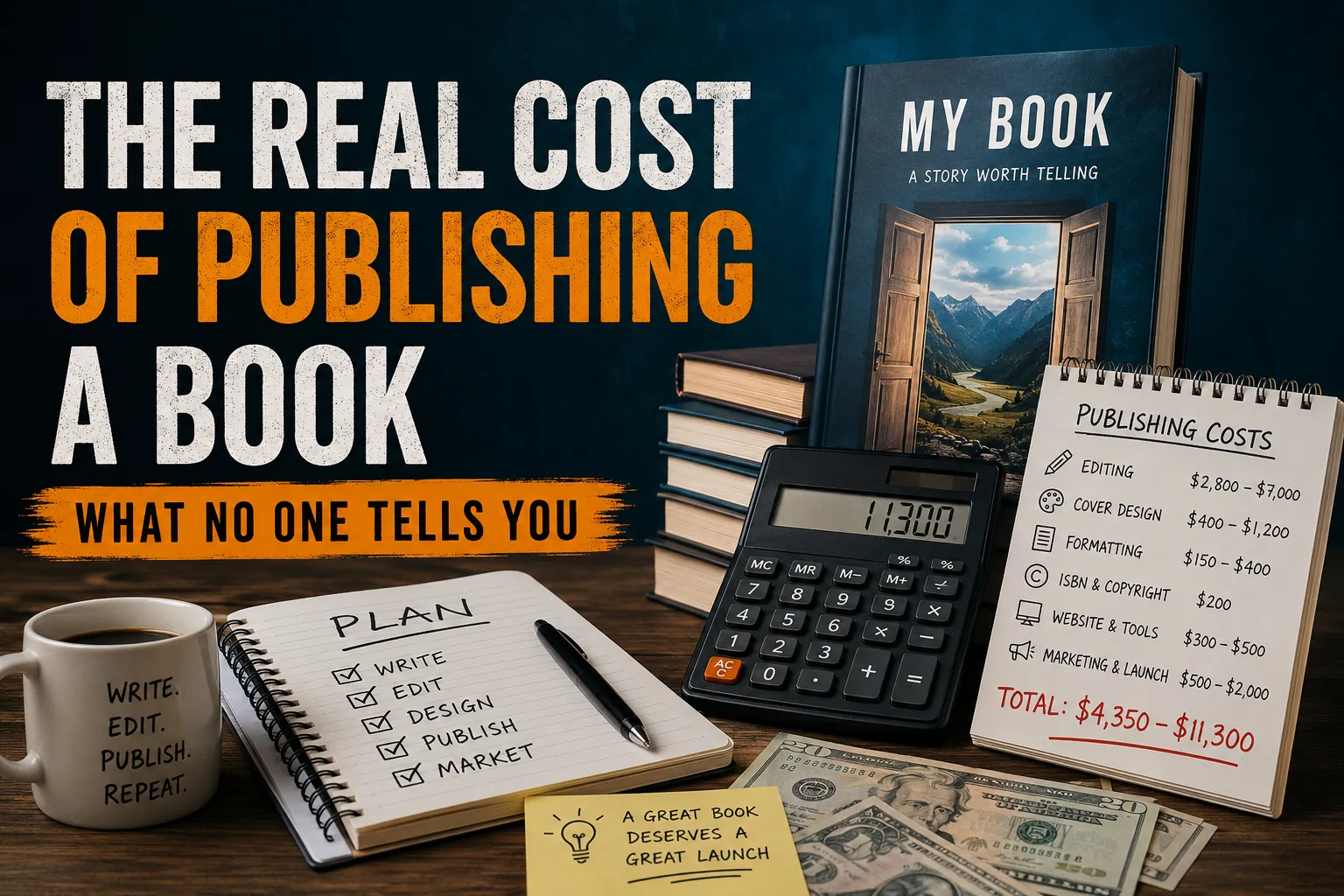
Here is a straight honest range for a professionally published independent novel in 2026. Editing across all stages runs $2,800 to $7,000. Cover design adds $400 to $1,200. Formatting is $150 to $400. ISBNs and copyright registration come to roughly $200. Author website and tools for the year cost $300 to $500. Launch marketing sits at $500 to $2,000.
Total realistic range: $4,350 to $11,300.
Where you land depends on how much you can do yourself, how experienced the people you hire are, and how seriously you take the launch. Some authors spend more. Many spend less and accept the quality gaps that come with that.
The Hidden Costs Nobody Puts on a Spreadsheet
Beyond the invoices there are costs that never appear as line items but are completely real.
Time is the biggest one. Writing, revising, communicating with editors, learning marketing, managing your platform and launch campaign, that is a second job running alongside whatever else your life already contains. The hours have value whether or not you invoice them.
There is also the emotional weight of promoting your own work publicly, handling criticism from strangers, managing your own expectations about sales. No budget spreadsheet prepares you for that part.
And then there is re-investment. Writers who find any traction tend to funnel earnings straight back into the next book, better production on the next project, audiobook recording, wider advertising. The cost of publishing a book rarely ends cleanly at publication day.
Is It Worth It in 2026?
Honestly, it depends on what you are trying to get out of it.
If fast money is the goal, the math is hard. Most independently published books eventually earn back their production costs but that timeline can stretch across months or years. The authors building real sustainable income usually have multiple books out, a loyal email list, and several years of consistent work already behind them.
If you are publishing because you have a story that matters and you want it to exist in the world made properly, then understanding the cost of publishing a book and budgeting for it seriously is absolutely the right move. A professionally produced book does not just feel better. It earns better reviews, performs better in algorithms, and represents your work with the respect it took years to create.
The writers who make it work are rarely the biggest spenders. They are the ones who understood what each cost was actually buying them and treated the whole thing like the serious creative and business endeavor it is.
My Honest Advice Before You Spend Anything
Put editing first, always. If your budget is tight, spend it on a good developmental edit before anything else. A beautiful cover on a broken story will not save you.
Get multiple quotes before hiring anyone. There are talented professionals at every price point and the most expensive option is not automatically the best one.
Talk to other authors before spending a single rupee or dollar. Most people who have been through this are generous about sharing what they learned, including what they would do differently.
And do not let the cost of publishing a book stop you from finishing the manuscript first. Write the book. Make it the best it can be. Then figure out how to bring it into the world properly.
The story you have been carrying around deserves to exist. Just go in knowing the full price of that journey.