




07 Sep 2026
Okay so this happened again last week. Someone messages me, “hey can you just proofread this real fast,” and I open the file and just… sigh. Because ten seconds in I already know this isn’t a ten minute job. Proofreading vs editing gets mixed up constantly, and for a long time I figured people just didn’t know better or didn’t care enough to look it up. But now I think it’s simpler than that honestly. Nobody ever sits you down and actually explains it. You just kind of absorb the wrong idea and carry it around for years.
I still remember handing my own manuscript to a friend way back and asking for “a quick proofread.” Her first comment was “does this whole chapter need to exist?” And I remember being a little annoyed, not gonna lie, because I wanted commas fixed, not my life questioned. Except she was right. What I actually needed wasn’t proofreading at all. It was something much bigger, and I just hadn’t realized it yet.
So let’s actually get into this, because once it clicks, and it will, you stop wasting time on the wrong kind of help. Or money, if there’s money involved.
What Editing Actually Means
Editing usually happens first, right after there’s something resembling a full draft sitting in front of you. This is the stage where you’re allowed, honestly kind of expected, to ask the big uncomfortable questions. Does any of this make sense? Is there an actual point buried in here or is it hiding under six paragraphs of throat clearing? Does the story go anywhere, or is it just wandering around hoping something happens eventually?
A decent editor will point out your intro takes three paragraphs to say what one sentence could’ve done. They’ll catch you contradicting yourself between chapter two and chapter five, something you didn’t notice because you were too deep in it. Sometimes they’ll say cut this whole section, and you’re attached to it, and that stings every single time. But usually? They’re right.
There’s actually a few different kinds of editing, which honestly took me a minute to learn myself. Developmental editing is the big picture stuff, structure, whether the argument holds up, whether the plot actually goes somewhere. Line editing zooms in closer, your voice, whether specific word choices are pulling their weight. Copy editing sits somewhere in the middle, catching grammar slips and consistency stuff, like spelling “email” one way on page three and “e-mail” on page eleven without ever clocking it.
This is honestly the part people underestimate most when proofreading vs editing comes up. Editing usually isn’t fixing something broken. A lot of the time your writing isn’t broken. It’s just not as strong as it could be yet, which, weirdly, is a totally different problem to solve.
A Small Example From My Own Writing
Not long ago I wrote a piece on remote work productivity, something like 2,000 words. Read it back, thought yeah, this is fine, done. Sent it to a friend who edits for a living. Her note came back saying the middle third read like padding, 400 words to say something that needed maybe a hundred, and the actual thing readers cared about got shoved into two sentences near the end.
That’s editing. Nothing to do with grammar. It’s whether what you wrote is actually doing what it needed to do.
Where Proofreading Comes In
Proofreading is the very last step. It’s what happens right before something goes out, whatever “out” means for you that day. Hitting publish. Sending a manuscript off. Emailing a report to your boss without wanting to disappear right after.
By the time you’re proofreading, the big calls are already made. You’re not wondering anymore if a paragraph belongs. You’re checking small stuff now. Did you type “their” instead of “there,” again, for the third time in this same document? Is your punctuation actually consistent? Did a sentence just trail off somewhere because your phone buzzed mid thought and you never came back?
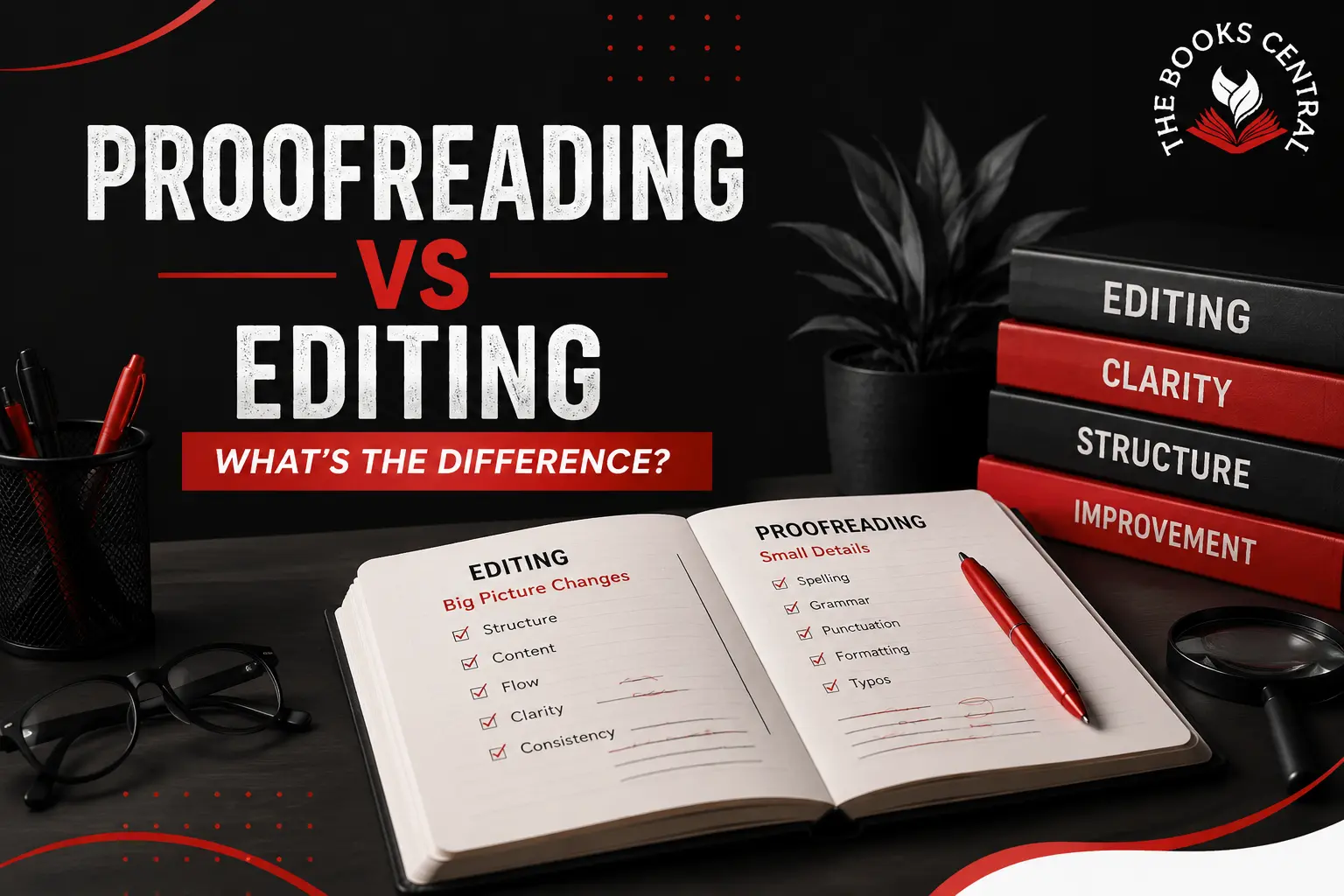
This is really the whole proofreading vs editing thing in one line, if you want it short. Editing shapes what you’re saying. Proofreading makes it look clean once you’ve said it. One happens while things are still shifting. The other happens once it’s basically locked and just needs a last once over.
I think of it kind of like renovating a house versus tidying before guests show up. Editing is knocking down a wall, redoing the kitchen, deciding you need a window that wasn’t there. Proofreading is wiping fingerprints off the glass afterward. Both matter, genuinely. But nobody hires the window cleaner to come knock down walls. That’d just be a weird call to make.
Small Things That Slip Past Even Careful Writers
Even people who’ve written for years miss stuff proofreading, mostly because by then they’re too close to it. Some repeat offenders:
Homophones, “affect” and “effect,” “its” and “it’s.” Your brain already knows what you meant so it just glides right past the actual mistake sitting there.
Formatting that’s inconsistent, switching between numerals and spelled out numbers without meaning to, headings that don’t match from section to section.
Doubled words, which happens a lot when you rewrite a sentence and forget there’s a leftover word just hanging around.
Names spelled two different ways in the same piece. Happens more than people admit, especially once things get longer.
None of this touches what you’re actually saying. Doesn’t make your argument stronger or weaker. But it makes you look a little sloppy, and people notice, even if they can’t say exactly what bugged them about it.
Why This Keeps Confusing People
Part of why proofreading vs editing trips people up is both involve reading closely and marking up problems. From outside they look almost the same. Two people, same document, both scribbling in the margins. Looks like the same job if you’re just glancing over.
But the mindset underneath is completely different. Editing means reading for meaning, structure, whether the whole thing holds together. Proofreading is way narrower, hunting surface level errors while assuming the content itself already works.
I’ve noticed freelancers and small businesses throw these words around interchangeably a lot, and for something low stakes, a quick blog post nobody’s paying for, it genuinely doesn’t matter. You’ll edit and proofread in one sitting without thinking about it twice. Fine, no harm done. But the second money’s involved, or there’s a publisher, or a client with expectations, that distinction matters fast. Paying proofreading rates and getting back something that still needs structural work feels like getting shortchanged even if nobody meant it that way.
Figuring Out Which One You Need
Here’s how I usually walk through this myself. A few honest questions.
Do you actually trust the structure of what you wrote? The argument, the flow, whether it hangs together? If you’re not sure, you need an edit first. No point polishing sentences in a section that might get cut next week anyway.
Has someone already looked at it for content and flow? If the bones feel solid and you’re mostly worried about typos or clunky phrasing now, you’re probably ready to proofread instead.
Is this the actual final version, the one going out the door for real? If yes, proofreading is always your last move, even after a full edit’s done. Editing tends to introduce its own small errors anyway, since you’re moving stuff around and rewriting as you go. So order matters here. Edit first, proofread last, no exceptions really.
If someone made me pick just one, I’d say editing wins most of the time, especially for newer writers. A flawless, typo-free piece that’s confusing to actually follow still fails at its job. Something with a stray typo but genuinely clear thinking behind it can still land fine with people. Not perfect, but it works. Doing both properly is the real goal, obviously. Just in the right order.
A Few Habits Worth Stealing
If you’re handling this yourself instead of paying someone, which, let’s be real, is most of us most of the time, a few habits genuinely help.
Put distance between you and the writing before either task. Even a couple hours helps some. A full day’s better if you’ve got it. Your brain stops autofilling based on what you meant to write and starts actually seeing what’s there.
Read it out loud while editing. Feels a little silly, sure, talking to your laptop alone. But it catches awkward phrasing way better than reading silently ever does. Trip over a sentence out loud and your reader’s going to trip over that same spot too.
For proofreading, try reading backward, sentence by sentence from the end. Sounds odd, I know. But it works because it stops your brain riding the momentum of the whole piece and forces you to actually look at each sentence on its own, which is exactly where typos hide.
Change the format before your last pass. Wrote it in Word? Read it as a PDF, or print it if that’s an option. Something about that visual switch tricks your brain into catching stuff it had gotten used to skipping.
And keep a running list of your own habitual mistakes. Everyone’s got a few. Maybe you overuse a word without noticing, maybe you always drop a comma in the same kind of sentence. Once you know your own patterns, proofreading gets faster because you already know where to look.
Wrapping This Up
At the end of the day, proofreading vs editing isn’t two versions of the same job. They’re separate tasks, done in a specific order, and skipping one or doing them backward tends to show in the finished piece whether you catch it yourself or not. Editing makes sure what you’re saying holds together and actually means something. Proofreading makes sure it looks clean and professional once it’s finally out there.
If there’s one thing worth keeping from all this, it’s don’t mistake a fast grammar pass for a real edit, and don’t assume a heavily edited piece is done just because the ideas are solid now. Give each step its own attention. Whether it’s a blog post, a work report, or that novel you’ve been chipping away at for way too long, the writing genuinely gets better when you treat these as two separate jobs instead of one.