



14 Oct 2026
Let me tell you something that took me an embarrassingly long time to figure out. When I finished my first manuscript, I had absolutely no idea what came next. I knew the writing part. I had no clue about the publishing part. So like most people in that situation, I started Googling. And within about fifteen minutes I had landed on three different websites all offering to publish my book for me, handle everything, take the stress away, just hand it over and they would do the rest.
Book publishing services are everywhere now. Some of them are genuinely useful. Some of them will take your money and give you almost nothing in return. And a lot of them sit somewhere in the murky middle where the value depends entirely on who you are, what your book is, and what you actually want to achieve with it.
I have talked to authors who swear these services saved them years of confusion. I have also talked to authors who spent thousands of dollars and ended up with a poorly formatted paperback and a cover that looked like it was made in 2003. Both experiences are real and both happen regularly. So the question of whether these services are worth it does not have one clean answer. What it has is a lot of important context that most people skip straight past when they are excited about finally getting their book out.
What Book Publishing Services Actually Are
Before you can decide if something is worth paying for, you need to understand what you are actually buying. This category of service covers an enormous range and the word “publishing” gets used very loosely.
The Spectrum From Legitimate to Predatory
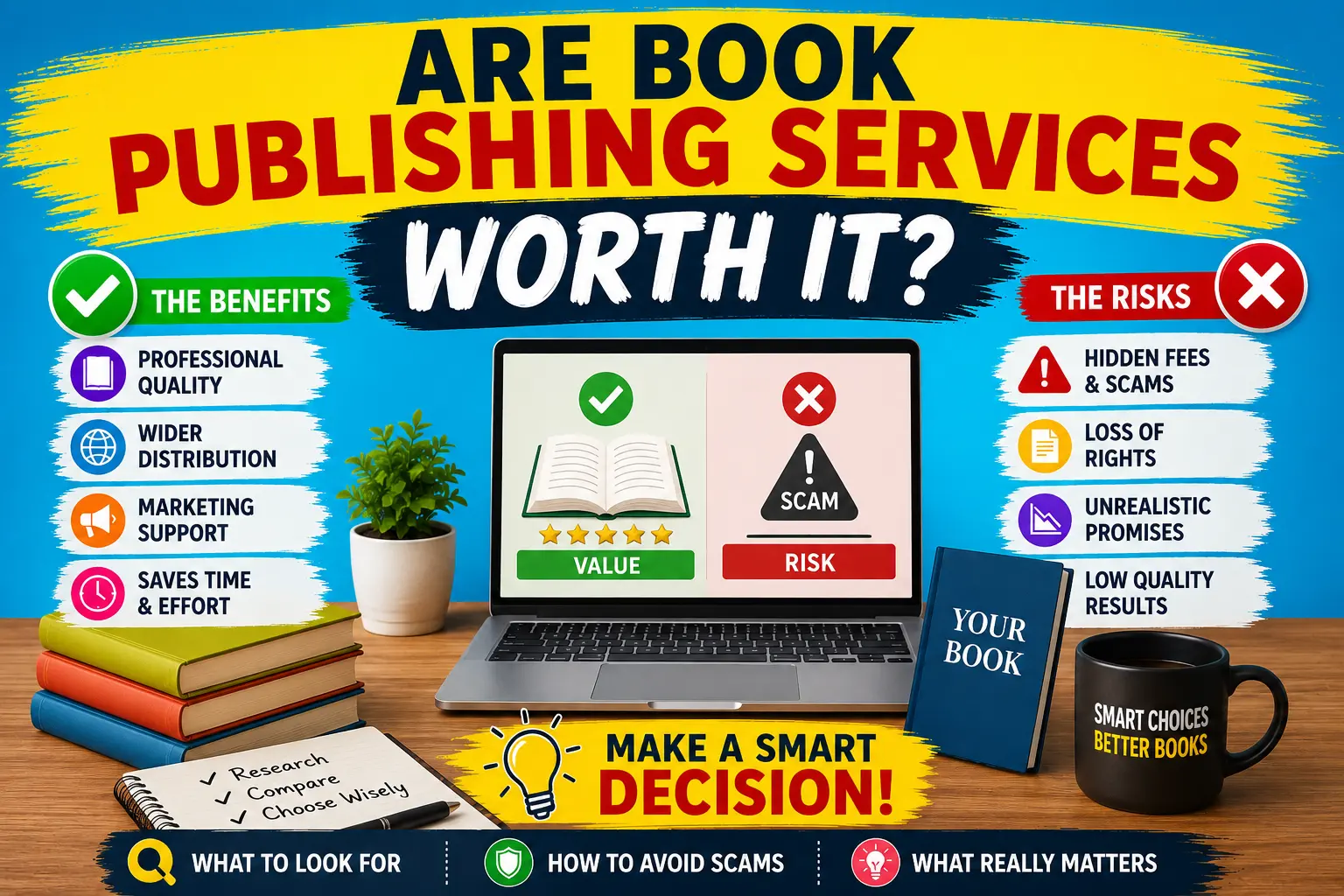
On one end you have reputable companies that offer real, transparent services. They will format your interior, design a professional cover, assign an ISBN, set up distribution to major retailers, and sometimes offer editing packages on top of all that. They charge clearly, deliver what they promise, and treat authors as clients with rights over their own work.
On the other end you have what the publishing industry calls vanity presses, though they rarely call themselves that. These companies target new authors who do not yet know how publishing works. They charge high fees, promise things like “wide distribution” and “marketing support” that turn out to mean almost nothing in practice, take rights that they have no business taking, and produce books that look noticeably amateur. The author pays, the company profits, and the book goes nowhere.
In between there are hybrid publishers, assisted self-publishing platforms, author services companies, and all kinds of other models. Navigating this space without some background knowledge is genuinely difficult.
What These Services Typically Include
When book publishing services are operating honestly and well, here is what they usually offer. Editorial services ranging from developmental editing all the way through to proofreading. Interior formatting for both print and digital. Cover design. ISBN procurement. Distribution setup through channels like Amazon, IngramSpark, and sometimes brick and mortar bookstores. Some also offer marketing packages that can include press releases, review submissions, and social media promotion.
The key word there is “offer.” Just because a service is included in a package does not mean it is done well. This is where author research becomes essential.
The Case For Using a Publishing Service
I want to be fair here because there are real, legitimate reasons why an author might choose to pay for publishing support rather than doing everything themselves.
Time Is a Real Cost Too
Self-publishing on a platform like KDP is free in terms of money but it is not free in terms of time and learning curve. To do it well you need to learn manuscript formatting, cover design principles, metadata optimization, category research, pricing strategy, and some basics of book marketing. That is a substantial investment of time and energy, and not every author has that to spare.
A writer who works full time, has a family, and managed to carve out the hours to finish a book may simply not have the bandwidth to also become an expert in indie publishing. For that person, paying someone to handle the technical and logistical side is not weakness, it is a reasonable allocation of limited resources.
The Production Quality Argument
Book publishing services that are genuinely good at their job produce better results than most first-time authors would produce on their own. Professional cover designers understand genre conventions in ways that matter enormously for sales. Experienced formatters know how to produce an interior that looks clean and readable in both print and digital without the weird spacing issues and font inconsistencies that plague amateur productions.
Readers may not consciously notice when a book is professionally produced, but they absolutely notice when it is not. A book that looks self-published in the negative sense of that phrase faces an uphill battle regardless of how good the writing is.
Distribution Access
Some publishing services have distribution relationships that individual authors cannot easily access on their own. Getting your print book into physical bookstores, for example, requires either working with a distributor like Ingram or going through a service that has that relationship built in. For authors who specifically want their book available in brick and mortar retail, this can be a real practical advantage.
The Case Against Paying for These Services
Now for the other side, because it is important and often gets drowned out by the marketing copy of the companies selling these services.
Most of What They Offer You Can Learn
The honest truth is that everything a publishing service does, an author can learn to do themselves or hire out piecemeal for significantly less money. Cover design from a freelancer on Reedsy or a designer found through genre-specific communities often costs less than the cover included in a publishing package and is frequently better. Interior formatting through Vellum or Atticus costs a one-time fee and gives you a tool you can use for every book you ever write.
Book publishing services bundle these things together and charge a premium for the convenience. That premium is sometimes worth it and sometimes represents a significant overpayment for work you could have arranged yourself at half the cost.
The Rights Question
This is the one that I feel most strongly about and the one that gets new authors into the most trouble. Some publishing services, particularly the ones that blur the line between service provider and publisher, ask for rights to your book as part of the arrangement. Sometimes this is framed as standard contract language. Sometimes it is buried in terms that authors sign without reading carefully.
Your rights to your own work are not something to give away without understanding exactly what you are agreeing to. If a publishing service is asking for any kind of ownership stake or distribution exclusivity, get very clear on what that means before you sign anything. An intellectual property lawyer costs money too but it is money well spent before you hand over rights to something you worked years to create.
The Marketing Promise Problem
Almost every paid publishing service offers some version of marketing support. And almost every author who has used these services will tell you the same thing afterward, the marketing component was the biggest disappointment. A press release that goes nowhere. A listing in a catalogue that no bookstore buyer actually reads. Social media posts that generate no engagement because the service account has no real following.
Real book marketing is hard work that requires either the author’s own effort and platform building or a significant budget for paid advertising managed by someone who actually knows what they are doing in today’s market. The marketing packages attached to publishing service bundles rarely deliver either of those things.
How to Tell a Legitimate Service From a Predatory One
This is practical information that every author considering these services needs to have before they start making phone calls or filling out contact forms.
Legitimate Services Do Not Solicit You
If a publishing company reached out to you, found your manuscript submission somewhere, sent you an unsolicited email about how excited they are about your work, that is a red flag. Real publishers and reputable publishing services do not cold-contact authors. The companies that do this are almost universally operating a model built around extracting money from hopeful writers.
Transparent Pricing Is a Green Flag
A legitimate book publishing service tells you exactly what you are paying for and what it costs. There are no vague promises, no “packages starting from” language that hides the real numbers, and no upsell pressure once you are already engaged with them. If you cannot find clear pricing on their website, that is information.
Check Where Their Books Actually End Up
Ask the service for a list of books they have published and then go find those books on Amazon. Look at the covers. Read the descriptions. Check the rankings. Look at the reviews. A company that has consistently produced professional-looking books with actual readers buying them is demonstrably different from one whose catalogue is full of books with no reviews and amateur production values.
Talk to Authors Who Have Used Them
The indie publishing community is genuinely helpful and authors talk to each other. Forums, Facebook groups, Reddit communities, writing associations, all of these are places where you can ask direct questions about specific companies and get honest answers from people who have actual experience with them.
When Book Publishing Services Make Sense
After all of that, here is my genuine assessment of when paying for these services is actually the right call.
Hiring a publishing service can be worthwhile when you need a professionally produced book on a tight timeline and have no desire to learn the technical aspects of self-publishing. It also helps when the company has a transparent track record, clearly stated pricing, and results you can verify independently. Keeping full ownership of your rights, paying a straightforward service fee, and maintaining realistic expectations are also signs that the investment may be justified.
On the other hand, unsolicited outreach should immediately raise concerns. A contract that asks for publishing or distribution rights deserves careful scrutiny before you sign anything. Likewise, marketing claims that sound too good to be true often fail to reflect the realities of how books are actually sold and promoted.
And it does not make sense if the pricing is unclear until you are already deep in a sales conversation.
The Alternative Worth Knowing About
For most authors reading this, the path that offers the most control, the best royalties, and the most flexibility is learning to navigate self-publishing directly. Book publishing services have their place but so does understanding the platform yourself.
KDP for ebooks and print on demand. IngramSpark for expanded distribution. A freelance cover designer from a community that specializes in your genre. Vellum or Atticus for interior formatting. These four things together will produce a book that competes visually and technically with anything a paid service would deliver, usually for significantly less total cost, and with you retaining every right to your own work.
Final Thoughts
Are book publishing services worth it? Sometimes yes and sometimes absolutely not, and the difference between those two outcomes usually comes down to how much research the author did before signing anything.
The writers who come out of these arrangements satisfied are the ones who went in with clear expectations, chose a company with a verifiable track record, kept their rights, and understood that no service can replace the work of building a real readership. The writers who come out frustrated are usually the ones who were sold a dream and discovered too late that the fine print told a different story.
Your book took real work to write. It deserves the same level of care and clear-eyed thinking when it comes time to put it out into the world.