



14 Oct 2026
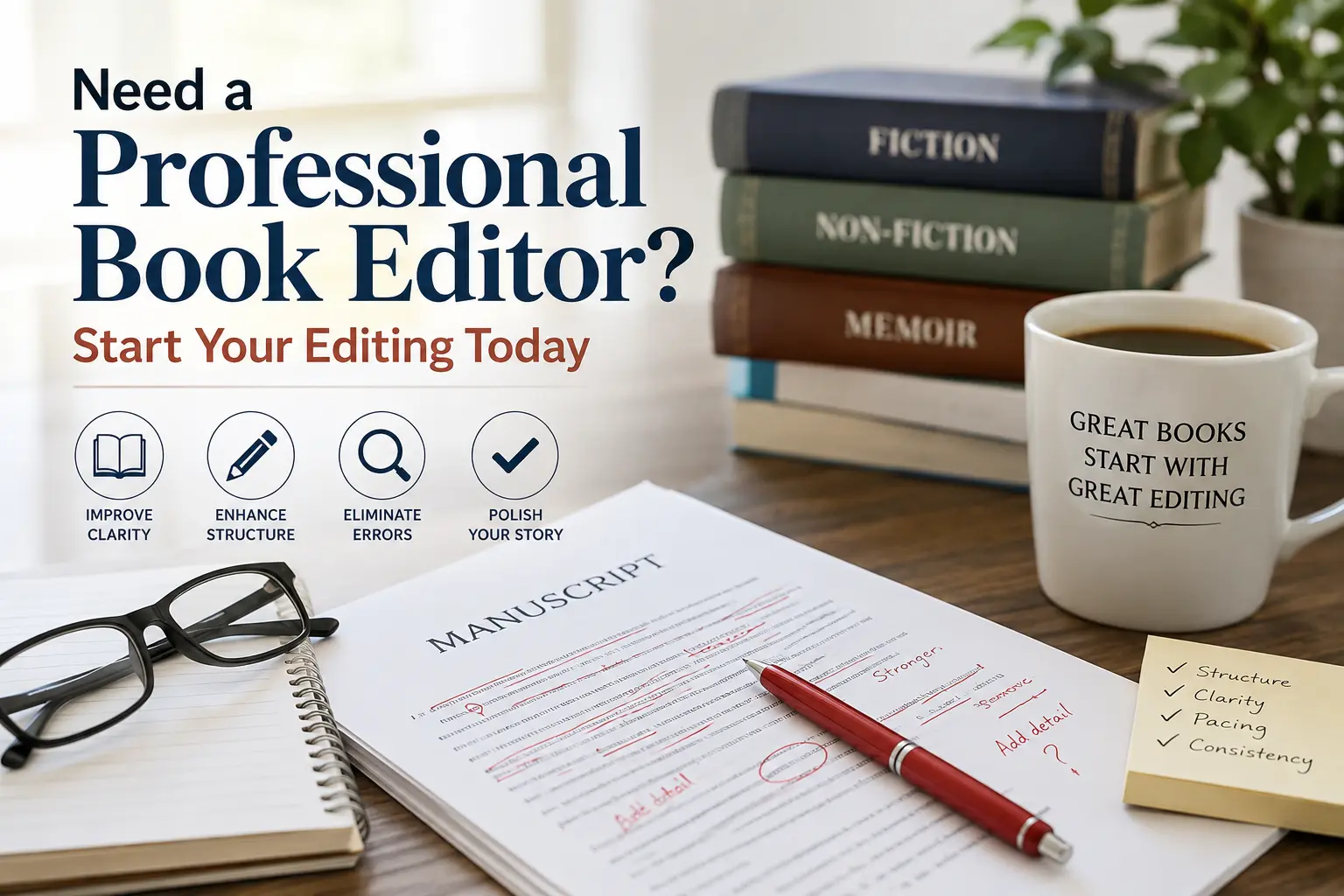
You finished your manuscript. Genuinely, congrats, because that alone puts you ahead of most people who just talk about writing a book someday and never do. But here’s a part nobody warns you about enough. A professional book editor is often the thing standing between a manuscript that reads like a rough draft and one that actually feels ready for readers. I say this from experience. I’ve gone through it myself, and I’ve talked to plenty of authors who either skipped this step and regretted it later, or hired the wrong person and regretted that even more.
So let me be straight with you. What editing actually involves, why it matters more than most first time authors expect, and how you find someone who’s actually good at the job instead of just someone with a nice website and a catchy tagline.
What a Professional Book Editor Actually Does
A lot of people assume editing just means someone reads your book and fixes typos here and there. That’s proofreading, and honestly it’s only one small slice of a much bigger job. Real editing happens in layers, and every layer catches something different from the last.
Developmental editing comes first, ideally. This is the big picture stuff. Does your story structure actually hold together? Do your characters make consistent choices, or does one suddenly act completely out of character in chapter fourteen just because the plot needed them to for a scene to work? Does pacing drag through the middle third, which, by the way, happens in nearly every first draft ever written, mine included? A developmental editor reads with all of this in mind and hands back feedback, sometimes running several pages, on what’s working and what needs rebuilding.
Quick tip:
not every manuscript needs every editing stage. A good editor will tell you honestly which pass your book actually needs instead of selling you a full package you do not require.
Then there’s line editing, which zooms in tighter. Someone looks at your actual sentences here, your word choices, how things flow rhythmically. Are you repeating the same phrase five times in one chapter and not even noticing? Is a scene that should feel tense instead reading flat because every sentence is roughly the same length and shape? Line editing shapes the prose itself, sentence by sentence, sometimes word by word.
Copyediting comes next. Grammar, consistency, technical accuracy. Did your character have blue eyes in chapter two and green eyes by chapter nineteen? A copyeditor will catch that. Punctuation, verb tense slips, formatting issues, all the stuff that would otherwise embarrass you in front of readers who notice more of this than you’d guess.
Proofreading comes last, right before publication. The final pass. Typos, stray punctuation, formatting glitches that somehow slipped through every earlier round despite everyone’s best efforts.
A genuinely skilled professional book editor knows which of these stages your manuscript actually needs at this point in its life. And a good one tells you honestly if you’re asking for the wrong service entirely. I’ve heard of authors who paid for a full developmental edit when their manuscript had already gone through three drafts with beta readers and really just needed a solid line edit. A good editor says so upfront rather than quietly taking your money for work you didn’t need.
Signs Your Manuscript Needs More Than Self Editing
Plenty of authors try self editing first, and that’s smart, honestly, nothing wrong with it. But there are signs it’s time to bring someone else in.
If your beta readers keep giving you conflicting feedback you just can’t reconcile on your own, that usually means it’s time for a professional opinion, someone who can see the forest instead of the trees you’ve been staring at for months. If you’ve reread your own manuscript so many times you genuinely can’t tell whether a scene still works, or whether you’re just remembering what you meant it to do back when you first wrote it, that’s another sign worth paying attention to. Writers lose objectivity after enough passes through the same material. Not a flaw exactly. Just how brains work after staring at identical paragraphs for months on end.
And if you’re planning to query literary agents or submit to traditional publishers, a professional book editor becomes nearly non negotiable. Agents read hundreds of submissions a month. Manuscripts with structural issues or clunky prose get rejected within the first few pages, sometimes the first paragraph if things are rough enough. You don’t really get a second shot at that kind of first impression.
How to Find the Right Editor for Your Book
Finding a good editor takes more effort than typing “book editor” into Google and hiring whoever shows up first with a slick looking website. Trust me on this one, I learned it the annoying way.
Start by looking for editors who actually specialize in your genre. An editor who’s spent years polishing literary fiction might not be the right fit for a fast paced thriller. And someone who edits nonfiction business books probably isn’t your best pick for a fantasy epic with three point of view characters and a made up language nobody but you understands yet. Genre matters here because pacing, voice, reader expectations, all of it shifts a lot between genres.
Ask for a sample edit before you commit to anything real. Most legitimate editors will edit a few pages for free, or for a small fee, so you can actually see their style before handing over money for a full project. This one step alone has saved a lot of authors from a mismatched working relationship that just wastes everyone’s time and money in the end.
Check reviews, and ask for references from past clients if you can get them. A professional book editor with a solid track record usually has authors willing to vouch for their work, and most won’t hesitate to connect you with someone if you simply ask.
Red Flags Worth Watching For
Let me flag a few warning signs, since the editing world does unfortunately attract people who aren’t quite qualified for what they’re offering.
Be wary of anyone guaranteeing your book will get picked up by a publisher, or turn into a bestseller. No editor can honestly promise that outcome. Too much depends on things completely outside anyone’s control, market timing, plain luck, factors nobody can predict. Real editors improve your manuscript. They don’t sell miracles, and you should raise an eyebrow at anyone who claims otherwise.
Watch pricing too, particularly anything that seems way below industry standards. Editing takes real time, often twenty plus hours for a full length novel depending on how thorough the pass needs to be. If someone’s charging a fraction of what similar services cost elsewhere, the quality’s probably going to reflect that, in ways you won’t appreciate until much later.
And pay attention to how they talk during your first conversations. If an editor seems dismissive of your questions, or vague about their process and what you’ll actually get at the end, that’s usually a preview of how the whole relationship will go. Good editors explain their process clearly and answer questions patiently, even the ones that feel basic to them after years of doing this work.
A Real Example of Editing Making a Difference
Let me share something concrete rather than keep this all abstract. A friend of mine wrote a memoir about recovering from a difficult health diagnosis. Powerful subject, genuinely moving story, but her first draft jumped around in time constantly, without much warning, and it left early readers pretty lost about where they even were in her timeline at any given moment.
Real editing does not change your story, it changes how clearly that story reaches the reader. Structure, pacing, and repeated phrasing are often the real culprits behind a manuscript that feels harder to read than it should.
A developmental editor she hired helped her rebuild the whole book around a clearer timeline, weaving flashbacks in more intentionally instead of scattering them wherever memory happened to strike mid draft. The line edit that followed tightened her prose quite a bit, cutting repetitive phrases she hadn’t even noticed herself, things like opening nearly every flashback with “I remember,” over and over without realizing it.
The finished book read like something completely different from that rough first draft, even though the actual events never changed one bit. That’s really what a good professional book editor brings to the table. Not a different story. Just a far clearer, more compelling way of telling the one that was already sitting inside you the whole time.
What to Expect Once You Start Working Together
Once you’ve hired someone, the process usually kicks off with a manuscript evaluation or a sample edit covering the first chapter or two. From there, expect back and forth over several weeks, sometimes a couple months, depending on your book’s length and how many passes you’ve agreed on together.
Good editors give detailed notes, not just track changes scattered across your document with zero explanation attached to any of it. You should understand why a change is being suggested, not just see red marks covering every page with no context at all. This helps you grow as a writer too, honestly. You start noticing your own patterns and weak spots over time, which makes your next book stronger before an editor even touches it.
Be ready for some feedback that stings a little, because that’s just part of the deal here. Even seasoned, published authors get tough notes on their drafts, every single time, no exceptions. What matters is staying open to it while still trusting your own instincts about your story. A good editor improves your book. They don’t rewrite it into something unrecognizable, and they definitely don’t strip away the voice that makes it yours in the first place.
Conclusion
Hiring a professional book editor is one of the smartest investments you can make in your writing career, whether you’re self publishing or chasing a traditional deal with an agent behind you. The right editor catches problems you can no longer see in your own work, sharpens your prose, and helps your manuscript reach its full potential before it ever lands in a reader’s hands. Take the time to find someone who genuinely fits your genre and your goals, ask the right questions early on, and don’t shy away from feedback that pushes your book to be better than that first draft ever was. Your story deserves that kind of care. And honestly, so do you, after everything it took just to get this far.