


12 Oct 2026
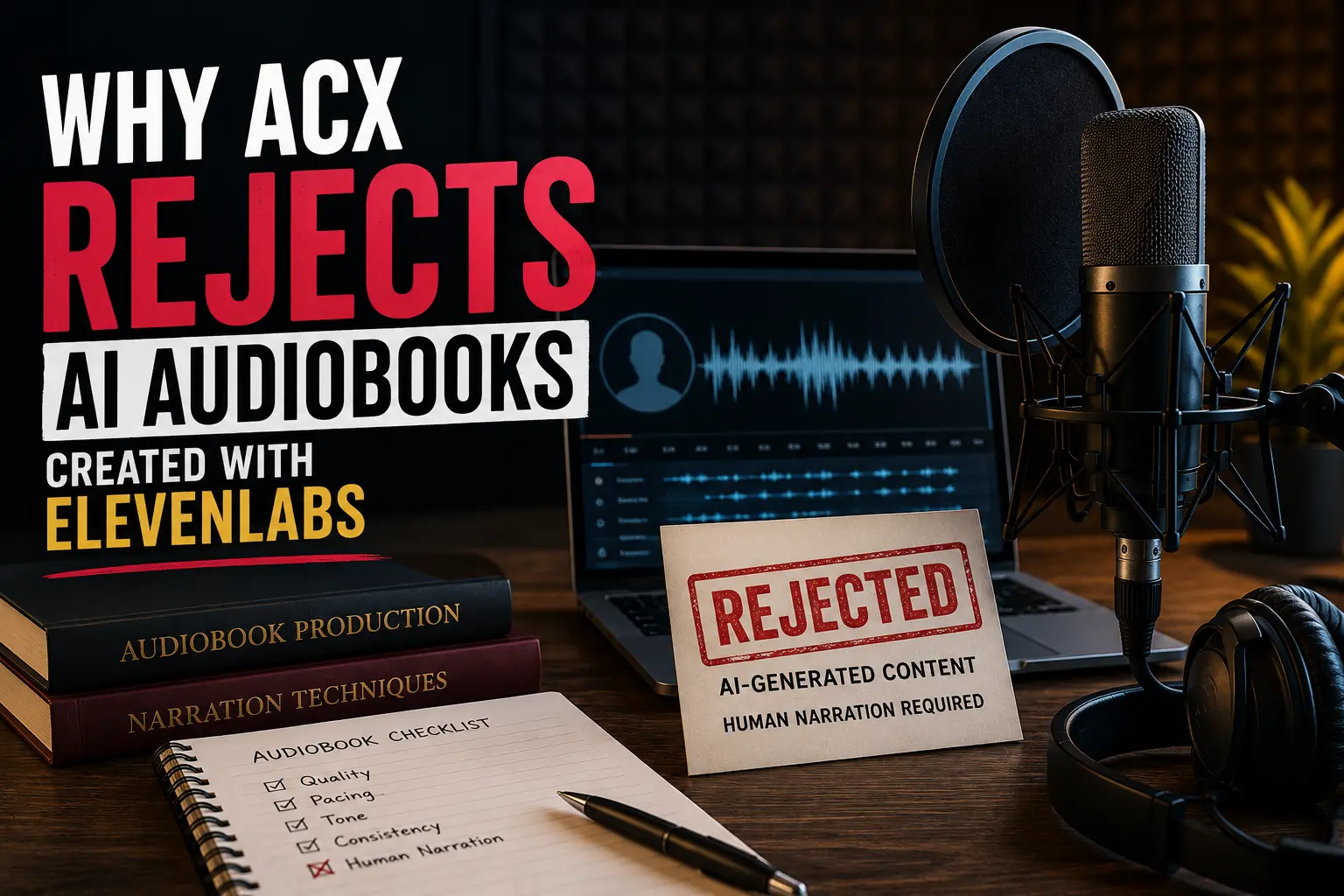
I got an email from an author last month asking me the same question I’ve now heard probably a dozen times this year. Why does ACX reject AI audiobooks that sound genuinely amazing, especially ones made with ElevenLabs, a tool that honestly produces some of the most natural sounding synthetic voice work I’ve ever heard? She’d spent weeks perfecting her narration, tweaking pacing, adjusting emotional tone. The final product sounded better than some human narrated audiobooks I’ve listened to. Then ACX bounced it.
She wasn’t confused about audio quality. She was confused about why quality apparently isn’t the deciding factor at all. Honestly, that confusion makes total sense once you consider how good ElevenLabs has gotten in just the past year or two. I’ve walked this road with a few authors now. I want to explain exactly why this keeps happening, what ElevenLabs actually can and can’t do on Audible’s platform. I also want to cover your realistic options if you’ve already built an audiobook using AI narration. You don’t want to waste the time and money you already put into it, so let’s get you a path that actually reaches listeners.
The Real Reason Behind the Rejection
Here’s the part that trips people up. ACX rejects AI audiobooks not because the audio sounds bad, but because of what the platform’s terms actually require. ACX still mandates human narration for anything going into Audible’s general catalog. This isn’t a quality bar you can clear with better prompts or a pricier ElevenLabs plan. It’s a categorical rule about who, or what, is allowed to be behind the voice, and no amount of polish changes that underlying requirement.
ElevenLabs makes remarkable tools. Its voice cloning and its newer Projects suite for long form audiobook production have genuinely changed what’s possible for indie authors on a budget. A full length novel that might have cost several thousand dollars with a human narrator can now be produced for well under a hundred dollars using AI voice generation. That’s not a small thing, and I understand why authors get excited and assume the output speaks for itself. When you’ve listened to a finished chapter and it sounds warm, expressive, and completely natural, it’s reasonable to think a rejection must be some kind of mistake.
ACX doesn’t evaluate submissions purely on how they sound. There are human quality control reviewers on the other end, and part of their job is catching audio that was clearly generated rather than performed.
Even when the voice is convincing, certain patterns can flag a submission for closer scrutiny. This includes pacing quirks, artifacts across long stretches of narration, or simple inconsistency between chapters. And if it becomes clear that someone produced the audio with an outside AI tool and submitted it as though a human narrator recorded it, that’s a direct violation of the terms. It’s not just a stylistic mismatch that might slide through on a lenient day.
Why This Isn’t Just About ElevenLabs Specifically
It’s worth being clear that this isn’t ElevenLabs being singled out. Any AI voice tool runs into the same wall with ACX, whether it’s ElevenLabs, Google’s narration tools, or anything else on the market right now. I read through one author’s account of trying Google’s AI narration platform. She remastered the files carefully to meet ACX’s technical standards, and still got flatly rejected. Amazon’s stated position is clear: ACX only accepts audiobooks that an actual human being has narrated. The technical polish didn’t matter. The source of the voice did, and that’s really the core distinction that keeps catching people off guard.
So if you’re wondering whether switching AI tools might get you a different result, it won’t. ACX rejects AI audiobooks across the board, regardless of which text to speech engine produced them. The rejection is baked into the policy itself, not into any particular company’s voice model, no matter how many updates that company rolls out or how much more lifelike the voices become over time.
There is one interesting wrinkle here though. ACX has started allowing narrators to license their own voice for AI replication through an official program. This means a human narrator consents to having their voice cloned and used in future productions. That’s a very different thing from an author independently running their manuscript through ElevenLabs and uploading the result. The replica program keeps a real narrator’s consent and involvement in the loop, along with presumably some royalty arrangement that compensates them for the use of their voice. Bringing in outside AI narration on your own, without any human narrator involved at all, does not fit into that same allowed category.
What This Means If You’ve Already Built an ElevenLabs Audiobook
If you’re sitting on a finished ElevenLabs production right now, wondering what to actually do with it, you’ve got more options than you might think, just maybe not the option you originally planned on when you started this whole process.
Findaway Voices has taken a notably different approach than ACX. It accepts AI narrated audiobooks as long as you disclose that you generated the content with AI during the publishing process. This isn’t a loophole or a gray area. It’s an explicitly stated policy, and it opens up wide distribution to platforms like Spotify, which recently began accepting ElevenLabs produced audiobooks directly through this pathway. If your priority is getting your book into listeners’ ears rather than specifically landing it on Audible, this route makes a lot of sense. It comes with far less friction than trying to sneak an AI narrated file past ACX’s review process.
Google Play Books has gone even further in the permissive direction, accepting AI narration without the same friction you’d hit elsewhere. Depending on your audience and where your readers actually shop for audiobooks, this might honestly be a better fit. It beats fighting an uphill battle with ACX for months, only to have them reject you again and again with no real path forward.
There’s also Amazon’s own virtual voice program, which is a separate, sanctioned pathway specifically for certain Kindle titles. It’s not the same as uploading an ElevenLabs file directly. You’re limited to Amazon’s own voice roster rather than your custom ElevenLabs voice. But it does get you a form of AI narration inside Amazon’s ecosystem without violating any terms, which is worth considering if staying within Amazon’s world matters to your overall strategy.
A Quick Story From an Author Who Learned This the Hard Way
One author I talked with had already spent close to seventy dollars generating a full five hour novel through ElevenLabs. He felt pretty proud of how professional it sounded after several rounds of editing and adjustment. He uploaded straight to ACX, assuming the audio quality would carry it through review the same way a strong manuscript carries itself through an editor. It didn’t. The rejection email was blunt about the human narration requirement. No wiggle room offered, no path to appeal based on how good the recording actually was.
Rather than scrapping the project entirely, he pivoted to Findaway Voices. He disclosed the AI narration honestly during setup, and had his book live on Spotify and several other platforms within a couple of weeks.
His sales never quite matched what an Audible listing might have generated. Audible still commands a huge chunk of the audiobook buying audience, but he wasn’t stuck starting from zero either. The lesson stuck with me because it’s such a common pattern. Authors don’t fail because their AI narration sounds bad. They fail because they assumed ACX’s rejection was about quality when it was actually about policy the entire time. Once you understand that distinction, the whole situation becomes a lot easier to plan around.
Planning Around This Instead of Fighting It
ACX rejects AI audiobooks as a matter of stated policy, not shifting quality standards. So the smartest move is deciding upfront which platform actually fits your goals. Do this before you spend money generating audio you might not be able to use where you originally intended.
If Audible’s massive built in audience and royalty structure genuinely matter to your strategy, budget for a human narrator from the start. That’s really the only reliable route onto the platform. Skip it and you risk disclosure problems or outright rejection, after you’ve already put time and money into an AI produced file.
If your priority is affordability and reaching listeners wherever they happen to be, whether that’s Spotify, Google Play Books, or Kobo, ElevenLabs paired with a distributor like Findaway Voices is a completely legitimate and increasingly common path. Just be upfront about the AI narration during setup. Disclosure isn’t optional on platforms that do allow it, and skipping that step risks the same kind of rejection or removal you were trying to avoid in the first place.
Regulation is also tightening around this whole space, with disclosure requirements for synthetic audio becoming more standardized across regions this year. Getting comfortable disclosing AI narration now saves you a scramble later.
That trend points toward transparency being the expectation everywhere eventually, not just on platforms that already require it today. It also builds trust with listeners who generally respond better to honesty upfront than to feeling misled after the fact.
Conclusion
If there’s one thing worth remembering here, it’s this: ACX rejects AI audiobooks regardless of how convincing the voice sounds. The issue was never really about audio quality in the first place. ElevenLabs and tools like it have made incredible narration accessible at a fraction of traditional costs. But that accessibility doesn’t override Audible’s human narration requirement. No amount of technical polish changes that reality.
Have you already invested in AI narration, or are you planning to? Then the smarter move is choosing a platform that actually welcomes what you’ve built. Don’t hope ACX will make an exception it clearly isn’t going to make. Know the rules before you generate the audio. Don’t wait until you’ve hit submit and found a rejection notice sitting in your inbox.