




16 Oct 2026
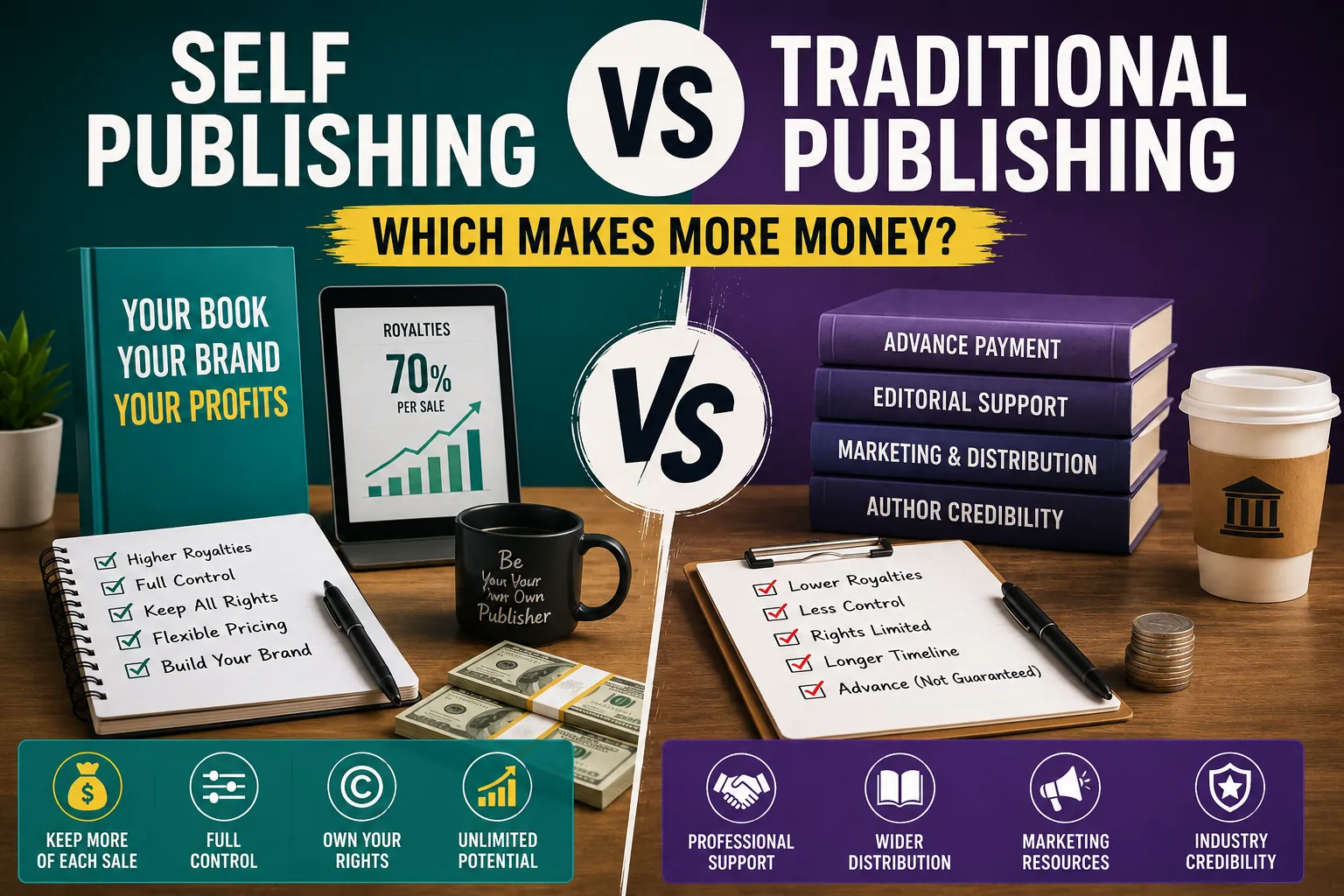
I have had this exact conversation at nearly every writing event I have attended over the past four years. Someone finishes their manuscript, starts researching their options, and eventually arrives at the debate of self publishing vs traditional publishing and with it, the question that nobody in the industry ever seems to answer directly. Which path actually puts more money in your pocket?
The honest answer is that it depends, but not in the frustrating non-answer way people usually mean when they say that. It depends on genuinely specific things. The kind of book you wrote. The audience waiting for that book. How much of yourself you are willing to put into the business side of being an author. What financial success actually looks like to you personally. And perhaps most importantly, where you are in your writing life right now.
Over the years, I’ve watched both paths play out for real authors. Some thrive in traditional publishing, while others struggle under it. On the other hand, self-published authors sometimes build incomes that many traditionally published writers would quietly envy, while others invest thousands into a book that barely sells a few dozen copies. The path itself is rarely the deciding factor. What you understand about that path before you commit to it usually is.
Here is what I actually know.
Why Nobody Gives You a Straight Answer on This
When writers start researching self publishing vs traditional publishing the content they find is almost always advocating for one side or presenting statistics without the context that makes those statistics mean anything.
Yes, self-published authors keep a higher percentage of each sale. Also yes, most self-published books sell very few copies. Yes, traditional publishing offers an advance that guarantees income before the book releases. Also yes, most debut advances are considerably smaller than the culture around publishing would have you believe, and a large percentage of authors never earn beyond that initial payment. Both of these realities exist at the same time and genuinely understanding how they interact is the only way to approach this question with any clarity.
What Traditional Publishing Actually Looks Like Financially
The Advance Is Not What Most People Think It Is
The advance is the number that dominates conversations about traditional publishing income and it deserves the attention, but not always for the reasons people give it. A publisher offers you a lump sum before your book earns anything from sales. That payment arrives guaranteed, which is genuinely meaningful and I do not want to dismiss it. But calling it a gift misunderstands what it is.
The advance is a loan against future royalties. Every dollar your book earns goes back to the publisher first until that initial payment is recovered. If your advance was $15,000 and your book eventually generates $40,000 in royalties, you receive another $25,000. If your book generates $11,000 in royalties and your advance was $15,000, you keep the advance and that is the end of your income from that book. Industry estimates have long suggested that somewhere between half and two thirds of traditionally published books never fully earn out. That means the advance and nothing more is the complete financial story for a significant portion of authors who go the traditional route.
Debut novel advances from major publishers right now typically sit somewhere between $5,000 and $30,000 for a standard deal, though both lower and higher numbers happen regularly. Genre matters enormously. A debut literary novel from an unknown writer might attract a $10,000 offer. A commercial thriller that multiple publishers want simultaneously can go considerably higher. A niche nonfiction title from someone without an existing platform might come in below that lower figure.
The Royalty Rates Themselves
Traditional publishing royalty rates are structured in a way that surprises most authors when they first encounter them. Standard hardcover royalties run around 10 to 15 percent of the retail price. Paperback royalties sit at roughly 7 to 10 percent. Ebook royalties through traditional publishers are typically 25 percent of net receipts, which after retailer discounts are applied works out to somewhere around 17 percent of what the reader actually paid.
Put that in real numbers. On a $15 paperback the author receives somewhere between $1.05 and $1.50 per sale. On a $12.99 ebook the author receives roughly $2.20. These are not nothing. But they are a very different picture from what the same sales would generate through self-publishing and that difference is worth sitting with.
What Traditional Publishing Offers Beyond the Money
Here is where the comparison genuinely gets complicated and where I think a lot of the debate goes wrong by oversimplifying. Traditional publishing is not purely a financial arrangement. It comes with editorial development from people who have worked with many books, professional cover design, physical distribution into bookstores and libraries, marketing infrastructure of varying quality, and a credibility that still carries real weight in specific contexts.
For authors targeting audiences where a traditional imprint signals legitimacy, certain academic readers, corporate and institutional buyers, mainstream media coverage, that credibility has monetary value that never shows up in a royalty rate comparison. A traditionally published book can sit on the table at the front of an airport bookstore in a way that most self-published titles still cannot. For authors whose goals include that kind of visibility, the economics look different than they do for someone primarily selling online.
What Self Publishing Actually Looks Like Financially
The Royalty Difference Is Real and It Matters
When the self publishing vs traditional publishing income conversation starts, the royalty gap is usually the first thing mentioned and honestly it should be because it is significant. Publishing an ebook through Amazon KDP at a price between $2.99 and $9.99 earns a 70 percent royalty. On a $4.99 ebook that is roughly $3.49 per sale. A traditionally published ebook at a comparable price point earns the author somewhere around $2.20. That gap on a single sale looks modest. Multiply it across consistent monthly sales and it becomes a completely different conversation.
An author moving 500 ebooks a month at $3.99 through KDP takes home roughly $1,400 from that one title in that one month. The same sales volume at standard traditional ebook royalty rates on a comparably priced title might generate $600 to $650. The difference over a year is not trivial. It is the difference between a side income and something that starts to look like a real one.
The Investment You Have to Make First
What the royalty advantage does not account for, and what enthusiastic self-publishing advocates often understate, is the upfront cost of producing a book that can actually compete in the market. Professional editing through multiple rounds, a cover designed by someone who understands your genre, proper interior formatting, and a sensible launch marketing budget add up to somewhere between $3,000 and $10,000 depending on the choices you make and the people you hire.
That investment has to be recovered before any of those royalties become actual profit. For authors whose books sell modestly, reaching break-even can take a long time. For authors who build an audience and sell consistently across a growing catalogue, the investment can be recovered within months and everything after that is genuinely in the black.
The Catalogue Reality That Single Book Comparisons Miss
This is the part that comparisons between self publishing vs traditional publishing almost always fail to capture properly because it does not fit neatly into a side by side chart. Self-publishing income rarely makes transformative sense from one book. It starts making real sense with a catalogue of books working together.
An author with five titles in a series who runs a promotional price on the first book generates sales across all five simultaneously. Every new reader who discovers that first book and finishes it is worth five sales, not one, and potentially a reader for life. An author with twelve titles spread across two series has income compounding in ways that no single-book scenario can illustrate. The self-published authors who have built genuinely life-changing income streams are almost without exception the ones who committed to writing consistently over years, not the ones who published one book and watched the dashboard.
Where Each Path Has a Real Advantage
Traditional Publishing and the Value of Certainty
If having guaranteed income from your writing matters to you at this stage of your life, traditional publishing provides something self-publishing genuinely cannot. The advance arrives regardless of how the book eventually performs in the market. For an author writing a first book while working full-time with financial responsibilities, that guaranteed payment carries real practical weight beyond just the number itself.
Traditional publishing also still opens specific doors that remain genuinely harder to push through independently. Major literary review coverage, serious award consideration, placement in physical retail locations, and acceptance by certain institutional markets all still flow more naturally from a traditional imprint. For authors whose version of success includes those outcomes, the credibility attached to a traditional deal is not a superficial thing.
Self Publishing and the Ceiling That Does Not Exist
For authors willing to treat writing as a business and commit to building a body of work over time, self-publishing offers income potential that traditional contracts rarely match for most writers. It provides higher royalties, direct access to sales data, and full control over pricing and promotion. Authors can also respond quickly when something works or stop when it does not. Over time, these advantages compound significantly.
The speed difference also matters more than people initially expect. A traditionally published book typically takes 18 months to two years from accepted manuscript to bookshelf. A self-published book can be live within weeks of the manuscript being finished. In fast-moving nonfiction categories or genre fiction where readers expect new releases regularly, that difference in pace directly affects income.
The Authors Who Do Both
The self publishing vs traditional publishing conversation is also becoming less either-or than it used to be and I think that shift reflects a healthier and more honest understanding of what each path is actually for. Many authors now make deliberate choices about which path serves which book. A nonfiction author might pursue a traditional deal for a mainstream title while self-publishing shorter companion works their publisher has no interest in. A romance author might build a large self-published series while going traditional with a crossover project they want in physical stores.
Authors who ask which path serves this specific book rather than pledging allegiance to one side tend to make better financial decisions across the full arc of their careers.
What the Successful Authors on Each Side Actually Do
Traditionally Published Authors Who Build Real Income
The traditionally published authors earning meaningful money over time are almost never the ones who signed one deal and waited for royalties to arrive. They negotiate firmly for the rights they retain, especially subsidiary rights such as audio, translation, and film. Over time, they publish multiple books and strengthen their relationships with publishers, gradually improving their terms. They also recognize that a publisher’s marketing energy goes toward the books with the highest projected return, which for a debut author is often not their book, so they focus on building their own audience instead.
Self Published Authors Who Build Real Income
The self-published authors who build sustainable income share patterns that have very little to do with luck or timing. They write in genres that already have active, loyal readerships. Rather than disappearing between releases, they publish consistently enough that readers remember them. They also invest properly in production, knowing a weak cover costs far more in lost sales than it saves in design fees. They treat marketing as a permanent part of their working life, not a short burst of activity around launch that quickly fades.
The Actual Answer
The honest answer to the self publishing vs traditional publishing income question is that the model matters considerably less than the author’s genuine commitment to their craft and their career.
A traditionally published author who negotiates thoughtfully, publishes consistently, and builds a real readership can earn very well. A self-published author with a growing catalogue in a commercial genre, proper production, and an active marketing approach can earn more than the majority of traditionally published authors ever will. What reliably produces poor results on either path is showing up passively and expecting the structure to do the work for you.
Choose the path that honestly fits your book, your audience, your goals, and the level of business involvement you are actually willing to take on. Then work that path with everything you have. That is the whole answer, and it was always going to be.