



16 Oct 2026
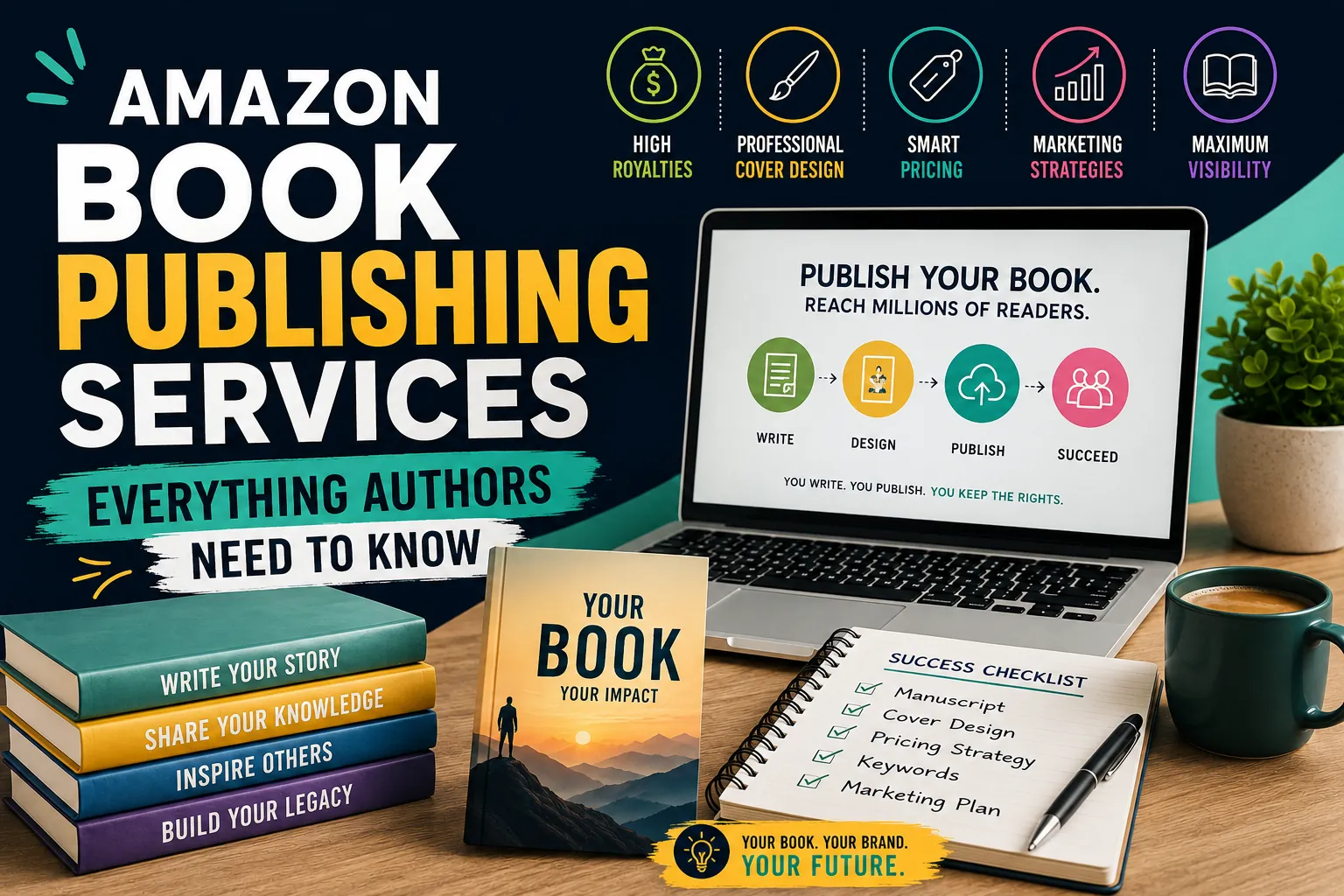
Writing a book is one thing. Getting it published is a whole different story. I know people who spent years on their manuscripts, edited until their eyes blurred, showed it to friends and family, got the nervous nod of approval, and then just sat on it because they had no idea what to do next. That feeling of being stuck between “I finished it” and “now what” is more common than any writing guide will admit.
Amazon book publishing services honestly changed that whole equation for writers like us. I have a cousin who wrote a self-help book based on her recovery journey. She queried agents for nearly eighteen months, got maybe four responses, and two of those were form rejections. She eventually uploaded the whole thing to KDP, and within a month she had readers leaving reviews she never expected. Real people, strangers, telling her the book helped them. That kind of thing was not possible for regular people before Amazon opened these doors.
What most new authors miss though is that Amazon’s publishing world is not just one button you press. There are multiple services, different royalty models, and real decisions you have to make before your book ever goes live. I want to break all of that down in plain language because the official documentation can feel a bit like reading an instruction manual for a piece of furniture that came with no pictures.
What Amazon Actually Offers Authors
People hear “Amazon publishing” and immediately think Kindle. That is understandable but it only scratches the surface of what is actually available to you as a writer today.
Kindle Direct Publishing (KDP)
KDP is the foundation everything else sits on. It is the platform where you upload your manuscript, set your cover, choose your price, and put your book in front of millions of readers both in digital and paperback format. And it costs you nothing upfront, which is still something I find remarkable when I think about what vanity presses used to charge authors just twenty years ago.
The control you get with KDP is not something to take lightly. Your rights stay with you. Your pricing is yours to decide. If your editor catches a mistake six months after the book went live, you fix the file and reupload it. Done. No waiting for a publisher to schedule a reprint. No bureaucracy. That kind of ownership over your own work changes how you think about the whole publishing process.
Royalties on ebooks are 70% when you price between $2.99 and $9.99, and 35% outside that window. Print books work differently because Amazon deducts the actual cost of printing before calculating your cut, which sits at 60% of the list price. It takes maybe twenty minutes to understand the math and after that it becomes second nature.
KDP Select and Kindle Unlimited
KDP Select is the optional program that gets authors into Kindle Unlimited, and the decision of whether to join it is one of the first real strategic choices you will make. Enrolling means your ebook lives exclusively on Amazon for 90 days at a time. In return, it gets placed inside Kindle Unlimited where subscribers can read it as part of their monthly membership.
You get paid based on pages read, not copies downloaded. The rate per page changes every month depending on the total KU pool and how many pages were read across all enrolled books. It sounds unpredictable and it is, but romance writers, thriller writers, and fantasy authors with series regularly report that their KU income dwarfs their regular sales. When readers in your genre are already swimming in Kindle Unlimited, being absent from it costs you visibility.
The flip side is real too. No Apple Books, no Kobo, no Barnes and Noble for that title during your enrollment window. If you have readers on other platforms or want to build a presence there, that exclusivity stings. There is no universal right answer here. It comes down to where your audience actually buys books.
Amazon’s Traditional Publishing Imprints
This is where things get interesting in a different way. Amazon is not just a self-publishing platform. They actually run traditional publishing imprints that acquire manuscripts, pay advances, handle all the editing and cover work, and distribute through every major channel. Thomas and Mercer handles crime fiction. Lake Union publishes literary and historical fiction. 47North does science fiction and fantasy.
These imprints work through literary agents and they are selective in the same way any traditional publisher is. But the combination of a real editorial team and Amazon’s distribution reach has produced some genuinely impressive bestsellers. If you have an agent and want a traditional experience without the friction of legacy publishing, these imprints are worth knowing about.
The Real Process of Getting Your Book Live on KDP
A lot of guides give you the overview and skip the practical stuff. Let me fill in what actually trips people up.
Preparing Your Manuscript
KDP takes Word files and PDFs for interior content. For a straightforward novel or nonfiction book, a Word document set to your chosen trim size works fine. The trim size matters most if you are doing print because every margin, every header, every page number has to be calculated around those dimensions before you even start formatting.
And formatting is where a lot of people underestimate the work involved. What looks polished on your laptop screen can look genuinely rough once it is a physical book in your hands. Inconsistent fonts, cramped margins, chapter headings that do not match throughout, these things signal to readers that the book was put together in a hurry. Vellum is the tool most Mac users swear by. Atticus works on any platform and has a lot of fans among indie authors. KDP also offers free templates if you want to get started without spending money.
Cover Design
Here is where I have watched good books struggle unnecessarily. The KDP Cover Creator is built into the platform and technically functional, but the covers it produces rarely hold their own against professionally designed competition. On Amazon, your cover is a tiny thumbnail competing with hundreds of others. It has maybe two seconds to earn a click.
Genre readers in particular are trained to recognize cover signals. They know what a cozy mystery looks like. They know what a dark romance looks like. When a cover does not match genre expectations, readers scroll past without even consciously registering why. A designer who works specifically in your genre understands these conventions and can build a cover that fits in while still standing out. It is one of the few places I would say spend the money even if the budget feels tight everywhere else.
Categories and Keywords
When you publish on KDP you pick two browse categories and enter up to seven keywords. These choices are quietly doing a lot of work. They determine which category lists your book can appear on, which means they affect your chances of hitting a bestseller ranking in a category where competition is manageable, and they shape which search queries bring your book up.
Most authors choose these quickly without much research and then wonder why nobody can find their book. Publisher Rocket is a paid tool a lot of serious indie authors use for keyword research. You can also do solid manual research just by spending time in Amazon’s category browser and looking at what top-selling books in your space are doing. Either way, do this before you publish, not as an afterthought afterward.
Understanding Royalties and Pricing
Pricing feels like it should be simple. You pick a number, Amazon sells the book, you get paid. But the more you think about it the more layers show up.
Amazon book publishing services hand you full control over your price, which is a gift and a responsibility at the same time. You can change it whenever you want, run sales, test different price points, and adjust based on what you learn. A lot of authors spend the first year experimenting before they land on what works for their specific readership.
How Ebook Pricing Actually Works in Practice
Readers have absorbed certain pricing norms whether they realize it or not. A $0.99 ebook registers as either a promotion or a very short piece of writing. Something priced at $4.99 or $5.99 tends to feel reasonable for a full-length novel without triggering the hesitation that can come with higher prices. Once you go above $9.99 you lose the 70% royalty tier and you start competing psychologically with traditionally published titles, which is a harder position unless you already have a strong following.
Series authors often use a discounted or even free first book as a reader acquisition strategy. The logic is straightforward. Get someone hooked on book one at low cost, and they will pay full price for everything that comes after. In genre fiction especially this model has worked reliably for years.
Figuring Out Print Pricing
Print-on-demand pricing through KDP starts with what it actually costs Amazon to print your book. A standard 300-page paperback might run $4 to $5 in printing costs. Your final price has to cover that before you see any royalty. Most paperbacks end up between $12.99 and $17.99 depending on length and what readers in your genre expect to pay. Going too cheap can actually raise red flags for readers who associate very low print prices with poor production quality.
Marketing After Your Book Goes Live
A lot of first-time authors believe that publishing is the hard part and sales will follow naturally. Then they watch their book sit at a rank of 800,000 for three months and realize something is missing.
Amazon Ads
Amazon’s advertising platform lets you run sponsored ads that appear in search results and on other product pages. When done well, this is one of the most targeted ways to reach readers who are already in buying mode. When done without any research or strategy, it is a fast way to burn through a small budget and feel confused about why it did not work.
The most sensible starting point is an automatic campaign with a small daily budget, maybe $5 to $10. Let Amazon’s system gather data on what search terms are bringing people to your listing. After a few weeks you have real information to work with and you can build manual campaigns around the terms that are actually converting.
Your Email List is More Important Than Any Platform
I cannot stress this enough and every author who has been building their readership for a few years will back me up. Your email list is the only channel you actually own. Your Amazon ranking can drop overnight. Social media algorithms change and your reach disappears. Your email list stays yours.
Starting to build that list before your book even launches is not overkill. It is just smart. A simple reader magnet, a short story, a bonus chapter, a related resource, offered in exchange for an email address gives you a way to connect with readers directly for every book you put out after this one.
Mistakes That Cost Authors More Than They Realize
Not Taking the Cover Seriously
A professionally designed cover is not vanity. It is a sales asset. Underinvesting here is one of the most common reasons a good book never finds its audience.
Writing a Description That Reads Like a Summary
Your Amazon book description is not a synopsis. It is the first piece of real sales writing your potential reader encounters. It needs to create an emotional response and a reason to buy in the first two or three lines. Most new authors write descriptions that accurately describe the book but give readers no reason to feel excited about it. That is a conversion problem that hurts sales every single day the book is live.
Launching With No Audience At All
Amazon book publishing services give you distribution. They do not give you readers. The recommendation algorithm kicks in after momentum already exists. Walking into a launch with no email list, no social presence, and no existing readers is not impossible to recover from but it makes the whole thing much harder than it needs to be.
Making the Decision That Fits Your Goals
Whether amazon book publishing services make sense for you comes down to what you actually want out of this. If creative control matters to you, if you want your book available within weeks instead of years, if keeping the majority of your royalties sounds better than waiting on quarterly statements from a publisher, then KDP is a genuinely strong path. Plenty of authors are earning full-time income inside this ecosystem right now.
If what you want is a traditional editorial relationship, a publisher’s marketing team, physical bookstore placement, or the particular credibility that comes from a legacy imprint choosing your book, those options still exist and still make sense for certain kinds of books and certain kinds of careers.
And plenty of working authors do both. KDP for their backlist or genre fiction, traditional publishing for specific projects that benefit from that infrastructure. The two are not mutually exclusive.
Final Thoughts
Twenty years ago the path from “I wrote a book” to “people are reading my book” required gatekeepers, agents, advances that never came, and years of waiting. Amazon book publishing services did not just create a shortcut. They created an entirely different road.
But that road still requires effort. Your cover has to earn its click. Your description has to earn the sale. Your keywords have to earn the visibility. And your marketing has to fill in the gaps that no algorithm will fill for you.
Put in that work and the platform is genuinely remarkable. Your readers are out there. The only question is whether you give your book a real chance to reach them.