



04 Nov 2026
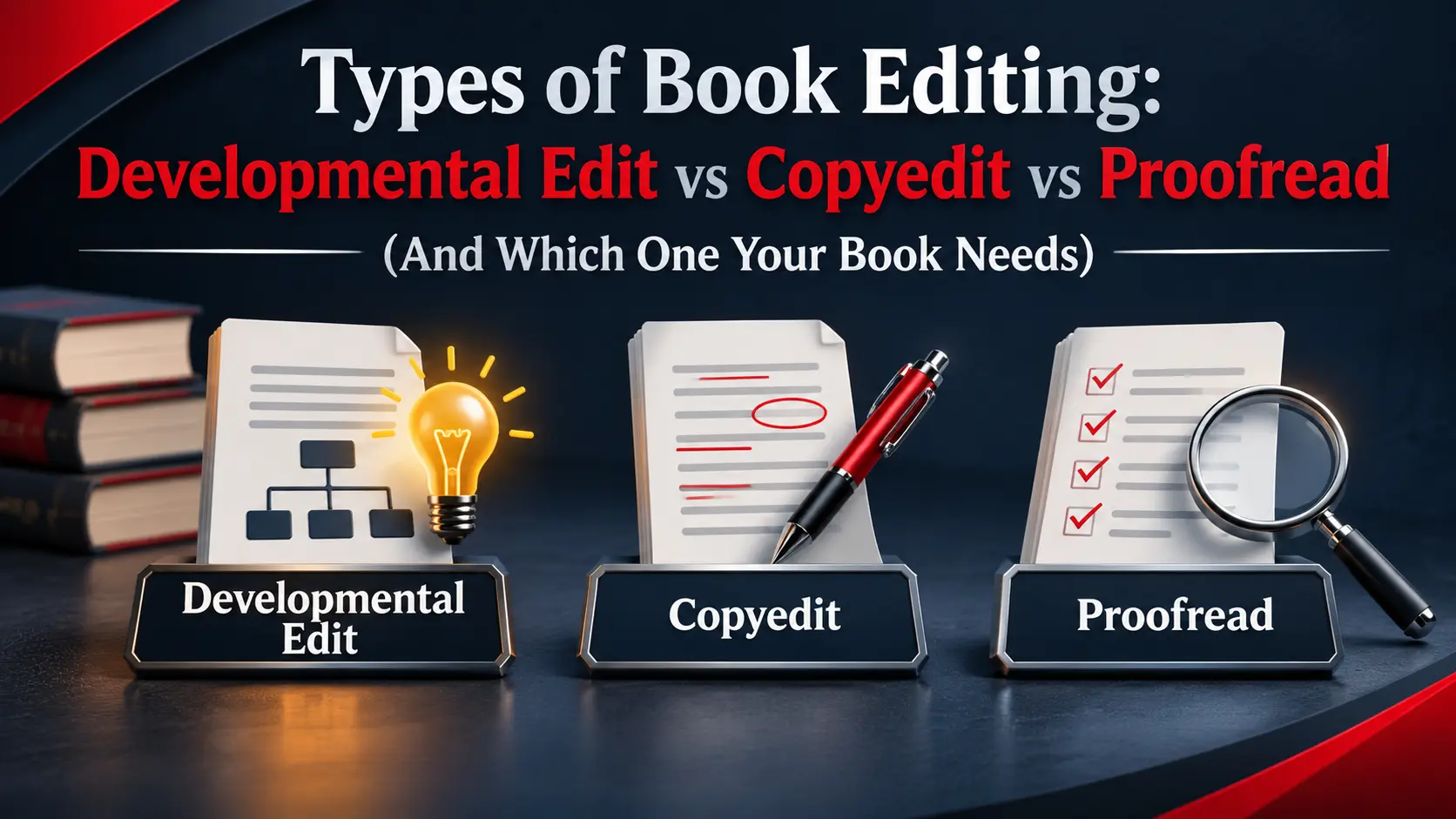
Book editing has a pecking order, and the types of book editing only make sense when you follow it. Fix the big structure first, then the sentences, and leave the typos for last. Get it backwards and you’ll pay twice for the same pages.
You just finished a draft. Now three different editors are telling you theirs comes first, and they can’t all be right. So who do you pay?
What Are the Main Types of Book Editing?
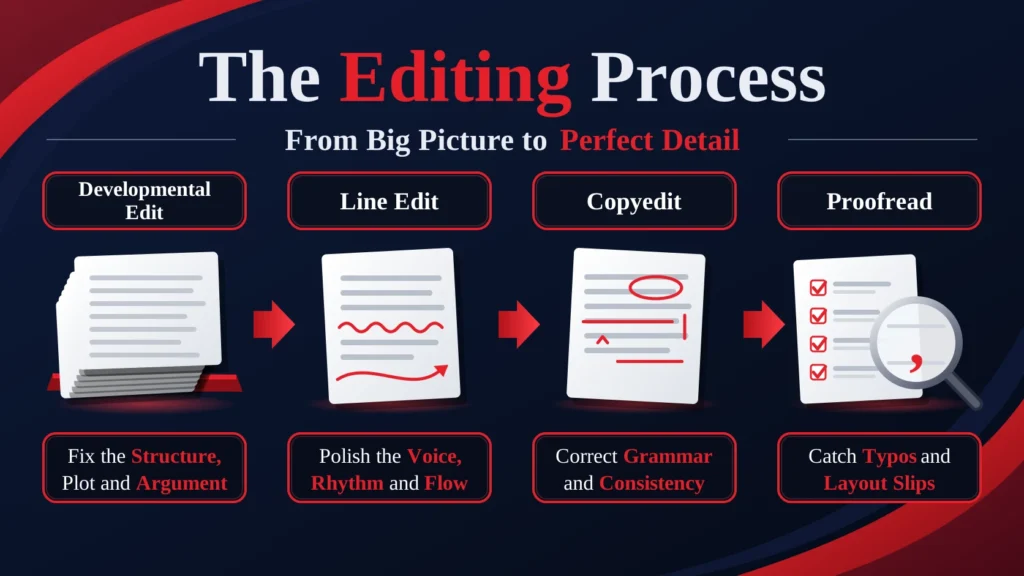
Most editors work in four stages: developmental editing, line editing, copyediting, and proofreading. Picture a camera lens. You start wide, with the whole book in the frame, and end up zoomed in on one stray comma.
- Developmental edit: Does the plot hold together? Is the pacing right for your reader? Does the ending earn its place?
- Line edit: How the prose actually sounds, including voice, rhythm, and clunky phrasing.
- Copyedit: Grammar, punctuation, consistency, and the style guide you’re following.
- Proofread: One last look at the typeset pages, hunting for typos and layout slips that got past everyone.
Some editors bundle the line edit into the copyedit and sell it as one job. Find out exactly what your quote covers before you sign. Vague quotes cause most of the disputes I hear about. See how a full-service team lays this out on our book editing services page.
What Is a Developmental Edit?
A developmental edit is a big-picture review of your book’s structure, content, and reader experience. The editor checks whether your character arcs land, where the pacing sags, where the logic springs a leak, and whether the opening sets up the ending. Typos can wait.
So what is a developmental edit in practice? You’ll get an editorial letter and notes in the margins, and the rewriting falls to you. Plenty of first-timers expect the editor to fix things, and they’re caught off guard. The editor diagnoses, but you hold the scalpel.
Do I Need a Developmental Editor?
Probably, if this is your first full draft. Also probably, if your beta readers can’t agree on where the book drags, or if you can’t sum up the heart of it in one breath. If you’ve already revised several times with sharp critique partners, you can often skip it.
Here’s a quick check I call the One-Sentence Test. Writing fiction? Say who wants what, what’s blocking them, and how things are different by the end. Writing nonfiction? Name your reader, name the problem keeping them stuck, and say what they’ll be able to do once they close the book.
Three tries and it still wobbles? That’s a structural problem, and no amount of comma fixing will rescue it.
Developmental Edit vs Copyedit: What Actually Changes?
A developmental edit changes what your book says and how it’s built. A copyedit changes how cleanly and consistently it says it. Picture one editor rearranging the furniture and the other dusting it.
The order matters for a dull but painful reason, which is money. Cut three chapters after a copyedit and you’ve paid someone to polish pages that no longer exist. I’ve watched an author learn this the hard way, and she was not thrilled. For a neutral breakdown of how the levels differ, the Chartered Institute of Editing and Proofreading guide to proofreading and editing is a solid reference.
Line Edit vs Copyedit: Where Does One End?
A line edit shapes style, voice, and flow. A copyedit makes sure everything is correct and consistent. People confuse them because both happen at the sentence level, but the goals are different.
Take a line from a thriller draft: “He walked slowly and sadly toward the door.” A line editor might tighten that to “He trudged to the door.” The copyeditor is busy with different problems. His eyes are green in chapter two and brown in chapter nine, and Katarina turns into Katrina somewhere around page 140.
If your prose already reads cleanly, you probably don’t need a separate line edit. Many authors combine it with the copyedit and trim the bill. Just get that agreed in writing.
Copyediting vs Proofreading: Which Comes First?
Copyediting happens first. Proofreading is the final stop, and nothing comes after it. Your copyeditor works inside the manuscript file, usually with tracked changes switched on, while the proofreader gets the formatted pages, meaning the print-ready PDF or the finished ebook layout.
Authors mix these two up constantly. Layout creates its own mess, like odd line breaks, wrong running headers, vanished italics, and page numbers that skip. A proofread done on the Word file can’t catch errors that haven’t been born yet.
A proofreader is there to catch what slipped through. Reopening decisions you made months ago isn’t their job. Even large publishers run several separate rounds, as this Reedsy comparison of copy editing and proofreading points out.
What Does the Book Editing Process Look Like From Start to Finish?
The usual order of editing stages is developmental edit, line edit, copyedit, then proofread, with your own revision fitted in between each one. Here’s how the book editing process tends to run:
- Step 1: Revise the draft on your own, then gather feedback from beta readers.
- Step 2: Hire a developmental editor and rewrite from their editorial letter.
- Step 3: Add a line edit only if your style needs it.
- Step 4: Send the cleaned-up draft for a copyedit, then go through every tracked change yourself.
- Step 5: Lay out the book for print and ebook.
- Step 6: Pass the formatted proof to a proofreader.
- Step 7: Approve the last corrections and check the files once more before you upload.
Leave breathing room after Step 2. The rewrite is yours, and it’s almost always the longest stretch of the whole journey.
Which Editing Does Your Draft Need? Two Scenarios
Theory only gets you so far. Here are two authors with two very different drafts.
Which Types of Book Editing Fit a First Finished Draft?
Maya finished a 90,000-word fantasy novel. Her beta readers loved the world but said the middle dragged, and two of them couldn’t explain why the villain did what he did. She skipped the copyedit and booked a developmental edit.
Smart move. Her editor suggested cutting a subplot and moving the villain’s backstory much earlier. A copyeditor would have lovingly polished chapters she ended up deleting.
What If You’ve Already Revised Heavily?
Daniel wrote a business book and spent a year workshopping it with a writing group. Readers finished it and could repeat the main idea back to him. His draft cleared the One-Sentence Test on the first attempt.
That meant he could skip the developmental edit. He went straight to a copyedit and booked a proofread after the layout was finished. It saved him real money, and he lost nothing, because the structure was already solid.
Is Manuscript Editing for Self-Publishing Any Different?
The editing is the same. What changes is who’s running the show. With manuscript editing for self-publishing, no one schedules the stages for you, so the order, the budget, and every handoff land on your desk.
My rule for tight budgets: spend on the earliest stage your draft truly needs. Later stages can’t fix structural problems, but a strong early stage makes the later ones faster and cleaner. If money’s limited, pay for one good developmental edit and self-edit hard before the copyedit.
Also, print and ebook files can break in different places. Check both at the proofread stage. Before you compare quotes, look at the Editorial Freelancers Association rate chart, and if you want help with formatting and uploading too, our book publishing service covers that.
How to Choose an Editor Without Guessing
To choose an editor, check genre fit, test their work on a sample, and get the deliverables in writing. A warm website and a nice bio don’t prove much. Work through this list instead:
- Check genre fit. Someone who adores cozy mysteries may be the wrong match for a technical memoir.
- Ask for a sample edit. A few pages show how heavy their touch is.
- Confirm the deliverables. How long is the editorial letter? How many passes do you get? Is a follow-up review included?
- Ask about the style guide. A copyeditor should name the one they follow, like Chicago or a house sheet.
- Put dates and payment terms on paper. It saves you awkward emails later.
A good match makes every later stage easier. A bad one makes you want to quit writing. If you’d like to see our approach first, you can request a sample edit through our contact page.
What Should You Do Next?
Run the One-Sentence Test on your draft today, before you spend a cent. If it wobbles, book a developmental edit. If it holds, line up a copyedit and plan a proofread for after layout.
Then map the types of book editing your draft needs onto a simple timeline. Write down each stage, who’s doing it, and the date you’ll send the file. That small document keeps you from buying the right service at the wrong time.
When you’re ready, send us a sample chapter along with your One-Sentence Test result, and we’ll tell you which stage fits your book. You can also explore our full book editing services before you decide.