




02 Nov 2026
Readers don’t gasp at a twist because it came from nowhere. They gasp because the answer was in plain sight and they read it wrong. If you’re wondering how to write a plot twist like that, start with the truth, stack a believable lie on top of it, and decide what the reveal takes from your hero. Below are the plot twist techniques I reach for most, plus a clue tracker you can run on a draft this afternoon.
Maybe it’s NaNoWriMo week and your middle has turned to mush. If you’re staring at a stalled draft, this guide to overcoming writer’s block can get you moving again. Or maybe your big reveal got a shrug from your critique group. The problem usually isn’t the size of the shock.
Heads up: I spoil a few famous stories below.
So What Actually Makes a Plot Twist Work?
A twist works when it rewrites the meaning of scenes the reader already finished. New information alone doesn’t cut it. People should want to flip back through the book and look again.
Two things have to be true. Readers can’t guess the answer too early, and once it lands they should be able to point at the page where you told them. Miss the first and the story is dull. Miss the second and they feel tricked, which is worse.
I’d honestly take a predictable book that plays fair over a shocking one that cheats. Surprise is easy to fake. Fairness isn’t.
None of this is new, by the way. Aristotle was already talking about reversal and recognition in the Poetics.

What Are the Main Types of Plot Twists?
Most types of plot twists fall into three camps: the reveal, the reversal, and the narrator you shouldn’t have trusted. Each one messes with something different. Knowledge, events, or trust.
Reveals and Reversals
A reveal pulls back a curtain. Maybe it’s a secret identity, a hidden motive, or a lie the whole town has been telling. A reversal changes the situation itself, so the plan backfires or the victory turns into a defeat.
Psycho is my favorite example of a sudden narrative reversal. The film sets up Marion Crane as the lead, then removes her before the halfway point, forcing viewers to rethink what the story is really about.
How to Write a Plot Twist Using an Unreliable Narrator
Here the narrator is the trap. They might lie, misremember, or just leave things out, and readers go along because the voice sounds so sure of itself. Critic Wayne C. Booth gave the device its name in 1961, as this overview of the unreliable narrator explains.
Agatha Christie’s The Murder of Roger Ackroyd is the classic case. Gone Girl plays a related game with a diary that was written to be found. Want to try one yourself? Three things help:
- Decide how your narrator fails: they lie, they’re wrong, or they leave things out.
- Give them a reason to hide it that a real person would have, like shame, loyalty, or fear.
- Keep each line technically true when you can. Omission feels fairer than a flat lie.
How to Write a Plot Twist in Seven Steps
You’re building a truth, wrapping a false belief around it, and then controlling when readers spot the gap. Seven steps cover it. The first four set the trap.
Steps 1 to 4: Setting the Trap
- Write the truth in one plain sentence. What’s really going on?
- Write the lie. This is what readers should believe until the reveal.
- Decide what the reveal costs. If it takes nothing from your protagonist, it’s trivia.
- Plant clues that carry two readings, one innocent now and one damning later.
Steps 5 to 7: Springing It
- Add a red herring. Give readers a false lead with real stakes, so chasing it feels like progress.
- Time the reveal. For how to write a twist ending, hold the truth until the final act and use the last scene to show the new reality.
- Show the aftermath. Give one character a scene where they choose differently because of what they know now.
Leave out step seven and your twist is just a fun fact. Readers need to watch it cost somebody something. If you’d like a second pair of eyes on that final act, our novel writing team can help.
Where Should the Reveal Land?
Usually late in the final act, right after the stakes peak. That gives the twist its full payoff and still leaves room for the fallout.
There’s one exception worth knowing. A midpoint twist, the kind that lands around the halfway mark, can turn the second half into a different story entirely. Plenty of thrillers use it to stop the middle from sagging.
Stuck between the two? Draft the reveal both ways. Then ask which version changes your protagonist’s choices more, because that’s probably your answer.
How Do You Hide Foreshadowing in Fiction Without Tipping Your Hand?
Tuck each clue inside an ordinary explanation. The reader should spot the detail, shrug it off, and move on to the next page. That shrug is the whole trick.
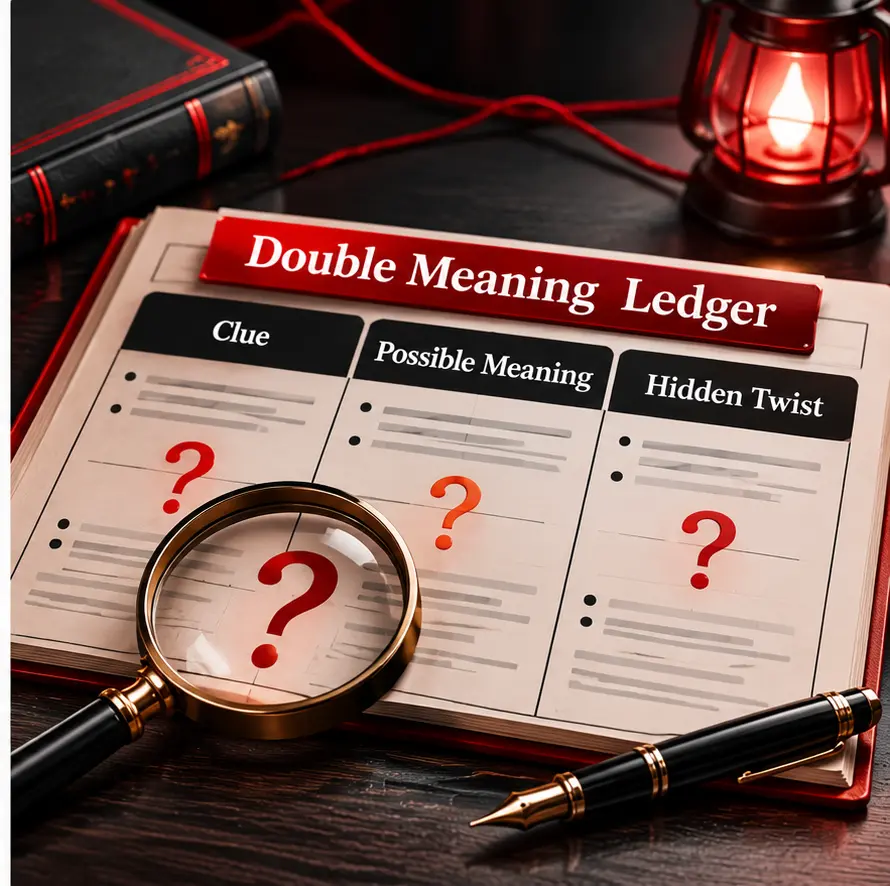
I track this with something I call the Double Meaning Ledger. It’s a three column list: the clue, what it seems to mean now, and what it really means after the reveal.
Scenario one. Say you’re writing a cozy mystery where the helpful housekeeper did it. Her ledger might show that she knows which stair creaks (seems like: years of service; really: she’s crept down at night). She also carries tea to the study early (seems like: kindness; really: she’s checking the safe).
The weak rows are almost always the ones with no believable harmless reading. If a clue only makes sense after the reveal, sharp readers will smell it. Fix it before you draft another chapter. For more on the different kinds of hints, this guide to foreshadowing in fiction is worth a read.
Can You Plant the Twist After Finishing the Draft?
Absolutely, and a lot of writers work this way. Draft toward your best guess, discover the twist somewhere in the messy middle, then go back and seed the clues with your ledger open.
That’s a relief during NaNoWriMo, when every pause to plan costs you words. Keep writing, jot “twist idea: sister left on purpose” in a margin note, and move on. Clue placement can wait for December.
One caution. Revision clues tend to be too tidy, so rough them up a little. Bury a couple under unrelated scenes so they don’t glow. A professional book editing service can also catch clues that glow too brightly.
Where Do Good Plot Twist Ideas Come From?
They come from your own story’s assumptions. List what readers take for granted, then flip one. That’s the fastest route to plot twist ideas that grow out of your book instead of landing on it from outside.
Try this:
- List five things readers take for granted. Think hero, trusted ally, goal, timeline, and stakes.
- Pick one and flip it. Write the flipped version as a single sentence.
- Test it. Does the flip explain scenes you’ve already written? If yes, keep it.
Scenario two. A NaNoWriMo writer is 25,000 words into a thriller about a missing sister. The assumptions are that the sister is a victim and the narrator is searching to save her. Flip the second one and things get interesting fast: the sister left on purpose, and the narrator’s search is what puts her at risk.
You can run the same exercise when writing a surprise ending for a short story. With fewer pages to work with, each clue has to pull more weight.
Which Plot Twist Examples Should You Actually Study?
The best plot twist examples hold up on a second look. Ask yourself what the story hid, and how.
- The Murder of Roger Ackroyd: nothing in the narration is false, but the crucial act gets quietly skipped.
- Gone Girl: the diary is a performance, so the reader’s trust gets used against them.
- The Sixth Sense: everyday scenes pick up a second meaning the moment the truth lands.
Pick one and reread or rewatch it with a notepad. Pause at every clue and write down the harmless reading it relied on. Do that two or three times and the patterns start showing up on their own. Writing Mastery’s breakdown of how misdirection works in these very stories makes a good companion read.
Why Do Unexpected Plot Twists Sometimes Land With a Thud?
Unexpected plot twists land with a thud when they feel unearned, pointless, or both. Most of the time it comes down to a few bad habits.
- No setup. A sudden rescue or secret with zero clues reads like a shortcut.
- Too many twists. Every extra reveal weakens the one before it.
- Nothing changes. If the plot rolls on unchanged, the reveal was decoration.
- Characters acting dumb. Readers notice when people ignore obvious facts just to protect the secret.
- The monologue dump. When the villain explains the whole scheme out loud, you’ve swapped drama for a lecture.
Here’s a blunt test before you commit. Suppose a reader guessed the reveal on page ten. Would the story still hold up? If it wouldn’t, you’re leaning on secrecy rather than structure.
What Should You Try Next?
Knowing how to write a plot twist matters less than trying one on a real draft. Set a timer for twenty minutes and run this:
- Write your story’s truth in one sentence.
- Write the lie readers will believe.
- Fill in a Double Meaning Ledger with five clues and check each one against your pages.
Then mark where each clue shows up and add any that are missing. Read your reveal scene out loud and listen for earlier moments that suddenly sound different. If they do, you’ve got a twist that holds up. For more craft advice, browse the writing guides on our blog.