





09 Sep 2026
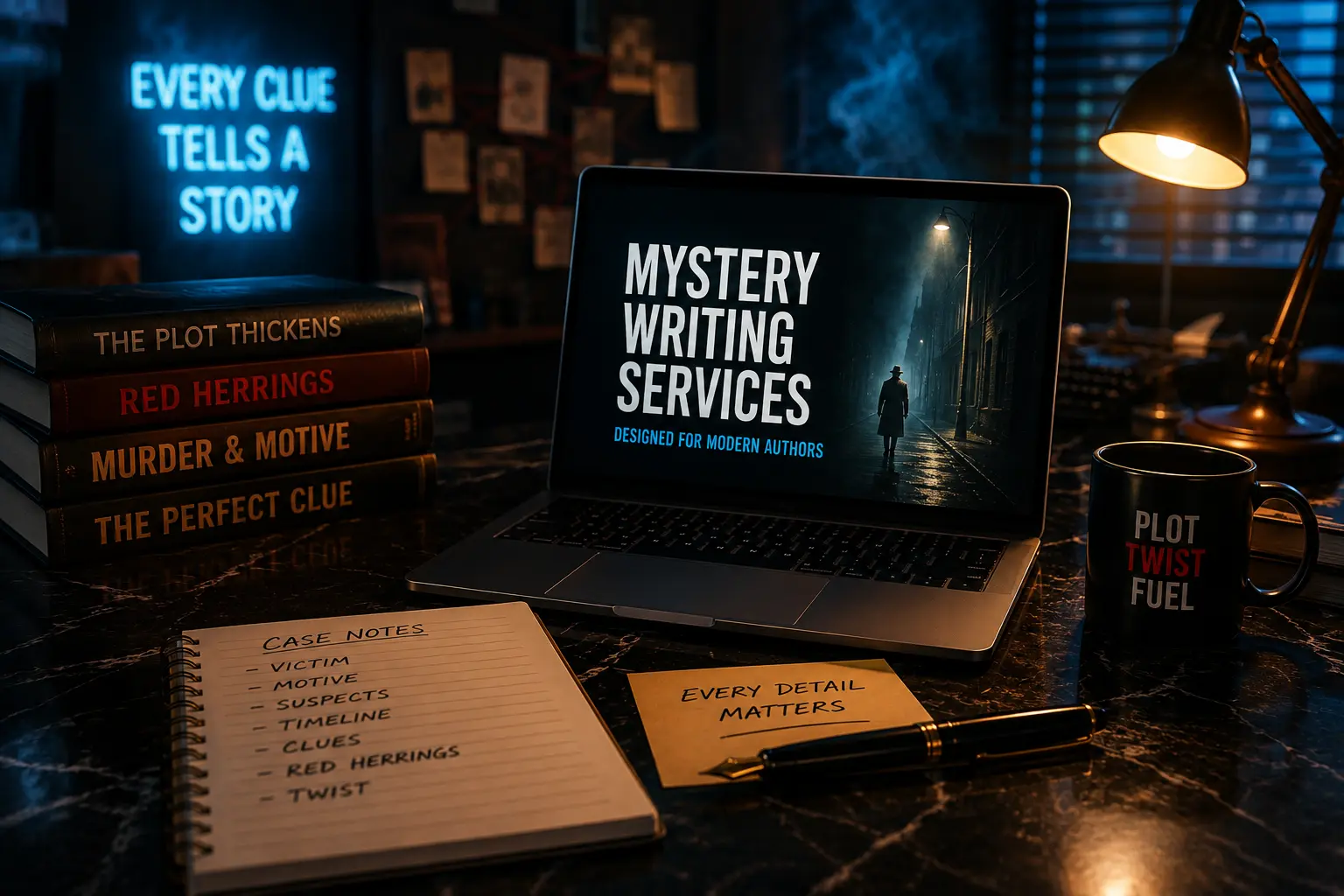
Marcus read his big reveal out loud to our writing group one Tuesday night, and the room just went quiet. Not the good quiet. Someone eventually asked how the detective knew that detail, and Marcus’s face did this thing where you could watch him realize, in real time, that he’d never actually planted the clue. It was sitting in his head the whole time, not on the page. That gap between what a writer knows and what they’ve actually written down is basically the whole reason mystery writing services exist.
Mystery readers play fair, mostly, and they expect the book to play fair back. Slip up on a timeline, let your detective know something they haven’t earned yet, and somebody catches it. Somebody always catches it. Reddit threads exist entirely for cataloguing plot holes in published mysteries, so imagine what an editor with genre training catches before your book ever gets that far.
Why Mystery Novels Are Harder to Write Than They Look
Nobody warns you about this going in. The crime itself, the murder or the theft or whatever kicks things off, that part’s almost easy. It’s everything wrapped around it that gets brutal. Eighty, ninety thousand words, and you’re the only person tracking who knew what and when they knew it.
Mystery readers don’t read the way other readers read. They’re cross referencing. They remember that one line about the gardener’s schedule from chapter four and they’ll bring it up in a Goodreads review if it doesn’t add up later. Show your hand too early and the book’s solved by page sixty. Hide it too well and the ending lands like a magic trick nobody asked for. Most writers can’t find that middle spot in their own draft. You wrote it. You already know whodunit. Of course it seems obvious or, worse, perfectly hidden to you.
Red herrings are their own headache. A red herring that works makes sense on its own terms, evidence really does point somewhere, even though it’s wrong. A red herring that fails feels like the author just lied to you for a few chapters. That line is thinner than people think.
I’ve read manuscripts, more than one, where the entire twist rested on some tiny detail buried on page forty and never touched again until page two eighty. Technically it’s there. Nobody remembers it though, and readers experience the twist as a cheat instead of a payoff. Catching that gap early, before a reader ever gets to feel cheated, is basically the job description for mystery writing services.
The Difference Between General Fiction Help and Mystery Specific Support
A solid general editor fixes your prose, tightens a saggy chapter three, maybe reworks your dialogue tags. All useful. None of it touches whether your detective’s knowledge lines up with what they’ve actually witnessed on the page. That’s a different skill, and skipping it costs you credibility with readers who were rooting for the book.
Subgenre matters too, more than people expect. Cozy mystery rules and noir rules barely overlap. A literary fiction editor might not blink if your cozy suddenly reads like hardboiled crime by chapter three, but a mystery reader absolutely will.
What Mystery Writing Services Actually Offer
The phrase makes people picture ghostwriting, someone else basically writing your book. That’s rarely it. Scope depends entirely on where your manuscript is and what you personally struggle with.
Full development suits writers with a strong idea but no map yet. Work usually starts before chapter one exists, mapping the crime, the suspects, the clues, the ending, sort of like drawing the blueprint first. Skip that step and you get Marcus, staring blankly at his writing group.
Developmental editing is for the ones who already have a draft and just feel something’s off. Sagging middle. A villain whose motive doesn’t hold up once you poke at it. A good editor reads almost like a detective themselves, sometimes literally tracking clues on a spreadsheet, and flags anything that doesn’t add up by the last chapter.
Then there’s plot consulting on its own, no line editing involved. Good for writers confident in their prose but shaky on structure. A consultant traces the timeline hour by hour if that’s what it takes, catching contradictions the author stopped seeing months ago.
Line Editing and Voice Consistency
Tone slips are sneaky. Cozy needs warmth even in tense moments, a little humor threaded through. Noir wants something leaner, shorter sentences, heavier silences between them. Lose that voice for even a chapter and readers feel it, even if they can’t say exactly why. Genre editors catch tone drift the same way they catch a dropped clue, almost automatically, because they’ve read enough of the genre to know what it’s supposed to sound like.
How to Choose the Right Mystery Writing Services for Your Project
Price is a factor, obviously, but it shouldn’t be the deciding one. Fit matters more. Does this person get your subgenre specifically, or are they applying general fiction instincts to a genre that plays by its own rules?
Ask for mystery specific samples. Someone with five romance credits and one mystery isn’t disqualified automatically, but ask what they thought worked in that project and what didn’t. You’ll learn more from that answer than from any resume.
Communication style is underrated here. Mystery editing means a lot of back and forth, timeline questions, “wait, does she know this yet or not,” that kind of thing. You want someone who explains their reasoning instead of dropping “doesn’t work” in the margin with nothing else attached. That kind of note doesn’t teach you anything for the next book.
Ask how they approach red herrings specifically. The answer tells you fast whether you’re talking to someone with real genre chops or someone applying generic editing instincts and calling it specialized.
Red Flags Worth Watching For
Anyone promising a full developmental pass in two weeks, be careful. Good plotting takes time, and rushed work tends to reproduce the exact plot holes you hired someone to catch. Vague pricing is another one. A trustworthy service tells you plainly what you’re getting, full manuscript edit, plotted outline, consultation notes, whatever it is.
What the Actual Collaboration Looks Like
People picture handing over a manuscript and getting it back weeks later covered in red ink. Sometimes, sure. More often it’s messier and more conversational than that. Calls where you talk through why a character acts a certain way. Emails asking things like whether the housekeeper actually has access to the study at nine at night, or whether that’s just an assumption sitting unexamined in your draft.
That back and forth is the actual value. Not the marked up document by itself. Someone poking holes while you can still fix them cheaply, before the whole structure hardens into something that’s painful to touch.
Building Your Mystery With the Right Support
This isn’t about giving up creative control, even though that fear keeps a lot of writers from ever reaching out. Good collaborations feel more like two people who both want the book to land. Your vision stays central. Someone experienced reinforces what’s holding it up underneath.
Building a house is a decent comparison. You know exactly how you want the kitchen to feel, which way the windows should face. You’d still hire someone to check the load bearing walls before you knock one down. Mystery structure works about the same way. Your instincts matter most, but the logic underneath needs a second set of trained eyes, ideally before a reader finds the crack for you, in public, in a review.
This goes double for first timers. Genre conventions take years to really absorb, through trial, error, and a pile of quietly abandoned drafts nobody talks about at parties. There’s no shame in leaning on someone experienced while you’re still learning. Even bestselling mystery writers, a dozen books deep, still work with genre editors, because they’ve gone blind to their own manuscript by month six of drafting it.
Balancing Independence With Professional Input
Some writers worry outside help flattens their voice, turns the book into something written by committee. Fair worry, but it usually means they worked with the wrong person. A genuinely good mystery editor protects your voice instead of overwriting it. Their job is logic and structure, not making your sentences sound like theirs. The best ones ask sharp questions and let you land on your own answer, instead of just handing you their preferred fix.
Conclusion
Mystery doesn’t forgive sloppiness the way some genres do. Every clue needs a reason for existing. Every red herring needs to feel plausible, not manufactured. Every reveal has to feel surprising and, somehow, inevitable at the same time, once the reader looks back over what they missed. That’s a lot to carry alone for months, which is why so many writers eventually ask for help instead of white knuckling the whole draft solo.
Finding the right mystery writing services comes down to genre understanding, honest communication, and real respect for the story you’re trying to tell. Whether that means building the structure from scratch or just having someone track your clues alongside you, the right support turns a decent idea into the kind of mystery people stay up too late finishing.