




05 Oct 2026
Nobody tells you this ahead of time. You’re 30,000 words into something and suddenly you don’t know if it’s a book or a very long email to yourself.
So, how long is it meant to be?
Everyone online has an opinion and none of them agree. 50,000. No, 100,000. Someone always brings up a picture book with 500 words like that proves anything, useless if you’re writing a thriller.
Truth is, it depends. Genre, reader, sometimes even the bookshop shelf it’ll sit on. Here’s what’s actually typical, category by category, and a way to figure out your own number without losing your mind over it.
The One Number Everybody Wants
70,000 to 100,000. That’s roughly where adult fiction and a lot of general nonfiction sits, and it’s what most publishers mean by “full-length.”
Usual. Not gospel. Great books get written at 40,000 words. Great ones get written at 200,000 too. The average just tells you where the crowd is, not where you have to stand.
Fiction
Debut novel? 80,000 to 90,000 is the number people keep repeating. Drop under 40,000 and it’s technically a novella now, which, fine, is still a real thing worth writing.
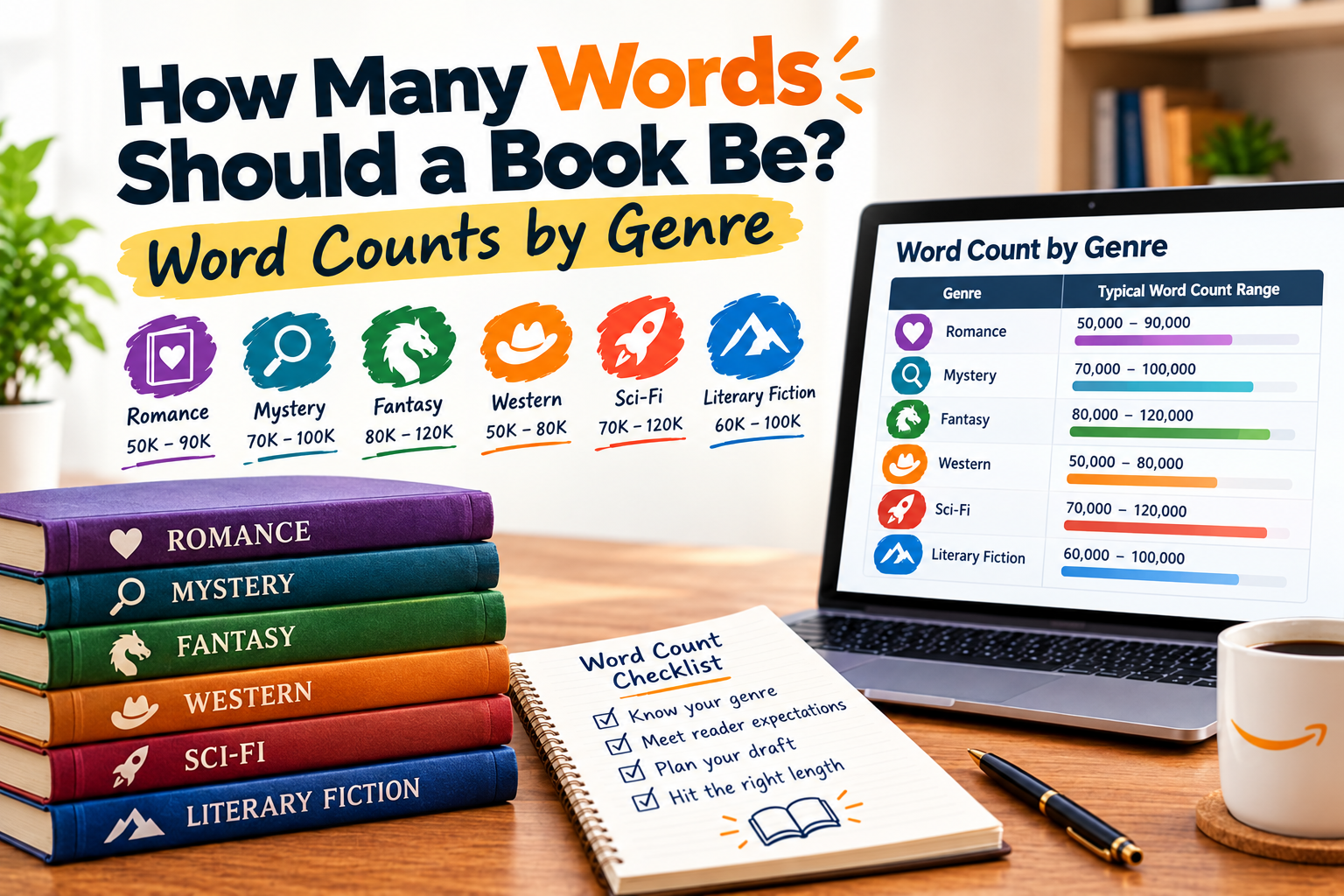
Genre pulls it around though. Romance, mystery, thriller usually 70,000 to 90,000, because nobody wants a thriller that dawdles. Historical fiction gets more breathing room, 80,000 to 100,000ish. Fantasy and sci-fi? 90,000 to 120,000, often more, because apparently every magic system needs its own chapter to explain itself.
YA runs shorter, 50,000 to 80,000. Middle grade even less, somewhere around 20,000 to 55,000.
If your story wraps up naturally at 35,000 words let it. Padding it out to hit “real novel” length usually just makes it worse, and honestly, nobody’s grading you on a curve anymore. Ebooks don’t need a print run, so short fiction actually has a shot at readers these days.
Nonfiction
There’s no clean rule here, can’t be, when one book’s explaining tax law and the next one’s about waking up earlier.
General nonfiction tends to fall 50,000 to 80,000, heavier subjects (history, politics, psychology) pushing the upper end. Self-help and business books have gotten shorter over the years 40,000 to 60,000 now, sometimes less. Good. A book people finish beats a book people quit on page 40.
Ebooks can go even leaner. Plenty of solid, useful guides sit at 10,000 to 20,000 words. Only real test: did the reader get what the title promised them?
Memoir
Memoir’s nonfiction wearing a story’s clothes beginning, turn, landing. Most guides say 65,000 to 90,000, sometimes creeping to 100,000. Famous people can publish thin memoirs and get away with it. First-timers, less so.
The real problem isn’t length. It’s cutting. Everything happened to you, so everything feels sacred. Got 120,000 words and need 80,000? Losing those 40,000 hurts, no way around it, but the book almost always comes out sharper for it. Keep what actually serves the story. The rest goes in a drawer, not the trash — you might need it for something else someday.
Biographies run longer. Whole life, mountains of research, that math checks out.
Kids’ Books
32 pages, 300 to 1,000 words, that’s your standard picture book. Most writers I’ve seen stick to the lower half. You read one aloud in two minutes flat. Pictures do half the storytelling, which means words get pricey one throwaway adjective and you’ve blown your budget.
Then it climbs. Chapter books, 4,000 to 10,000 words. Middle grade, into the tens of thousands. Age matters here more than anywhere else in this whole list, rules are strict, so check what’s normal for the exact age band before you fall for a draft that doesn’t fit it.
Words aren’t Pages
You think in words. Printers think in pages. A standard paperback page holds roughly 250 to 300 words, depending on font and margins and trim size, that sort of thing.
So 80,000 words lands you around 270 to 320 printed pages. Matters if you’re self-publishing more pages, more printing cost, and that eventually shows up in what you charge. Amazon’s “print length” is a guess too, based on about 250 words a page. Don’t build a business plan on it.
What Agents Actually Do With The Number
Going traditional as a debut? Word count’s a filter before anyone even reads your writing. 200,000-word first novel, or a 20,000-word “novel” good luck getting past the query stage on either end. A little over or under, fine. Wildly off from your genre, people notice, and not in a good way.
Self-publishing skips all that. Nobody’s checking your homework. But readers still show up with expectations baked in. A 35,000-word romance and a 90,000-word one can both do well they just get marketed differently, and honestly, they feel like different kinds of purchases to the person buying them.
Picking Your Own Number
Don’t start with a number at all, honestly.
Grab five or six recent books in your category the ones your reader already owns and eyeball how long they run. Now you’ve got a realistic zone. Then finish the whole draft before judging anything, because almost every manuscript changes shape in editing anyway. Long ones get trimmed. Thin ones need filling in. You won’t know which one you’ve got until it exists on the page.
Done at 55,000 and the genre “wants” 80,000? Don’t pad it just to match. Needs 105,000 to actually work? Don’t hack it down for the sake of a number. And if you genuinely can’t tell get an editor to look at it. They’ll know within a chapter or two.
The Mistakes People Keep Making
Padding’s the big one. Readers smell it instantly, and they’ll say so in the reviews, not kindly.
Then there’s the flip side — cutting a story so hard it develops plot holes. Treating every genre like it needs the same length. Confusing word count with page count (they’re not the same thing, not even close). And getting so fixated on hitting a number that the actual sentences stop mattering.
The count’s a guide. Your reader’s the actual point of all this.
Handing it Off to Someone Else
Some people have a great story and zero clue how to shape it into a book. Others know their subject cold, no time to sit and write 60,000 words about it. That’s where professional book writing services come in, genuinely useful for both situations.
A decent team, book writers, editors, a ghostwriter, can build the structure, aim for a sensible length for the genre, and hand back something polished. The Books Central does this for fiction, nonfiction, memoirs, kids’ books, working from your outline and whatever ideas you already have. Takes real pressure off if you’re a first-time author with no idea what “the right length” even looks like for your category.
If you go this route: say your target word count and genre out loud upfront, ask to see samples of their writing, and make absolutely sure the rights stay with you.
Quick Hits
Full-length novel 70,000 to 100,000, 80,000-90,000 for most debuts.
Nonfiction 50,000 to 80,000 general, 40,000 to 60,000 for self-help and business.
Memoir 65,000 to 90,000, sometimes a bit more.
Picture book a few hundred words up to 1,000, across about 32 pages.
Short self-published book totally fine, as long as it delivers what it promised.
So, Really, How Long?
Long enough to finish the story or solve the problem. Not a page more than that. The ranges above are a map, worth knowing where the edges sit. But nobody’s ever picked up a book because it hit exactly 82,000 words.
Pick a reasonable zone, write the whole thing, shape it later in editing. And if the hard part is just getting the idea onto the page at all that’s what a professional book writing service is actually for.