




07 Sep 2026
When I published my first book through Amazon KDP, I spent more time confused about the printing side of things than I did about anything else. Writing the book was the easy part. Figuring out the business end of it, specifically the Amazon KDP paperback printing cost, was where I kept hitting walls. I searched for clear answers and kept finding articles that either glossed over the details or threw numbers at me without explaining what they actually meant for my earnings. Eventually I just went through the whole thing myself, made some expensive assumptions, learned from them, and came out the other side with a pretty clear picture of how it all works. This is the guide I wish had existed when I was starting out.
How Amazon KDP Paperback Printing Actually Works
Most people come into KDP thinking about it like a traditional printer where you pay upfront and boxes of books show up at your door. That is not how it works at all and once you understand the actual model everything else starts clicking into place.
With KDP you pay nothing upfront. There is no minimum order, no setup fee, and no inventory to store. When a customer buys your paperback, Amazon prints that single copy right then and ships it directly to the buyer. The cost of printing that one copy gets deducted from your sale price before your royalty is calculated and whatever is left after that deduction is what lands in your account.
So the printing cost is not something you ever see as a separate bill. It is invisible in a way, which is actually why so many new authors ignore it until they wonder why their royalties feel so small.
The Two Royalty Options and Why They Matter Here
KDP gives you two royalty rate choices for paperbacks. The standard option is 60 percent of your list price minus the printing cost, available for books sold directly through Amazon marketplaces. The expanded distribution option drops your rate to 40 percent but opens up your book to other retailers, libraries, and wholesale channels outside of Amazon.
The formula that determines what you actually earn per sale looks like this. Take your royalty rate and multiply it by your list price, then subtract the printing cost. So if your book costs 3.50 dollars to print and your list price is 14.99 dollars on the 60 percent plan, you are earning around 5.49 dollars per sale. Change that printing cost by even a dollar and your royalty shifts meaningfully, especially when you multiply it across hundreds of sales.
What Actually Drives Your Amazon KDP Paperback Printing Cost Up or Down
I spent a lot of time early on not understanding why my printing cost was what it was. I thought it was somewhat arbitrary. It is not. There are specific variables that KDP uses to calculate the cost and once you know what they are you can actually make intentional decisions that affect your bottom line.
Ink Type
This is by far the biggest factor. Black and white printing and color printing are not even in the same ballpark when it comes to cost. For text heavy books like novels, memoirs, business books, or anything without images, black and white is the only sensible choice financially. Color printing costs nearly six times more per page and that number is not an exaggeration. I will show you exactly what that looks like in the tables below.
Page Count
Every page costs money to print. On a black and white book the per page cost is small enough that it is easy to dismiss, but it adds up across a full manuscript. A book that is 50 pages longer than it needs to be is costing you money on every single sale for as long as that book is live. Good editing is good for your reader and good for your royalty statement at the same time.
Trim Size
The physical dimensions of your book affect how your content flows across pages which in turn affects your total page count. A 6×9 trim fits more words per page than a 5×8 trim for the same manuscript. I have seen authors reformat their book to a larger trim size and knock 40 or 50 pages off their count, which translated directly into a lower printing cost per copy.
Which Amazon Marketplace Makes the Sale
Amazon has printing facilities in different countries and the cost of printing a book in the UK is different from the cost of printing the same book in the US or Germany. Your royalty on each sale is calculated using the local printing cost for whatever marketplace the customer bought from, which is why your earnings per sale can vary slightly across different countries even when the customer paid a similar price.
Amazon KDP Paperback Printing Cost by Page Count and Ink Type
Here are the actual numbers. For the US marketplace KDP uses a fixed base cost plus a per page rate that differs depending on whether you are printing in black and white or color.
Black and White Printing Costs
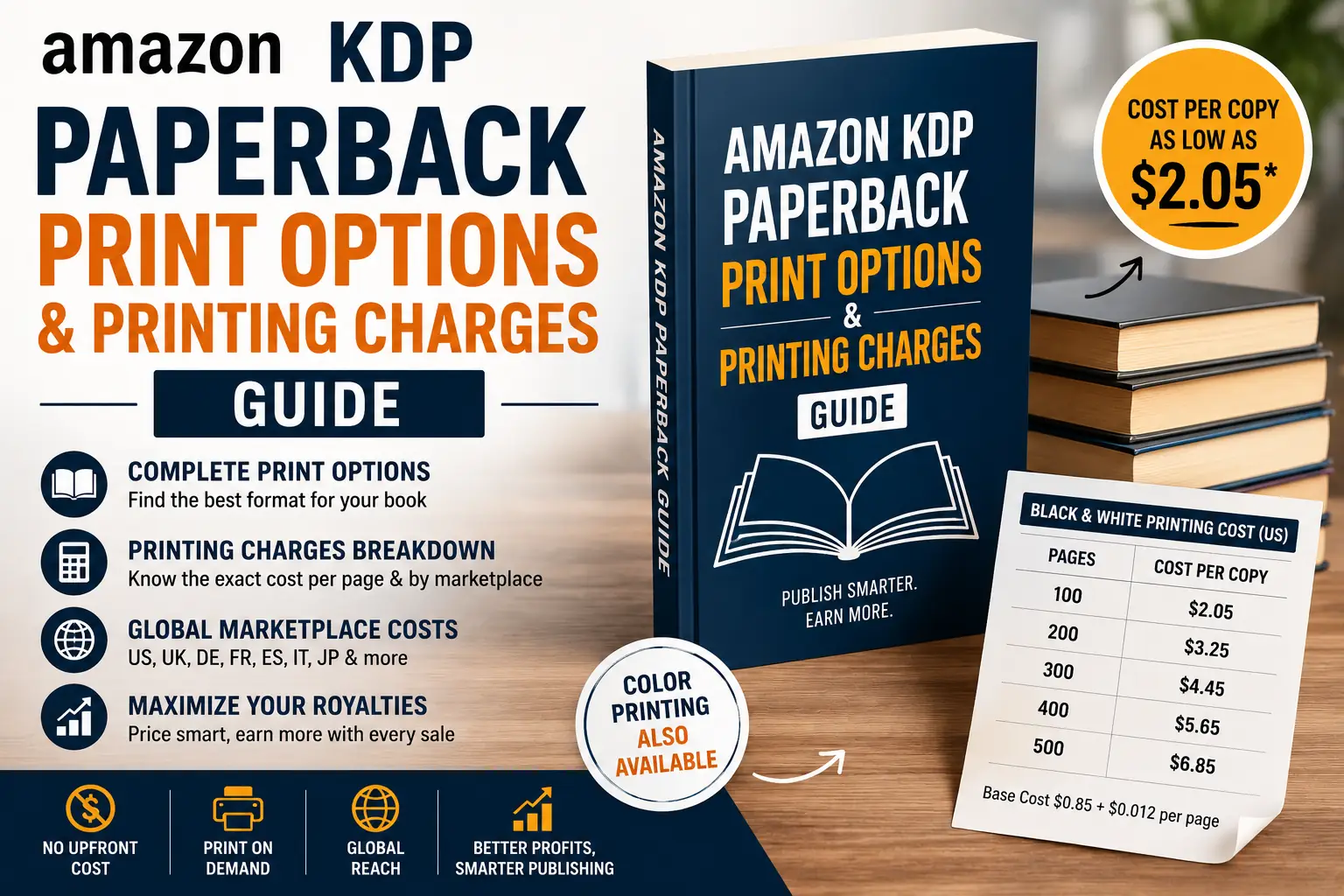
For black and white paperbacks on Amazon.com the base cost is 0.85 dollars and the per page rate is 0.012 dollars.
| Page Count | Printing Cost Per Copy |
| 100 pages | $2.05 |
| 150 pages | $2.65 |
| 200 pages | $3.25 |
| 250 pages | $3.85 |
| 300 pages | $4.45 |
| 350 pages | $5.05 |
| 400 pages | $5.65 |
| 450 pages | $6.25 |
| 500 pages | $6.85 |
These numbers are manageable. A 300 page black and white paperback costing 4.45 dollars to print leaves plenty of room to price the book competitively and still earn a decent royalty.
Color Printing Costs
For color paperbacks on Amazon.com the base cost stays at 0.85 dollars but the per page rate jumps to 0.07 dollars. That is the number that changes everything.
| Page Count | Printing Cost Per Copy |
| 50 pages | $4.35 |
| 75 pages | $6.10 |
| 100 pages | $7.85 |
| 150 pages | $11.35 |
| 200 pages | $14.85 |
| 250 pages | $18.35 |
| 300 pages | $21.85 |
When I first saw these numbers I understood immediately why color books are so difficult to price on KDP. A 200 page color book costs nearly 15 dollars just to produce one copy. By the time you set a price high enough to cover that and still earn anything meaningful, you are competing against traditionally published color books that are priced lower because they were printed in large offset runs.
How to Figure Out Your Minimum List Price Before You Publish
KDP will not allow you to set a price below the printing cost because Amazon cannot sell a book at a loss. But just hitting the minimum means your royalty is basically zero, so understanding how this calculation works helps you plan your pricing properly from the start.
The Minimum Price Formula
Divide your printing cost by your royalty rate and you get your minimum viable list price. For a 250 page black and white book with a printing cost of 3.85 dollars on the 60 percent plan, that works out to 3.85 divided by 0.60 which is 6.42 dollars. KDP rounds up so your actual minimum would land around 6.99 dollars.
Switch to expanded distribution and the math changes because your royalty rate drops to 40 percent. The same book now has a minimum of 3.85 divided by 0.40 which is 9.63 dollars, so you would be looking at a minimum around 9.99 dollars for expanded distribution eligibility.
A lot of authors set their price to satisfy the expanded distribution minimum across the board so they do not have to manage different pricing tiers. It is one less thing to think about.
What Your Royalty Actually Looks Like at Different Price Points
This table uses a 250 page black and white paperback with a printing cost of 3.85 dollars on the 60 percent royalty plan.
| List Price | Royalty Rate | Royalty Per Sale |
| $7.99 | 60% | $0.94 |
| $9.99 | 60% | $2.14 |
| $12.99 | 60% | $3.94 |
| $14.99 | 60% | $5.14 |
| $16.99 | 60% | $6.34 |
Look at the difference between pricing at 7.99 and pricing at 14.99. You earn 5.14 dollars at the higher price versus less than a dollar at the lower price. The book does not need to sell five times as many copies at 14.99 to outperform the lower priced version in total earnings. Most non fiction paperbacks in the 200 to 300 page range sit between 12.99 and 16.99 on Amazon for exactly this reason.
Amazon KDP Paperback Printing Cost Across International Marketplaces
If you are distributing your book globally through KDP, the printing cost changes depending on where the buyer is purchasing from. Each marketplace has its own production costs and those feed directly into what you earn per sale in that region.
Printing Costs by Marketplace
| Marketplace | Currency | Base Cost | Per Page B&W | Per Page Color |
| Amazon.com (US) | USD | $0.85 | $0.012 | $0.070 |
| Amazon.co.uk (UK) | GBP | £0.70 | £0.010 | £0.060 |
| Amazon.de (Germany) | EUR | €0.70 | €0.012 | €0.070 |
| Amazon.fr (France) | EUR | €0.70 | €0.012 | €0.070 |
| Amazon.es (Spain) | EUR | €0.70 | €0.012 | €0.070 |
| Amazon.it (Italy) | EUR | €0.70 | €0.012 | €0.070 |
| Amazon.co.jp (Japan) | JPY | ¥90 | ¥1.50 | ¥8.00 |
| Amazon.com.au (Australia) | AUD | $1.10 | $0.015 | $0.085 |
Your royalty from each marketplace gets calculated in that local currency using those local printing costs, then converted to your payment currency when KDP sends your monthly payment. This is why a sale on Amazon.com.au might feel slightly different from a US sale even when the prices look similar on paper.
Ordering Author Copies and What You Actually Pay
This feature surprised me when I first discovered it and it has become one of my favorite things about publishing through KDP. You can order physical copies of your own book at the bare printing cost with no royalty markup added on top.
How Author Copy Pricing Works in Practice
Because you are buying copies of your own book rather than selling them, you do not earn a royalty on author copies and KDP does not charge you one either. You just pay the printing cost plus shipping. For a 250 page black and white paperback that means 3.85 dollars per copy plus whatever shipping costs based on your location and how fast you need them.
I order author copies regularly for speaking events and local bookstore meetings and the quality has always been consistent. For small quantities they are genuinely competitive with what a third party short run printer would charge you.
| Copies Ordered | Printing Cost 250pg B&W | Estimated Shipping US | Estimated Total |
| 1 copy | $3.85 | $5.50 | $9.35 |
| 5 copies | $19.25 | $6.50 | $25.75 |
| 10 copies | $38.50 | $8.00 | $46.50 |
| 25 copies | $96.25 | $12.00 | $108.25 |
| 50 copies | $192.50 | $18.00 | $210.50 |
If you are an author who sells at in person events, this is worth paying attention to. You are getting professionally printed copies of your book at cost and selling them at whatever price you choose, keeping the full difference yourself since there are no Amazon fees involved in a direct sale.
Practical Ways to Bring Your Printing Cost Down Without Hurting Your Book
After going through several KDP launches I have picked up habits around this that genuinely make a difference. None of them involve compromising on quality. They are just smarter decisions made earlier in the process.
Edit for Length Not Just Quality
Every 10 pages you cut from a black and white book saves you 12 cents per copy. On 500 sales that is 60 dollars. On 2000 sales it is 240 dollars. Cutting pages is not just about making a tighter read. It is about your long term earnings. I now think about page count during editing the same way I think about chapter structure and pacing. It matters.
Use Your Trim Size to Your Advantage
If your manuscript is sitting at 320 pages formatted in 5×8, try reflowing it in 6×9 and see what happens to your page count. I did this with one of my books and dropped from 318 pages to 264 pages. That reduced my printing cost by almost 65 cents per copy which does not sound huge until you multiply it across every sale the book has made since launch.
Cream Paper Costs Nothing Extra and Looks Better
KDP offers cream paper as an alternative to white for black and white interiors and it does not add a single cent to your printing cost. For fiction and narrative non fiction it makes the reading experience feel warmer and more like a traditionally published book. It is a completely free upgrade that I use on every text heavy book I publish now.
Think Hard Before Committing to Color
If you are considering color for elements that might work just as well in black and white, run the numbers first. Going from color to black and white on a 200 page book drops your printing cost from around 14.85 dollars to 3.25 dollars. That is an 11.60 dollar difference per copy. At 14.99 list price your color book royalty on the 60 percent plan would be essentially nothing after that printing cost. The same book in black and white earns you around 5.74 dollars per sale. That difference is not abstract. It is real money on every sale.
Final Thoughts
Getting your head around Amazon KDP paperback printing cost before you publish is one of the most useful things you can do as a self published author. It is not the most exciting part of the process but it directly controls how much you earn from every sale your book makes, potentially for years.
The things that matter most are ink type, page count, and how you price relative to your minimum. Black and white printing gives you enormous flexibility. Color printing requires very careful pricing strategy to earn anything meaningful. And pricing well above your minimum is not optional if you want your book to generate income that actually feels worth the effort you put into writing it.
Before you hit publish on any KDP paperback, open the royalty calculator in your author dashboard, plug in your real numbers, and test three or four different price points. See what your royalty looks like at each one. That exercise takes maybe five minutes and it gives you a much clearer picture of what you are actually building toward with every sale.