




16 Oct 2026
You’ve finished your manuscript. Now someone’s telling you it needs editing. Fair enough. But then you start googling around and suddenly there are two totally different terms staring back at you, developmental editing vs copy editing, and nobody’s bothered explaining what actually separates them. I hit this wall with my first manuscript. Hired an editor, got back a document covered in comma corrections, thought, great, done. Wasn’t done. Not even close. My plot still had holes you could drive a truck through. That’s when I learned, the hard way, that these two types of editing aren’t interchangeable, and picking the wrong one first can cost you months.
Why This Distinction Actually Matters
Here’s the thing nobody tells first time authors clearly enough. Editing isn’t one step. It’s several distinct stages, and each one focuses on something completely different. Mix them up, or skip one entirely, and you end up with a manuscript that reads beautifully sentence by sentence but falls apart structurally. Or the reverse, a solid story riddled with grammar issues nobody caught in time.
Understanding developmental editing vs copy editing before you hire anyone saves actual money, not just time. I’ve watched writers pay a copyeditor to polish sentences in a manuscript that still needed a full structural overhaul underneath. All that careful grammar work gets tossed later anyway, once bigger issues surface and whole chapters get rewritten or cut.
There’s a timing problem too, one most people don’t think about until it bites them. These stages happen in order for a reason. Doing them backward, or squeezing both into one rushed pass, creates more headaches than it solves. I’ve seen that mistake play out more times than I can count at this point.
A Quick Story That Explains the Difference Better Than Any Definition
A friend of mine, call her Sara, wrote a memoir a few years back. Gorgeous writing at the sentence level, honestly some of the best prose I’d read from a first time author. But her chapters jumped around in time without warning, and readers had zero idea where they were half the time. She hired a copyeditor first, assuming that was the standard first move. The copyeditor cleaned up her grammar nicely, told her the manuscript was ready.
It wasn’t ready. Beta readers were lost by chapter three. She eventually brought in a developmental editor who restructured the whole timeline, and only after that rewrite did copyediting actually make sense as a final polish. That detour cost her extra months and extra money, all because nobody explained developmental editing vs copy editing to her at the start.
What Developmental Editing Actually Involves
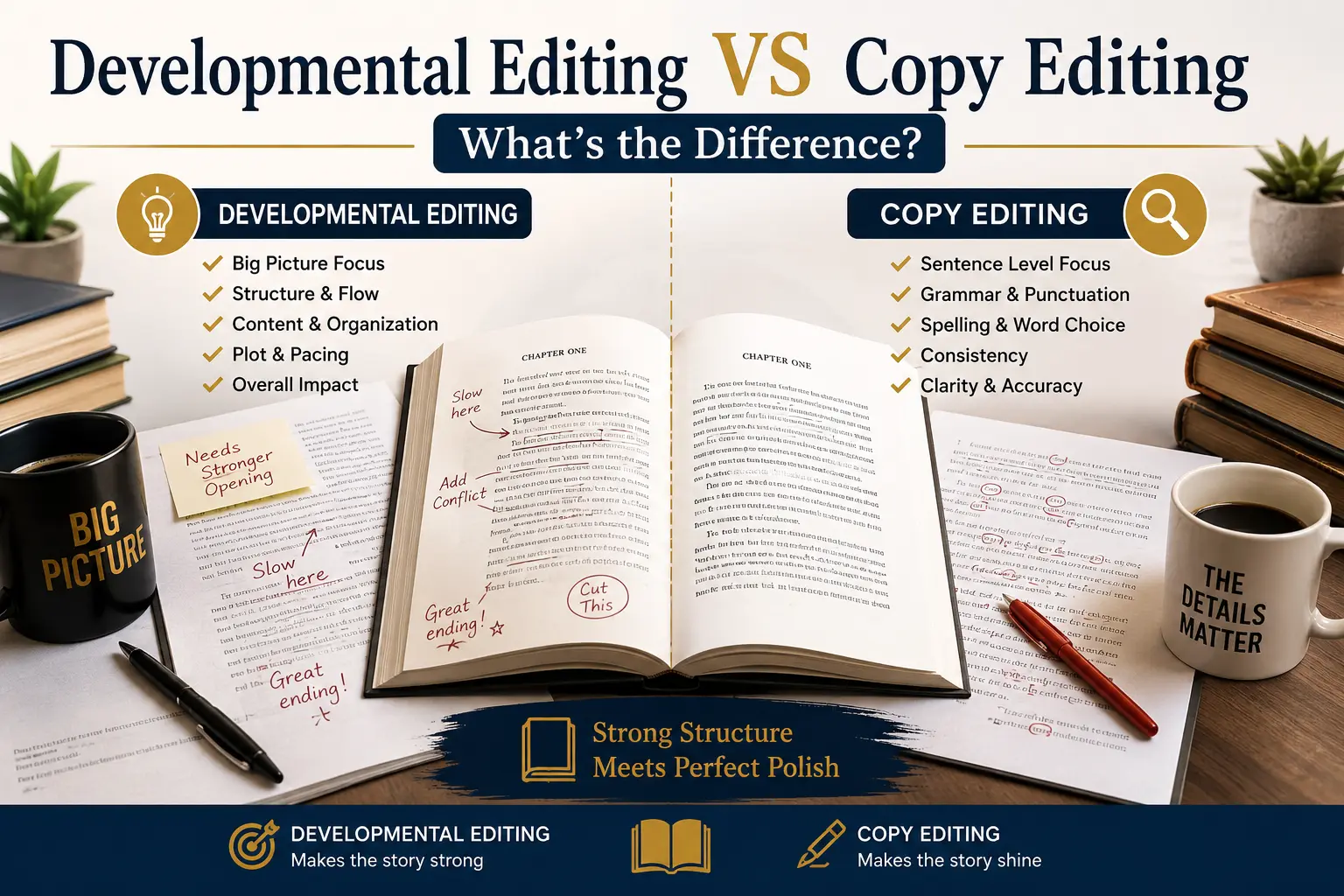
Developmental editing comes first, and it deals with the big picture. Plot structure. Pacing. Character development. Whether your book’s overall argument or story arc actually holds together from start to finish. A developmental editor isn’t losing sleep over whether you used “who” instead of “whom” in chapter four. They’re asking bigger questions. Does this character’s motivation make sense? Does the middle section drag? Is your nonfiction argument building logically toward the conclusion, or does it wander?
This stage often means significant rewriting. Genuinely significant. Entire chapters might get restructured, moved, or cut outright. Characters sometimes get merged or dropped because they weren’t pulling their weight. For nonfiction, this might mean reorganizing your whole chapter order because the original structure buried your strongest points somewhere in the middle instead of building toward them.
Developmental editing usually takes longer than people expect, often four to eight weeks depending on length and how many issues surface. And here’s something worth knowing upfront, you’ll likely need another round of writing after this feedback lands. It’s not one and done. The editor doesn’t just hand you notes and you’re finished. It’s collaborative, and honestly it takes more emotional energy than copyediting, since you’re questioning choices you already made and felt good about.
Signs Your Manuscript Needs Developmental Editing First
How do you know if this is the stage you need right now? A few signs show up consistently. Beta readers keep asking confused questions about your plot or timeline. Multiple people mention the middle section feels slow, or that they lost interest around chapter ten. Your nonfiction chapters feel disconnected from each other, more like separate essays than one argument building toward something.
Sound familiar? Developmental editing needs to happen before anything else touches your manuscript. Fixing grammar in a book with structural problems is a bit like repainting a house sitting on a cracked foundation. Looks fine for a moment. The real issues are still underneath, waiting to cause trouble later.
What Copy Editing Actually Involves
Once your structure’s solid, copy editing steps in for the sentence level details. Grammar. Punctuation. Word choice. Consistency. All of it gets cleaned up here. A copyeditor checks whether your character’s eye color stays the same from chapter three to chapter twenty. They catch repeated words, clunky construction, inconsistent formatting scattered throughout.
Copy editing is more mechanical than developmental editing, sure, but that doesn’t make it less important. A brilliant story riddled with grammar mistakes still reads as unprofessional, and it can genuinely hurt your credibility, especially with nonfiction where accuracy affects your reputation long term.
This stage moves a lot faster, often two to four weeks depending on length. The revisions are smaller in scope too. You’re not rewriting chapters here, you’re accepting or rejecting sentence level changes throughout the document, which feels far less overwhelming than the developmental stage ever did.
The Detailed Checklist a Good Copyeditor Actually Follows
A thorough copyeditor checks dozens of small things at once. Are commas placed correctly throughout? Is tense consistent, especially in scenes that shift between past and present? Do character names stay spelled the same every time they show up? Are chapter headings formatted consistently? Does dialogue punctuation follow standard conventions the whole way through?
None of this matters much if your plot doesn’t work or your argument doesn’t hold together, which is exactly why order matters so much in this developmental editing vs copy editing comparison. Copy editing polishes something that already works. It doesn’t fix something fundamentally broken underneath.
How to Decide Which One You Need Right Now
So how do you figure out where your manuscript stands today? Start by getting honest feedback from a few trusted readers, not people who’ll just tell you it’s perfect because they love you. Ask specific questions. Did the pacing feel right? Were there moments of confusion about plot or character motivation? Did the ending feel earned, or come out of nowhere?
If the feedback centers on confusion, pacing problems, or structural stuff, you need developmental editing first. Full stop, no way around it. If readers say the story works but mention typos or awkward phrasing here and there, you’re probably ready for copy editing instead.
Budget matters here too, realistically. Developmental editing generally costs more per word than copy editing, simply because it demands more expertise and time from your editor. If money’s tight, prioritize developmental editing anyway, even if that means pushing copy editing back. A well structured book with a few grammar issues is still readable and enjoyable. A grammatically flawless book with a broken structure is much harder to sit through, no matter how clean each sentence reads on its own.
Can You Skip Straight to Copy Editing to Save Money?
I get asked this constantly, and I understand the appeal. Copy editing costs less, so why not just start there? Here’s my honest answer. You can, technically, but you’re gambling that your manuscript’s structure is already solid, and most first time authors genuinely can’t judge that about their own work. We’re too close to our own stories to see the cracks clearly. I certainly couldn’t, back when I started.
If you’re confident in your outlining process, and you’ve already gone through several rounds of self editing plus beta feedback specifically about structure, you might genuinely be ready to skip straight to copy editing. But if you’re unsure, and most writers are unsure here, it’s worth spending a bit more upfront on developmental editing rather than discovering structural problems after you’ve already paid for a polished manuscript that needs rewriting anyway.
Final Thoughts on Developmental Editing vs Copy Editing
At the end of the day, developmental editing vs copy editing isn’t a competition between two equally valid choices. They’re sequential stages, both important, just at different points along your manuscript’s road to publication. Developmental editing fixes the bones of your book, structure, pacing, whether your story or argument actually holds together. Copy editing polishes what’s already working, catching the grammar and consistency issues that would otherwise pull readers out of an already solid story.
Skip the order, or squeeze both stages into one rushed pass to save time, and you’ll likely pay more in the long run while feeling frustrated with results that don’t match what you hoped for. Take the time to figure out which stage your manuscript genuinely needs first, invest properly in that stage, and trust that the sequence exists for good reason. Your readers will notice the difference, even if they can’t quite put into words why the finished book feels so much stronger than that early draft ever did.