



14 Oct 2026
I talked to a writer last year who spent three months finishing her first novel. She was proud of it, genuinely proud. Then she started researching what it would cost to publish it properly, and she nearly quit on the spot. “I thought it would be like $300,” she told me. “Nobody warned me. “Nobody warns most people. That’s kind of the problem . Book publishing services can run you anywhere from a few hundred bucks to $25,000 or more, and the range is so wide that most first-time authors either massively underprepare or panic and overpay. This guide exists so you don’t do either.
I’ll walk you through every real cost in 2026, tell you what’s actually worth spending money on, and be straight with you about where corners can be cut and where they absolutely cannot.
So What Even Falls Under “Book Publishing Services”?
Before we get into numbers, it helps to understand that publishing a book isn’t one thing. It’s a whole series of things, and each one can cost money.
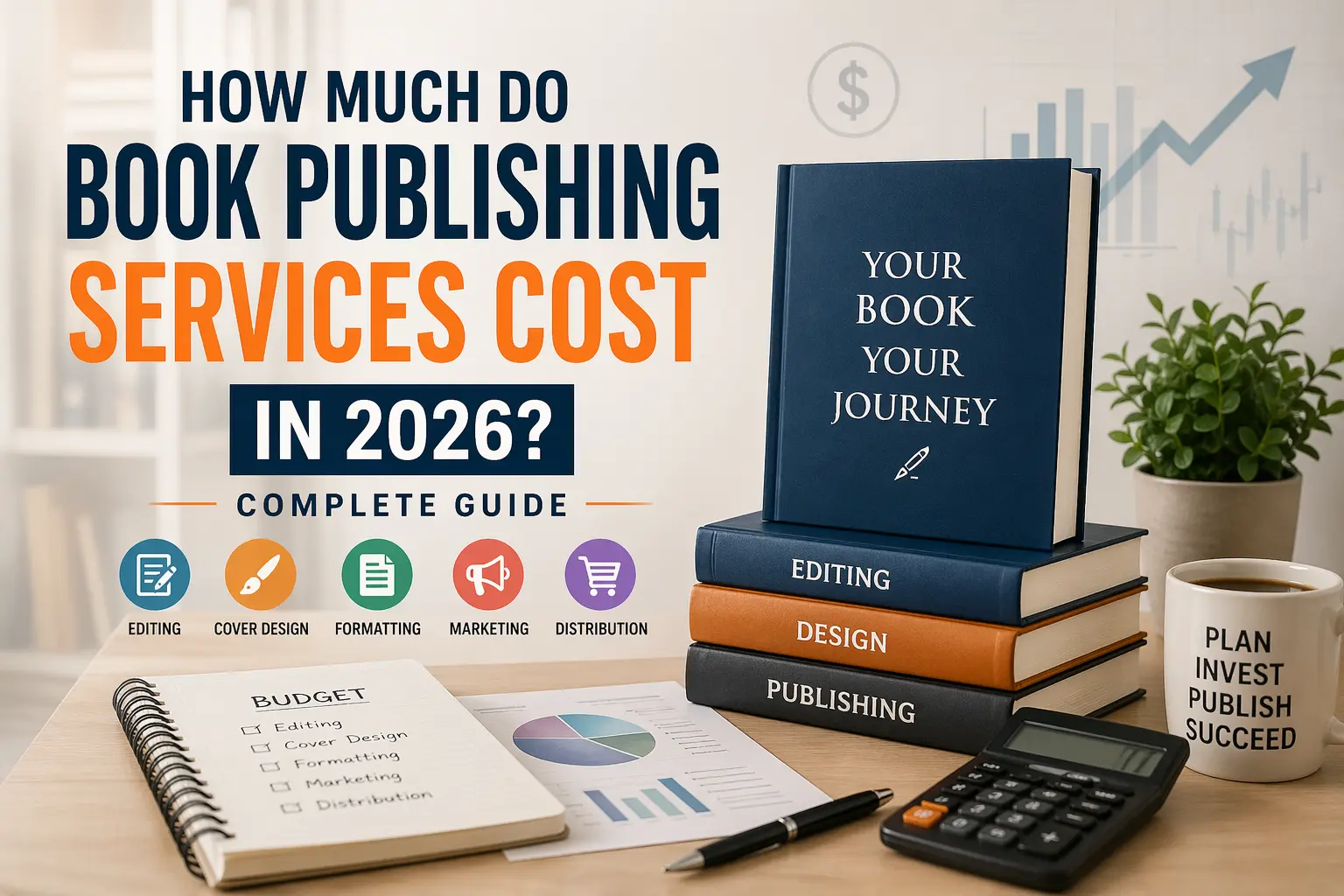
When people talk about book publishing services, they’re really talking about all of this put together:
- Editing (and not just one round, usually several)
- Cover design
- Interior formatting so it doesn’t look like a Word document in print
- ISBN registration and copyright filing
- Printing, whether on-demand or in bulk
- Getting your book distributed to actual retailers
- Marketing so people find out it exists
- eBook conversion
Some companies bundle all of this. Others charge per service. And your total cost will look completely different depending on which route you take: traditional publishing, hybrid, or going fully independent.
Let’s go through each one honestly.
Traditional Publishing: The “Free” Option That Isn’t Always Free
Most writers grow up dreaming about this path. You finish the book, an agent signs you, a big publisher picks it up, and six months later your name is on a spine at Barnes & Noble. And the money thing? Publishers cover all of it: editing, design, printing, distribution, even a cash advance.
So it costs you nothing, right?
Sort of. The production costs are zero upfront, yes. But traditional publishing takes things from you that money can’t buy back easily, mainly time and creative control. The average gap between signing a deal and having a book in stores is one to three years. And you’ll give up 85–90% of your print royalties and around 75% of eBook earnings to do it.
You might still spend a little along the way:
- Manuscript formatting before you submit: $0–$200
- A professional manuscript evaluation to know if it’s ready: $300–$800
- Query letter coaching if you want help with the pitch: $100–$500
None of that is required, but authors who invest in those things tend to query more confidently. The real cost of traditional publishing, and I mean this, is waiting years while someone else controls your book. Some authors are fine with that trade. Others aren’t.
Self-Publishing: What It Actually Costs to Do It Right
Self-publishing has completely changed in the last decade. Amazon KDP, IngramSpark, Draft2Digital, the tools exist for anyone to publish now. The problem is that “anyone can publish” got twisted somewhere into “it’s basically free.”
It is not free. Not if you want a book that looks and reads like it belongs on a shelf next to traditionally published titles.
Here’s a real breakdown of what quality book publishing services will cost you if you go independent in 2026:
Editing: Spend Here Before Anywhere Else
This is the hill I’ll die on. Every dollar you put into editing pays off more than any dollar you put anywhere else. A badly edited book gets torn apart in reviews, loses readers after page ten, and tanks your reputation as an author before it even gets started.
There are different kinds of editing, and they each do different things:
| Type of Editing | What It Does | Cost Range |
|---|---|---|
| Developmental Edit | Big-picture fixes: structure, pacing, plot holes | $1,500 – $5,000+ |
| Line Edit | Sentence-level flow and voice | $800 – $3,000 |
| Copy Edit | Grammar, continuity, consistency | $500 – $2,000 |
| Proofreading | Final read for typos and errors | $200 – $800 |
For a typical 60,000-word novel, you’re realistically looking at $1,000–$4,000 for editing, sometimes more. A literary memoir or complex nonfiction can run higher. Yes, it stings. But a poorly edited book at $0 editing cost is still a poorly edited book, and readers will let you know.
Cover Design: Don’t Lie to Yourself About This
“Don’t judge a book by its cover” is something people say. It is not something they do.
When someone is scrolling through hundreds of Amazon results, your cover has about two seconds to either stop them or lose them. A cover that looks amateur tells the reader the inside probably feels amateur too, even if that’s not true.
- Premade covers: $50–$200 — fine for a very tight budget, limited originality
- Basic freelance designer: $150–$500 — hit or miss depending on who you hire
- Mid-range professional: $500–$1,200 — where most indie authors should aim
- Premium studio: $1,200–$3,000+ — for authors building a serious series or brand
Spend what you can here. It’s one of the most visible parts of your investment.
Interior Formatting: The Thing Everyone Forgets Until It’s Too Late
I’ve seen authors spend months on a manuscript, thousands on editing, then upload a raw Word file to KDP and wonder why the interior looks wrong. Fonts off. Margins weird. Chapter headings all over the place.
Interior formatting is what makes your book feel professionally made when someone opens it.
- Basic formatting (eBook + print): $100–$300
- Professional typesetting: $300–$800
- Complex formatting (children’s books, heavy illustrations, charts): $800–$2,500
- eBook only: $50–$300
If you’re handy with Vellum or Atticus, you can do basic formatting yourself. But for print books especially, it’s worth having someone who knows what they’re doing.
ISBN and Copyright
This stuff trips people up. Here’s the simple version:
- Single ISBN through Bowker: $125 — you own it, you’re listed as publisher
- 10 ISBNs through Bowker: $295 — much better value if you’re serious
- Free ISBN through KDP or IngramSpark: technically works, but the platform becomes your publisher of record, which matters for distribution
- Copyright registration: $45–$65 online through the US Copyright Office
- Library of Congress Control Number: Free, and worth getting
You own copyright the moment you create the work. Registration just makes it easier to defend legally.
Printing
- Print-on-demand per copy: $3–$8 depending on page count and trim size
- Offset printing (buying 500–1,000+ copies upfront): $1.50–$4 per copy
- Author copies: Usually 40–60% off retail price
First book? Do print-on-demand. Seriously. I’ve talked to authors with 400 copies of their debut novel in a storage unit. Don’t be that person. Prove there’s demand before you invest in inventory.
Hybrid Publishing: The Middle Option Worth Knowing About
Hybrid publishing is an interesting model. You pay for production services, but you keep far more control and a much bigger slice of royalties than you would in a traditional deal. A good hybrid publisher brings professional quality: real editors, real designers, real distribution, but you’re funding it.
Expect something like this from legitimate book publishing services in the hybrid space:
| Package Level | Typical Cost |
|---|---|
| Basic | $2,500 – $5,000 |
| Standard | $5,000 – $10,000 |
| Premium | $10,000 – $25,000+ |
The royalty split is usually 50–70% in your favor, compared to 10–15% with traditional houses. That’s a meaningful difference if your book actually sells.
Watch out: The hybrid space is absolutely crawling with predatory “vanity” publishers who dress themselves up as hybrid publishers. They’ll charge you $8,000 and deliver a book that looks self-published in the worst way, with zero real distribution. Before you sign anything, read their reviews on every platform you can find, ask to speak with previous authors, and get a line-item breakdown of what you’re actually paying for.
Full-Service Publishing Packages: What You Get at Each Price Point
Rather than hiring five separate freelancers, many authors go with a single company that handles everything. Here’s what those book publishing services bundles typically include at different budgets:
BUDGET
$500 – $1,500
Gets you published. Don’t expect premium results.
- Basic proofreading
- Premade or template cover
- Standard formatting
- Upload to Amazon KDP
STANDARD
$1,500 – $4,000
Where indie publishing starts to look credible.
- Copy editing or line editing
- Custom cover design
- Print and eBook formatting
- Distribution to major retailers
PREMIUM
$4,000 – $10,000
Full professional quality, wide reach.
- Full editorial suite
- Premium custom cover
- Wide distribution (Amazon, B&N, Ingram)
- Press release, author bio, back cover copy
DELUXE
$10,000 – $30,000+
Best for brand-building authors.
-
- Everything in Premium
- Launch strategy and PR
- Audiobook production
- Social media support
- Bookstore placement help
Marketing: The Part Most Authors Underbudget By a Lot
Here’s the uncomfortable truth: publishing a good book is not enough. You have to get it in front of people. And people have to trust it enough to buy it. That requires marketing, and marketing costs money.
Typical costs to plan for:
- Book launch strategy consultation: $200–$1,000
- Amazon ads management: $300–$1,500 per month
- Goodreads advertising: $100–$500/month
- Blog tour: $150–$600
- Press release writing and distribution: $200–$800
- Social media content and management: $500–$2,500/month
- BookTok or influencer campaign: $300–$3,000+
- Kirkus Reviews or similar paid editorial review: $150–$450
- Audiobook production: $2,000–$10,000+
For a debut title, budget somewhere between $500 and $3,000 for marketing and treat it as a learning experiment. See what actually moves copies in your genre before scaling anything up.
The Full Cost Picture: All Routes Side by Side
| Publishing Route | Realistic Total Investment |
|---|---|
| Traditional Publishing | $0 upfront (you trade royalties and time) |
| Budget Self-Publishing | $500–$1,500 |
| Mid-Range Self-Publishing | $2,000–$6,000 |
| Premium Self-Publishing | $6,000–$15,000 |
| Hybrid Publishing | $3,000–$25,000+ |
| Vanity Publishing | $5,000–$50,000+ (usually not worth it) |
Why Does the Same Service Cost $300 from One Person and $3,000 from Another?
Good question. A few things drive that gap:
Length of the book. Nearly everything: editing, formatting, printing, scales with word count and pages. A 90,000-word thriller costs more to edit than a 40,000-word self-help book.
Genre demands. A children’s picture book with full-page illustrations is a completely different beast than a straight-text memoir. Illustrated books cost more across the board.
The person’s experience. An editor who has worked on ten bestsellers charges more than someone who edited three books for friends. That premium usually reflects something real.
Your timeline. Needed in four weeks instead of four months? Count on paying a 25–50% rush fee. If you have time flexibility, use it.
Formats you’re publishing in. Print, eBook, audiobook: each format has its own cost. Publishing all three opens more revenue channels but requires more investment upfront.
Distribution reach. Getting your book into Ingram’s catalog and available internationally costs more to set up. But if you’re serious about sales, it matters.
What I’d Actually Tell a Friend Before They Spent Anything
Don’t hire the first editor, designer, or publisher you find. Get multiple quotes. Look at actual work they’ve done for books in your genre. Check reviews not just on their website but on places like the Alliance of Independent Authors or Reedsy’s marketplace.
If someone guarantees your book will become a bestseller or promises a certain number of sales, run. That’s not a service, that’s a sales tactic.
Don’t order a print run until you’ve tested demand. Print-on-demand exists for a reason.
Editing is not optional if you care about your reputation. Cover design is not optional if you want people to click on your book.
And if you want a team that tells you the truth about what your project needs and what it’ll actually cost, The Books Central is a good place to start that conversation.
Final Thought
There’s no single right number for what book publishing services should cost. It depends on your book, your goals, and your budget. A short family memoir might be beautifully published for $900. A business book meant to build a personal brand and generate clients might easily justify $12,000.
What separates successful indie authors from ones who feel burned isn’t budget size. It’s knowing where to spend and having realistic expectations about what each dollar does.
Take your time. Ask questions. Don’t let urgency, real or manufactured, push you into a bad decision. You wrote the book. That part is already done. Everything after this is just making sure it gets the shot it deserves.