





12 Oct 2026
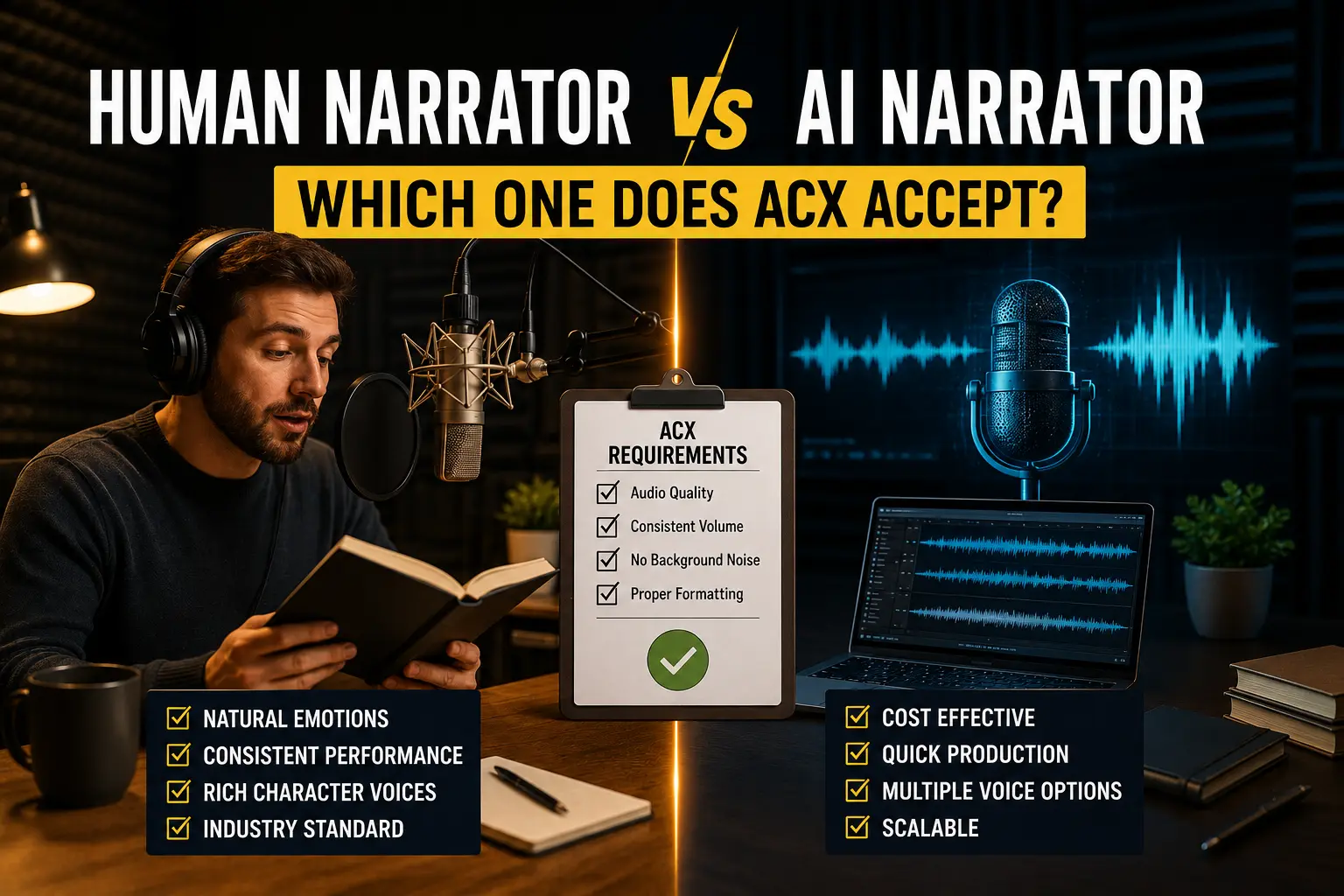
A few weeks back, an author I know messaged me in a bit of a panic. She’d spent her entire budget on a professional human narrator for her audiobook. Then she watched a friend generate an entire book using AI voice software in about two days flat. Naturally she wanted to know if she’d wasted her money. The AI narrator vs human narrator question came up almost immediately in that conversation. It’s honestly one of the most common things authors ask me these days, and the answer isn’t as simple as either side wants it to be.
So let’s actually dig into what ACX allows, what they don’t, and what makes more sense depending on your specific situation as an author. Along the way, I’ll share a few things I’ve picked up from watching other writers navigate this exact decision.
What ACX’s Current Policy Actually Says
ACX has gone back and forth on AI narration over the past couple of years, which honestly hasn’t made things easy for authors trying to plan their production budget in advance. At various points they’ve paused AI submissions entirely while figuring out their policy, then reopened things with specific requirements attached. If you researched this topic even a year ago, some of what you read is probably already outdated.
Right now, ACX does accept AI narrated audiobooks, but there are conditions. You typically need to disclose that AI narration was used, and the file still has to meet every single technical standard that human narrated audiobooks meet. There’s no special leniency just because a computer generated the voice. If anything, AI files sometimes get scrutinized a bit more closely because ACX knows the technology is still catching up on certain nuances that matter for long form listening.
Human narration, meanwhile, has never had these restrictions because it’s been the standard since ACX started. A professional narrator understands pacing instinctively, adjusts their performance based on the story’s emotional beats, and generally produces something that passes technical review more predictably. That said, human narration isn’t automatically flawless either. I’ve heard plenty of stories about ACX rejecting human narrated files too, usually over technical mixing issues rather than performance problems. A narrator can deliver a beautiful performance, yet room noise or inconsistent levels can still get the file bounced back.
Why This Debate Even Exists in the First Place
Here’s the honest truth behind why the AI narrator vs human narrator conversation has gotten so heated in author communities. Cost is the biggest factor by far. Hiring a professional narrator for a full length novel can run anywhere from several hundred to a few thousand dollars depending on the narrator’s experience and your book’s length. AI narration, by comparison, might cost you a monthly software subscription and a few hours of your time.
For authors publishing on a tight budget, especially those with multiple books already out and more coming, that cost difference is enormous. It’s not surprising so many are experimenting with AI tools. They’re hoping to produce audiobooks for titles that otherwise would never get an audio version, simply because the economics didn’t work. I’ve spoken with authors who have eight or nine backlist titles sitting without audio editions. Human narration for all of them would have cost more than the books have earned combined.
But there’s a quality conversation happening alongside the cost conversation, and that’s where things get genuinely complicated. Saving money doesn’t matter much if the finished product turns listeners away.
Where AI Narration Still Falls Short
I’ll be straightforward here since I’ve tested both approaches on my own projects. AI narration has improved dramatically over the past two years, to the point where casual listeners sometimes can’t tell the difference within short clips. But stretch that out across an entire eight or ten hour audiobook, and cracks start showing that a lot of authors don’t anticipate when they’re only listening to a two minute sample.
Emotional range is probably the biggest gap.
Emotional Range Gets Lost Over Long Sessions
A skilled human narrator naturally shifts their tone during a tense confrontation versus a tender reunion scene. They often do this without even consciously thinking about it. AI tools can approximate this if you’re carefully adjusting settings scene by scene. Leave it running on default, though, and you often get flatness that becomes noticeable over long listening sessions, even if individual lines sound fine in isolation.
Pronunciation Consistency Becomes a Real Problem
Unusual character names, invented fantasy terms, or specific regional phrases sometimes get mispronounced differently each time they appear. This happens if you’re not manually correcting things throughout the entire manuscript. A human narrator, once they learn how to say a name correctly, generally stays consistent for the rest of the recording sessions without needing constant supervision. I’ve listened to AI generated samples where the same character’s name was pronounced three different ways across a single chapter. It’s the kind of thing that pulls a listener right out of the story.
Multiple character voices present another challenge worth mentioning. A talented human narrator can give five or six characters genuinely distinct voices within one scene, shifting pitch and rhythm so listeners never lose track of who’s speaking. AI narration tools are getting better at this, but it still often requires generating separate voice tracks and manually stitching them together, which adds a layer of production work most authors don’t anticipate when they first start exploring AI narration as a shortcut.
Where Human Narration Also Has Real Limitations
It’s worth being fair here because human narration isn’t some flawless alternative either. I think people sometimes romanticize it a bit too much in these discussions, especially those who’ve never actually gone through the process themselves.
Scheduling is a genuine headache. Good narrators book up months in advance, especially the ones with strong reviews and audiobook experience. If you’re trying to launch your book alongside a specific marketing push or release date, waiting for narrator availability can throw your entire timeline off completely. I know an author who had to push her launch back nearly four months because her preferred narrator was booked solid. Finding someone else on short notice felt like settling for less.
Cost, obviously, remains the other major limitation, and for a lot of authors this alone rules human narration out for smaller or midlist titles that won’t sell enough copies to justify the upfront investment. There’s also the reality that not every narrator is a great fit for every book. Mismatched vocal tone or pacing style with your genre can hurt the listening experience just as much as a flat AI voice would, and finding the right narrator often takes trial and error through auditions, sometimes several rounds of them before you find someone who genuinely fits the tone of your story.
How to Decide Which Approach Fits Your Book
Given everything above, here’s how I’d actually think through the AI narrator vs human narrator decision if I were in your position right now.
If your book is emotionally complex, character driven, or leans heavily on dialogue with distinct voices for multiple characters, human narration is probably still the safer bet. These are exactly the areas where AI narration tends to struggle most. Readers of emotionally rich fiction notice flatness quickly. They sometimes leave reviews that specifically criticize the narration quality, even when they praise the writing itself.
If your book is more straightforward, maybe a nonfiction title, a business book, or something with a single steady narrative voice throughout, AI narration becomes a much more realistic option. These formats don’t demand the same emotional range. A well produced AI narrated file can genuinely hold up fine for this kind of content. This works especially well for instructional or informational books, where listeners care more about clarity than performance.
Budget matters here too, obviously. If audio is genuinely not in your budget otherwise, AI narration at least gets your book into audio format. That’s better than no audiobook at all, especially for backlist titles that wouldn’t justify a human narrator’s cost. An imperfect audiobook still reaches listeners who exclusively consume books through audio. That’s a growing segment, and authors who stick to text only formats miss out on it entirely.
Practical Tips If You Choose AI Narration
If you do decide AI narration makes sense for your project, a few things will noticeably improve your odds of getting past ACX review.
Master your audio properly before submission. Raw exports rarely hit ACX’s exact technical requirements, so running everything through dedicated mastering software matters just as much for AI files as it does for human recorded ones.
Listen through your entire manuscript, not just the opening chapters. Pronunciation errors and pacing issues tend to accumulate in the middle sections that most authors rush through during their review process, assuming if the first chapter sounds good, the rest will follow naturally.
Add proper room tone manually if your software generates pure digital silence between chapters, since reviewers tend to flag that unnatural silence during technical review.
Consider blending approaches too. Some authors use AI narration for straightforward sections and hire human talent for particularly emotional or dialogue heavy scenes. It takes more coordination, but it can genuinely offer the best of both worlds if your budget allows for even a partial human narration investment.
Wrapping It Up
The AI narrator vs human narrator debate isn’t going away anytime soon. Honestly, there’s no universally correct answer here. It depends on your book’s genre, your budget, and how much emotional nuance your story demands from its narration. ACX currently accepts both options. You just need to follow their disclosure rules and meet the same technical standards regardless of which route you choose. My advice, based on watching plenty of authors go through this process, is simple. Be honest with yourself about your book’s actual needs. Don’t pick a side out of pure cost savings or curiosity about the technology. Either choice can work well. It just needs to match what your story actually requires from the person, or the software, reading it aloud.