



12 Oct 2026
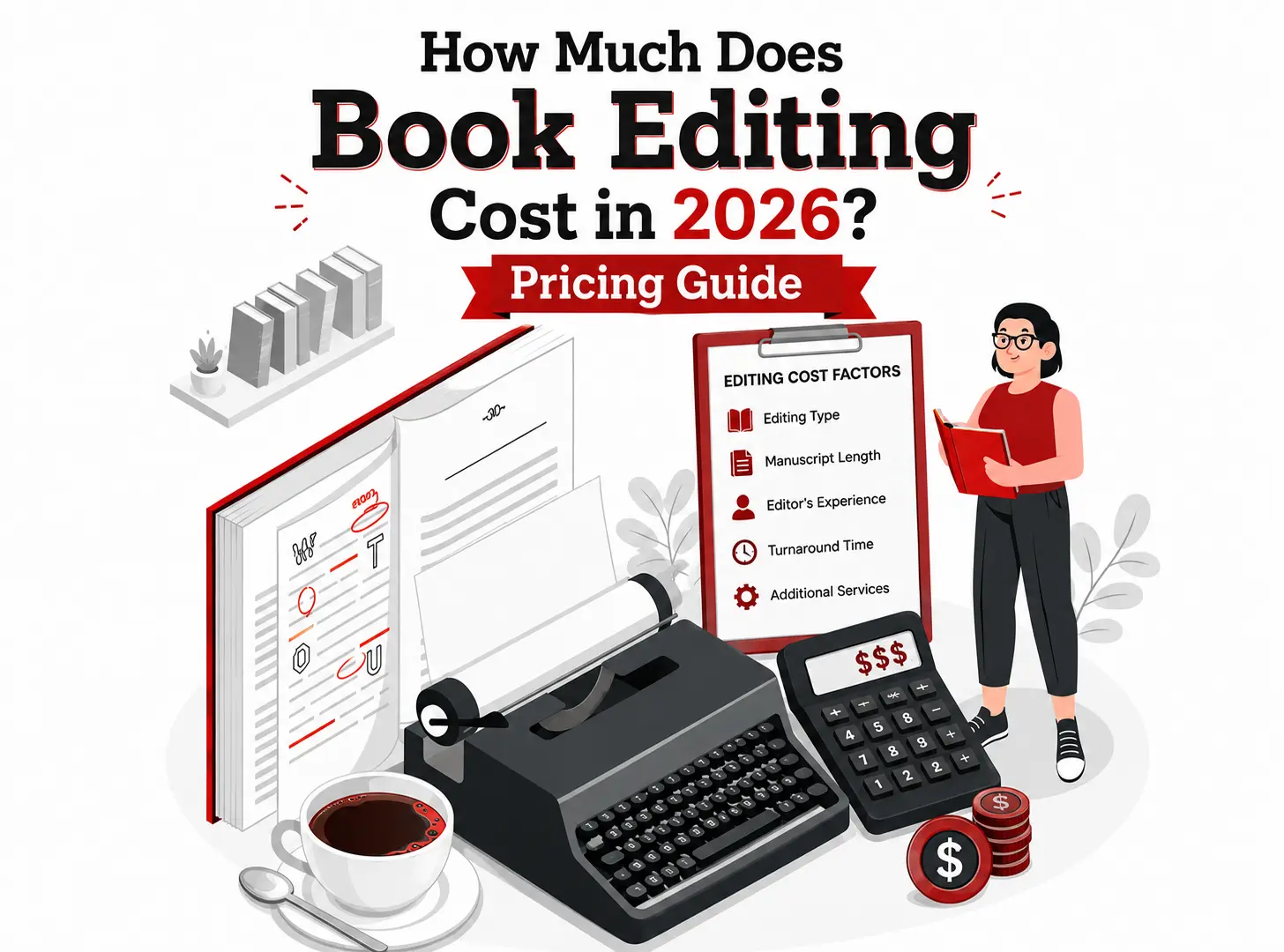
Somebody asked me this exact question last month. She’d just finished her first novel, 82,000 words, three years of Sunday mornings, and she wanted a number before she’d even tell me the genre. I get why. You wouldn’t call a contractor and just say “fix my house,” and a manuscript is a bigger deal to most people than their kitchen.
Here’s the thing though. There isn’t one number. A tight 60,000-word thriller and a messy, half-revised 130,000-word memoir are not the same job. Not close. Any editor who quotes you a price without reading a single page is guessing, and you should probably walk away from that quote. A book editing service built around developmental work prices completely differently than one that mostly proofreads. And now there’s a new wrinkle nobody had to think about five years ago: whether to run your draft through a generative AI tool before, instead of, or alongside hiring an actual person.
So let’s get into it. What actually moves the price, what each editing stage involves, and where something like Google Gemini fits if your budget is tighter than you’d like.
Quick version, if you’re skimming: book editing cost comes down to manuscript length, editing type, and how experienced the editor is. Priced per word, per page, hourly, or as a flat fee, depending on who you ask. Developmental editing costs more than copy editing or proofreading, since it’s a much deeper read of the whole story. Proofreading is the cheapest, because it only deals with what’s sitting on the surface.
How Much Does Book Editing Cost in 2026?
There’s no industry standard here. None. If a website gives you one flat number without asking a single thing about your manuscript, that’s not helpful, honestly, it’s kind of a red flag. What actually exists is a handful of pricing structures editors build their rates around, and once you get familiar with them the whole process stops feeling like a black box.
Most editors work one of four ways. Per word, your total count times a set rate. Per page, usually based on a “standard” page somewhere around 250 words. Hourly, which comes up a lot when a manuscript is rough or heavily revised and nobody can guess the time upfront. Or a flat project rate, one number, quoted after the editor’s actually looked at your pages.
Which one an editor picks usually depends on the work itself. Structural editing is hard to price by the word (too unpredictable), so a lot of developmental editors just quote flat. Copy editing and proofreading move at a steadier pace, which is part of why they’re more often billed per word or per page.
| Editing Type | Typical Pricing Model | What It Includes |
| Developmental Editing | Per word or flat project rate | Structure, plot, pacing, big-picture issues |
| Line Editing | Per word or per page | Style, clarity, flow, sentence-level improvements |
| Copy Editing | Per word or per page | Grammar, consistency, wording, accuracy |
| Proofreading | Per word or per page | Final spelling, punctuation, and formatting checks |
Rates swing a lot. Editor experience, your genre, even where in the world they live. So take any “average price” you find online with a grain of salt, honestly more than a grain. What actually works is asking for a sample edit and a real quote tied to your actual pages. Not some number off a chart.
What Factors Affect Book Editing Cost?
A few things stack up to make your final price. Learn them and budgeting stops being a guessing game, plus you’ll spot it faster when a quote just doesn’t add up.
Manuscript Word Count
Usually the biggest single factor, full stop. A 30,000-word novella and a 100,000-word novel don’t take the same amount of anyone’s time, even with equally clean prose. Most pricing scales with length one way or another, so a longer book almost always costs more to edit. That’s why the first question most editors ask isn’t your genre. It’s your word count.
Type of Editing
People lump “editing” into one vague thing, but it’s really several separate jobs wearing the same name. Developmental editing is the big picture stuff, does the plot hold together, does the middle drag, does the argument (for nonfiction) land. Line editing is about how sentences read and flow. Copy editing checks grammar and consistency. Proofreading is the very last look before the book goes out into the world.
Different skills, different time investment, different price tags. A good professional book editing service tells you upfront which stage, or combination, your manuscript actually needs. Not the whole menu, just what fits.
Condition of the Manuscript
A draft that’s already been through a few self-edits and some honest beta reader notes needs less from a pro than a raw first draft. If there are real plot holes, a character whose name quietly changes halfway through (this happens more than you’d think), or grammar that needs attention on nearly every page, an editor’s going to spend more hours in there. Shows up in the price. Every time.
Genre
What you’re writing shapes what your editor’s actually looking for. Romance and mystery both carry pacing conventions a sharp editor checks your manuscript against. Nonfiction, memoir, business books, self-help, needs a different kind of eye, more focused on clarity and the strength of your argument than on plot. Children’s books are almost their own discipline entirely, age-appropriate language and pacing that a general fiction editor might not know well. Get someone who actually knows your genre and you’ll feel it in the notes.
Editor Experience
Fifteen years in the genre plus a strong portfolio, that editor’s going to cost more than someone just starting out. Doesn’t automatically make them the right fit for your book. But experience is a real part of what you’re paying for, especially in genre fiction or technical nonfiction, where knowing the subject actually matters.
Turnaround Time
Need it back in two weeks instead of two months? That costs extra. Rushing usually means the editor’s rearranging their whole week, or working nights, to hit your deadline. Most book editing services build a rush fee in for exactly that reason.
How Much Does Each Type of Book Editing Cost?
Developmental Editing Cost
The deepest stage, usually the priciest. Dealing with the bones of the book here: plot, structure, character arcs, pacing, or the overall argument if it’s nonfiction. A developmental editor might not touch one word of your actual prose. They’re telling you what to cut, expand, rebuild from scratch. That kind of analytical read, often across a couple rounds of notes back and forth, is why professional book editing at this level costs more than anything that comes after.
Line Editing Cost
Somewhere between developmental work and copy editing sits line editing. An editor goes sentence by sentence here, voice, rhythm, word choice, the actual texture of your writing. Slower than copy editing, more detail-heavy, and pricing at book editing services that treat this as its own stage usually reflects that.
Copy Editing Cost
More mechanical. Grammar, punctuation, consistency (did your protagonist’s eyes go from brown to blue by chapter nineteen? it happens), basic accuracy. Not restructuring anything, just tightening what’s there. That narrower job is faster, and cheaper, than developmental or line work. Probably what most people picture when they hear “editing” in the first place, honestly.
Proofreading Cost
The last check, right before print or upload. A proofreader’s not touching structure or style anymore, just typos, stray spacing, punctuation, formatting glitches. Since it’s last in line and covers the least ground, proofreading cost sits at the bottom. It’s also the step people cut first when money’s tight, which is a shame. Often the whole difference between a book that reads finished and one that reads almost finished.
Book Editing Cost Per Word vs Per Page vs Hourly
Every method has trade-offs. Worth knowing before you agree to anything.
| Pricing Method | Advantages | Possible Drawbacks |
| Per Word | Easy to compare across editors | Total cost scales directly with manuscript length |
| Per Page | Simple for print-formatted manuscripts | Page length definitions can vary by editor |
| Hourly | Flexible for complex or heavily revised work | Final cost can be harder to predict in advance |
| Flat Project Fee | Predictable, single number to budget around | Requires the editor to accurately assess scope upfront |
Per-word pricing’s usually the easiest way to compare quotes, since you can do the math yourself once you know your word count. A flat fee gives more budget certainty, but only once the editor’s actually read enough to size the job up correctly. That’s the whole reason a sample edit’s worth asking for before you sign anything. Get a feel for these differences in book editing pricing, and comparing book editing rates stops feeling like guesswork.
How Much Does It Cost to Edit a 50,000-Word Book?
Fifty thousand words is on the shorter side for a novel, a lot of young adult and shorter commercial fiction lands right there. Since per-word and per-page pricing scales with length, a book this size generally costs less to edit than something twice as long. Still, the type of editing matters more than the raw number.
Rough sense of scale: 30,000 words is closer to novella territory, usually the fastest and cheapest to edit. 50,000 is common for shorter novels, manageable for most editing types. 75,000 shows up a lot in commercial fiction and plenty of nonfiction. 100,000 is common in epic fantasy and dense nonfiction, typically the most time-consuming.
Worth repeating, because it trips people up constantly: word count is one input, not the whole equation. A clean, well-revised 50,000-word draft can cost less than a rougher 40,000-word one that needs real developmental work. Skip the generic averages. Get a quote based on your actual pages.
How Much Does It Cost to Edit a 100,000-Word Book?
Roughly double the length above, and yeah, it affects the price, though not always in a straight line. Longer manuscripts mean more editing time, simply more to read and mark up. More complexity too, longer books (especially fantasy or literary fiction) tend to carry more subplots and continuity details to track. Turnaround stretches out, a full developmental edit on 100,000 words takes noticeably longer than a proofread of the same length, since the work goes so much deeper. And the total climbs, because pricing scales with length even when the per-word rate itself doesn’t budge.
Editors on longer projects often split things into stages, developmental first, then line or copy editing, then proofreading, instead of one giant pass. Lets authors budget in chunks rather than swallowing the whole cost at once.
AI Book Editing vs Professional Book Editing
I’ll be honest, this is the section people ask me about most right now. Generative AI’s genuinely changed what authors can do before a manuscript ever reaches a professional. Worth being straight about where it helps and where it just doesn’t.
AI editing tools are actually decent at catching grammar and spelling mistakes, flagging clunky or repetitive sentences, nudging basic readability, throwing out brainstorming ideas or alternate phrasing, spotting the odd inconsistency (a name or detail that quietly shifts partway through). If your budget’s tight, running a draft through an AI tool first can genuinely clean up more than you’d expect before it goes to a professional. AI proofreading especially tends to catch stuff people don’t see coming.
What it still doesn’t do well: context, actually understanding what a scene’s trying to accomplish inside the bigger story. Narrative judgment, knowing when to cut a subplot and when a slow chapter’s doing exactly what it should. Keeping your voice intact instead of quietly smoothing it into something generic. Structural and character feedback grounded in real genre conventions. The kind of judgment calls that require weighing trade-offs instead of applying a rule.
Neither side wins outright, and it’s really not either-or for most authors. Plenty of writers use AI early to knock out the obvious stuff, then bring in a professional book editing service for the deeper work AI still struggles with. Which combination makes sense depends on your budget, how rough the draft is, and how much you’re willing to do yourself.
Can Google Gemini Edit a Book?
Google Gemini, like other generative AI tools, can genuinely act as a useful assistant during editing. Worth being clear-eyed about what that means though. Gemini reads pasted-in text and offers suggestions. It’s not a licensed editor, and how useful it is depends a lot on how you use it.
Authors are using Gemini for spotting repetitive wording across a chapter, suggesting alternate phrasing for a sentence that isn’t landing, checking general readability, brainstorming a way out of a stuck scene, summarizing chapters to sanity-check pacing, flagging possible continuity slips. Genuinely useful stuff. A lot of writers experimenting with Gemini for authors find it works well as a companion during self-revision. Not a replacement for one.
The limits are real though. AI tools get things wrong, sometimes confidently wrong. Gemini can misread context, flag a deliberate stylistic choice as an error, or miss an actual problem entirely. Its rewrites can quietly flatten your voice if you accept them without a second look. And since the output still needs a human to review it, it’s not a stand-in for editorial judgment. If your manuscript deals with something personal or sensitive, think twice before pasting it into any AI tool at all.
Is Google Gemini a Replacement for a Professional Book Editor?
Short answer: not for the parts that actually make a book feel finished. Gemini’s genuinely useful for certain mechanical, exploratory tasks. It’s not a substitute for the judgment a professional editor brings to structure, voice, genre.
| Task | Generative AI / Gemini | Professional Editor |
| Grammar suggestions | Useful | Strong |
| Basic readability | Useful | Strong |
| Structural judgment | Limited | Strong |
| Author voice | Can risk changing it | Strong |
| Story development | Limited | Strong |
| Genre expertise | Variable | Strong |
| Contextual judgment | Variable | Strong |
| Final editorial decision | No | Yes |
Honestly, the Google Gemini vs professional editor question isn’t about crowning a winner. It’s about knowing where each one’s actually strong. Most authors lean on Gemini during self-revision, then bring a professional in for the deeper work, which is roughly where most honest AI vs human book editing comparisons land anyway.
How to Choose a Book Editing Service
Once you’ve decided to bring in professional help, picking the right book editing service matters just as much as the decision itself. Check the editor’s experience, how long they’ve done this and in what genres. Check whether they actually work on books like yours regularly, or if this is a stretch. Ask what editing type they’re offering, developmental, line, copy, proofreading, and whether they’re upfront about the difference. Ask for a sample edit, most editors worth hiring will do a few pages before you sign anything. Look at testimonials and portfolio, specific and checkable, not vague praise. Pay attention to how they communicate, clear and respectful beats vague or harsh every time. Ask about revision policy, are follow-up questions or a second pass actually included. Check turnaround time against your real publishing schedule. And look for pricing transparency, an itemized quote, not a number pulled out of nowhere.
A book editing service worth your money walks you through all of this before asking for a deposit, not after.
Questions to Ask Before Hiring a Book Editor
Before signing on with any manuscript editing service, it’s worth asking:
- What type of editing does my manuscript actually need?
- Do you specialize in my genre?
- Do you charge per word, per page, or per project?
- Can I get a sample edit before committing?
- What exactly is included in the quoted price?
- Realistically, how long will this take?
- Are revisions or follow-up questions part of the deal?
- Will you preserve my voice, not rewrite it into yours?
- Do you offer proofreading as a separate step afterward?
- Can you help me get the manuscript ready for publishing once editing’s done?
A good editor answers all of this without flinching. Vague or defensive answers, that’s your cue to keep looking.
Is Professional Book Editing Worth the Cost?
For most authors, yes, as long as you’re realistic about what editing can and can’t do. It genuinely improves readability, consistency, overall quality. Catches the stuff you’re too close to your own manuscript to see anymore. Often it’s the whole difference between a book that reads polished and one that reads like a solid first draft.
What it won’t do is promise an outcome. No editor guarantees bestseller status, a specific Amazon ranking, or a set number of sales. What you’re actually buying is a stronger, more publish-ready manuscript. That’s real, and it’s controllable, even if it’s not a guarantee of commercial success.
Not sure what type ofediting your manuscript actually needs? The Books Central can help you figure out the right level of professional editing before you publish, whether that’s developmental editing, a final proofread, or full-service support through book publishing services, book formatting, book cover design, and Amazon KDP publishing.