



03 May 2026
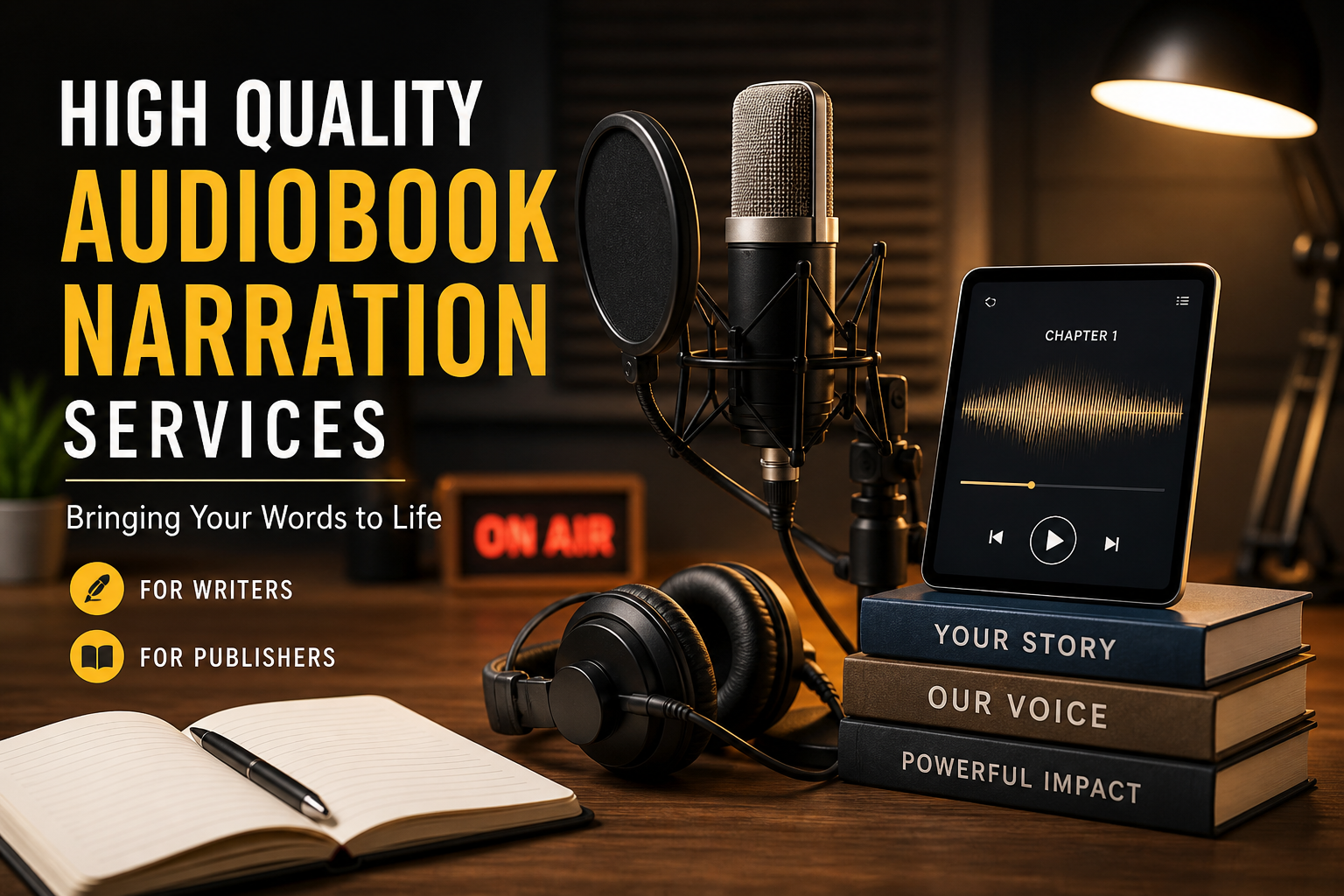
My friend finished her novel after three years of working on it. It was a good book, genuinely good, the kind where you read a chapter and forget you were supposed to stop an hour ago. She got it published in ebook and print, and it did okay. Then someone convinced her to release an audiobook. While looking into audiobook narration services, she found a narrator on a budget platform, paid very little, approved the samples without really listening carefully, and uploaded the finished files.
Six months later, she had forty three reviews on the ebook version and just four on the audio. Three of those four mentioned the narrator felt disconnected from the material. She lost those listeners before they ever gave the story a fair chance.
That experience is what made me start paying attention to how audiobook narration services actually work, what separates the ones worth using from the ones that waste your time and money, and why the difference matters far more than most authors expect going in.
The audiobook market is not what it was five years ago. It is bigger, more competitive, and the listeners in it are more experienced. They have heard a lot of audiobooks. They know within ten minutes whether a production feels right or whether something is slightly off, even if they cannot explain exactly what that something is. That instinct they have developed as listeners is the standard your production is being measured against whether you know it or not.
Audio is not a bonus format anymore. It is a genuine revenue stream that some authors find outperforms their ebook sales entirely, particularly in genres like thriller, romance, fantasy, and self-help where listeners are deeply engaged and remarkably loyal to authors they discover through listening.
The Part Most Authors Get Wrong From the Start
When writers start looking into audio production they tend to fixate on cost. How much does a narrator charge? Can I find someone cheaper? Is there a way to do this without spending too much? These are not unreasonable questions but they are the wrong starting point, and starting there almost always leads to decisions that look sensible on a spreadsheet and feel disappointing in practice.
The right starting point is fit. Does this narrator’s voice actually work for this specific book? Not in general, not based on their demo reel of their best material, but for your book, your genre, your reader’s expectations. A narrator who does beautiful work on literary fiction might be completely wrong for a fast-paced thriller. Someone who shines in self-help might make your business memoir feel strangely detached. These are not small differences. They are the difference between a listener finishing your book and recommending it and a listener abandoning it somewhere in chapter three because something feels off and they cannot quite name what.
Worth Remembering
I have listened to audiobooks where the narrator was technically flawless and I still did not finish them. Perfect enunciation, clean recording, zero production errors, and somehow completely wrong for the material. That is a casting problem and no amount of technical quality fixes a casting problem.
I have listened to audiobooks where the narrator was technically flawless and I still did not finish them. Perfect enunciation, clean recording, zero production errors, and somehow completely wrong for the material. That is a casting problem and no amount of technical quality fixes a casting problem.
What a Full Production Actually Involves
People hear audiobook narration services and picture one person with a microphone reading your book out loud. The reality of a proper production is more involved than that and understanding what goes into it changes how you evaluate what you are being offered.
Recording happens in an acoustically treated space with professional equipment. This matters more than most authors realise because the room a narrator records in shows up in the audio even on ordinary earphones. A slightly reflective room, background hum from an HVAC system, inconsistent room tone between sessions recorded on different days, listeners feel all of this even when they cannot identify it. It contributes to a vague sense of something being slightly off that colours their experience of the entire book.
After recording comes editing. Not just removing stumbles and retakes but going through the audio carefully to catch mouth sounds, uneven breath patterns, timing issues, places where the pacing drags in ways that worked on the page but feel slow in audio. This is painstaking work that takes considerably longer than the recording itself and is frequently underestimated by authors who have never been through a production before.
🎙️
Professional Recording
Acoustically treated studios with proper equipment. The room quality shows up in the final audio even on basic earphones.
✂️
Editing and Mastering
Removes retakes, breath issues, and timing problems. Mastering meets the exact technical specs required by ACX and other platforms.
🎯
Casting and Direction
Matching the right voice to the right book. Genre fit, tonal range, and character differentiation all require careful evaluation.
Then there is mastering, which gets the finished audio to the technical specifications that major distribution platforms actually require. ACX has specific requirements. Findaway Voices has its own. Getting these wrong means your files get rejected and you go back through the process, which costs time and sometimes additional money depending on who you are working with. A genuinely full-service production handles all of this as one integrated process rather than leaving you to coordinate pieces separately.
Why Listening to Samples Is Not Optional
Every narrator has a demo. Most demos are carefully chosen to show their range and their strongest material. A demo tells you something useful but it does not tell you enough.
What you actually need to hear is how that narrator handles material similar to yours for several minutes at a stretch. Not a polished ninety second showcase clip but a real extended passage that gives you a sense of their natural pacing, how they differentiate between characters if your book has them, whether their instinct for where to pause and where to push matches the rhythm of your prose.
“
Most professional narrators will do a short custom audition with a passage from your actual manuscript if you ask. That tells you something no demo ever can, which is whether this specific voice fits this specific book.
Skipping this step and relying on demos alone is one of the most common reasons authors end up unhappy with productions they paid real money for. Some narrators charge a small fee for a custom audition. That fee is worth paying every single time because the cost of getting casting wrong is far higher than any audition fee.
The Self-Narration Question
Some authors want to narrate their own books and occasionally this is genuinely the right call. If you are a known speaker, if your personal voice and presence are part of your brand, if listeners are coming to your nonfiction specifically because of who you are, there is a real argument for putting your own voice on it.
For everyone else, and I say this without any intention to be discouraging, the gap between writing well and narrating well is larger than most people expect until they are sitting in front of a microphone trying to read their own prose for the fourth hour in a row and their voice is doing things they did not know it could do.
Recording one finished hour of audiobook typically takes somewhere between three and five hours of actual recording time, before any editing. A book of ninety thousand words might produce ten to twelve hours of finished audio. Add editing and mastering on top of that. Authors who go in thinking self-narration will save them time usually discover fairly quickly that it saves them money and costs them something considerably more valuable.
The Time Reality of Self-Narration
A ninety thousand word book produces roughly ten to twelve hours of finished audio. At three to five recording hours per finished hour, that is potentially sixty hours of recording before a single minute of editing begins. Most authors do not factor this in until they are already committed.
A ninety thousand word book produces roughly ten to twelve hours of finished audio. At three to five recording hours per finished hour, that is potentially sixty hours of recording before a single minute of editing begins. Most authors do not factor this in until they are already committed.
What the Right Service Does Differently
There are a lot of people and companies offering audiobook production now and the quality range is genuinely wide. A few things mark out the ones worth working with.
1
They ask questions about your book before recommending anyone
What genre is it? What is the tone? Who is the intended listener? Is there significant dialogue or is it primarily one voice? A provider who skips straight to pricing without understanding your book is treating all books as interchangeable. They are not.
2
They are transparent about their revision process
What happens if you get through a third of the finished audio and something feels consistently off? How many rounds of correction are included? What is the quality standard they are producing to? Providers who have genuine confidence in their work answer these questions without hesitation.
3
They do not disappear after delivering your files
Distribution decisions, the choice between exclusive and wide distribution, understanding the royalty structures of different platforms, these things have real financial implications that persist for years. A service that helps you think through those decisions is providing genuine long-term value.
4
They can point you to finished work in your genre
References and actual listening samples from comparable titles matter far more than general testimonials. If a provider has done strong work in your genre they will be able to point you to titles you can evaluate yourself before you commit anything.
The Cost Reality
Professional audiobook narration services are priced per finished hour in most cases and the rates vary with experience and track record. A narrator with a strong catalogue in your specific genre costs more than someone newer to the market, and in most cases that premium is justified by the fit and the quality of the final product.
What authors often underestimate is the total cost of a full production once editing, mastering, and quality control are included alongside narration. Getting a clear breakdown of what is included at what price, before you commit, is basic due diligence that is worth doing carefully.
The expensive mistake is not paying more for quality. The expensive mistake is paying for a production that misses on casting or quality control and then having to decide whether to live with it or start over. Starting over costs more than getting it right the first time by a significant margin.
On Revenue Sharing Arrangements
Some narrators offer to work for a share of royalties instead of an upfront fee. This can make professional narration accessible when budget is tight, but go in with clear eyes about how long the arrangement lasts and what happens to rights in different scenarios before you agree to anything.
Some narrators offer to work for a share of royalties instead of an upfront fee. This can make professional narration accessible when budget is tight, but go in with clear eyes about how long the arrangement lasts and what happens to rights in different scenarios before you agree to anything.
Reaching Listeners You Cannot Reach Any Other Way
Here is the thing about audio that does not get said enough. There are people who do not read anymore, or who never read much to begin with, who listen to hours of audiobooks every week. They are not your ebook audience or your print readers. Instead, they are a completely separate group of people who genuinely love stories and ideas but prefer to experience them through listening. Reaching them requires a production that is strong enough to hold their attention from the very beginning.
A reader who discovers an author through audio often goes back and listens to every title in their catalogue. That loyalty compounds in a way that does not happen as consistently in other formats.
For publishers the case is even clearer. Audio rights are negotiated separately, licensed separately, and monetised separately. A strong audio production protects and maximises the value of an asset that will generate returns for years. Cutting corners on production to save money upfront is rarely the calculation it appears to be when you look at the full timeline.