



07 Sep 2026
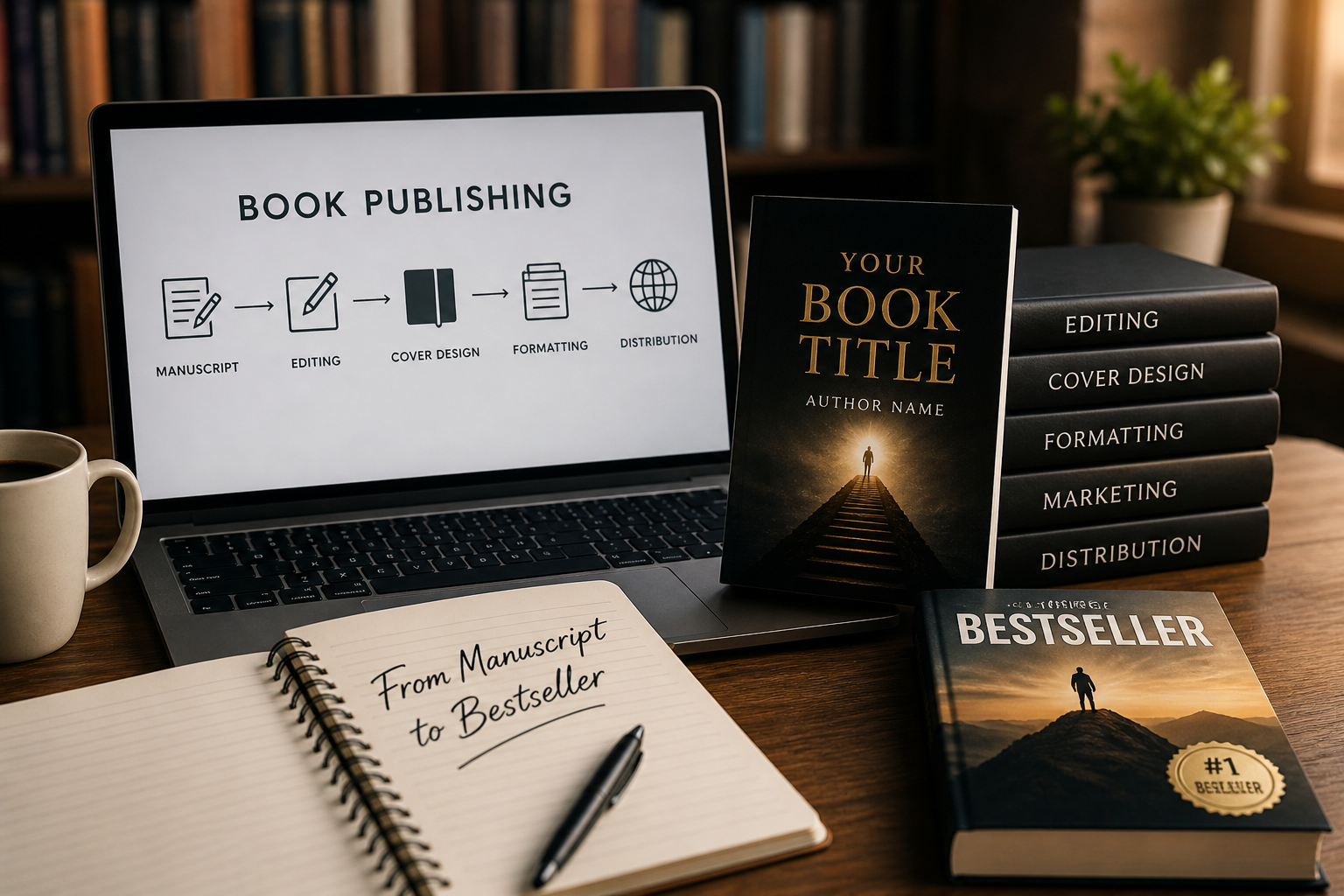
Nobody warns you about the silence after you finish writing a book. You close the laptop, maybe make yourself a cup of tea, and then it hits you. Now what? You have this thing you worked on for months, sometimes years, and suddenly the next step feels completely unclear. I have seen this happen to writers who are genuinely talented, people who had something real to say and said it well. And a surprising number of them never moved past that moment because they did not know where to turn. The ones who figured it out almost always say the same thing looking back. They found the right book publishing services at the right time, and that changed everything.
That might sound like an exaggeration but stay with me here.
Publishing a book is not one skill. It is about fifteen different skills bundled together and handed to a person who spent all their energy becoming good at writing. Editing, cover design, formatting, distribution, metadata, marketing strategy, platform algorithms, retailer relationships. None of these things are taught in any writing course. None of them come naturally just because you are a good writer. And all of them matter enormously to whether your book finds readers or quietly disappears.
The Honest Truth About What Goes Wrong
Most books that fail do not fail because the writing was bad. That is the part that surprises people when they first hear it. They fail because the production was rushed, or the cover looked homemade, or the editing was not thorough enough, or the book was listed in the wrong category on Amazon with keywords that nobody actually searches for. These are not creative failures. They are logistical ones, and they are completely avoidable with the right support.
I remember talking to an author once who had written a genuinely compelling memoir. She had real stories, a clear voice, and something worth reading. But she had used a budget cover service, skipped developmental editing to save money, and had no real plan for how to get the book in front of readers. A year after publishing, she had sold fewer than a hundred copies, mostly to people she already knew. The writing was not the problem. Everything around the writing was.
Worth Remembering
That gap between what the writing deserves and what the book actually achieves is exactly what good professional support is supposed to close. The manuscript is only the beginning of the journey.
That gap between what the writing deserves and what the book actually achieves is exactly what good professional support is supposed to close. The manuscript is only the beginning of the journey.
Editing Is the Thing Most Authors Underestimate
Ask any author who has worked with a skilled developmental editor and they will tell you it was uncomfortable and invaluable in equal measure. Uncomfortable because hearing that your structure needs rethinking or that your third act loses momentum is never easy, especially after you have spent a year on something. Invaluable because those are the exact things a reader would feel, even if they could not articulate why the book was not working for them.
Developmental editing is not about fixing grammar. It is about whether your book actually does what you intended it to do. Does your argument build toward something convincing? Does your story earn its ending? Are there chapters that slow everything down in ways that could be restructured without losing anything important? A skilled developmental editor has read enough books and worked with enough writers to spot these things fast, and more importantly, to help you fix them in a way that keeps your voice intact.
Then there is copy editing, which is an entirely different discipline. This is the person who catches that you used the word “suddenly” forty three times throughout your manuscript. The one who notices that your character’s eyes changed color between chapter two and chapter fourteen. The one who smooths out the sentences that are technically correct but slightly clunky in ways that accumulate over hundreds of pages and quietly exhaust a reader without them realizing why.
“
Writers cannot do this for themselves. Not because they are not smart enough but because the brain simply cannot read its own familiar text with fresh eyes. You know what you meant to say, so your brain fills in the gaps and reads what it expects rather than what is actually on the page.
Covers Do More Work Than You Think
There is a version of this conversation where someone says readers should not judge books by their covers and technically that is a lovely sentiment. Practically speaking it has nothing to do with how people actually behave when they are browsing for something to read.
A cover has roughly two seconds. That is genuinely about how long someone spends on a thumbnail before deciding to click or scroll. In those two seconds the cover needs to tell the reader what kind of book this is, make them feel something, and look professional enough that they do not immediately assume the content will disappoint them.
🎯
Genre Signaling
Every genre has a visual language readers recognize instantly. Getting it right removes friction before they even read the title.
📱
Thumbnail Test
Most readers find books on phones. Your cover must work at tiny sizes, not just in full resolution print.
✅
Credibility Signal
A professional cover tells readers before they open a single page that the content inside is worth their time.
Every genre has a visual language that readers have absorbed over years of browsing. Thriller readers, romance readers, self-help readers, literary fiction readers, they all have subconscious expectations about what a book in their preferred category looks like. A cover that violates those expectations, even subtly, creates friction. And friction at the browsing stage means lost sales before the reader ever gets to your first page.
Getting Your Book Where Readers Are Actually Shopping
Writing a great book and having it sit in the wrong place is one of the more frustrating things that can happen to an author. And it happens more than you would think. Getting onto the major retail platforms properly involves more than uploading a file. It involves the right metadata, accurate categories, searchable keywords, proper ISBN registration, and in many cases relationships with distributors that individual authors simply do not have access to.
Beyond digital platforms, getting physical copies into bookstores and libraries is a whole separate conversation involving specific distributors, understanding how returnable stock arrangements work, and knowing which accounts are worth pursuing for your particular title. Book publishing services that have been operating for any meaningful length of time have already navigated all of this. They have the relationships, the systems, and the knowledge of what works for different types of books. An author figuring this out alone is essentially reinventing a wheel that already exists.
Marketing, and Why Most Authors Dread It
Here is something writers tend to feel guilty about admitting. They do not want to market their books. They want to write books. Marketing feels like a different job, one they did not sign up for and do not particularly enjoy. And honestly, that reluctance makes complete sense because marketing is a different job. It requires different thinking, different skills, and a different relationship with your own work than writing does.
But the book market is genuinely crowded. Thousands of new titles every week across every category you can imagine. A book without any real visibility strategy is not going to get found through good intentions and hope. The platforms have algorithms. Those algorithms respond to certain signals in the first days and weeks after a book launches. Understanding those signals, setting up a launch properly, writing a book description that actually converts browsers into buyers, these things require knowledge that most authors do not have and should not be expected to develop from scratch on top of everything else.
The Launch Window Matters More Than Most Authors Realize
Retail algorithms pay close attention to the first two to four weeks after a book goes live. Sales velocity, reviews, and click-through rates in that window determine whether your book gets organic visibility going forward or disappears into the catalogue.
Retail algorithms pay close attention to the first two to four weeks after a book goes live. Sales velocity, reviews, and click-through rates in that window determine whether your book gets organic visibility going forward or disappears into the catalogue.
Choosing the Right Path for Your Specific Situation
Traditional publishing, hybrid publishing, fully independent self-publishing. These are all legitimate paths and each of them suits different authors in different circumstances. What matters is being honest with yourself about what you actually want, what timeline makes sense for you, and what level of involvement you are prepared to take on.
1
Traditional Publishing
Offers credibility and the publisher absorbs production costs. The tradeoffs are significant creative limitations, very low royalty percentages, and a timeline that can stretch to several years with no guarantee of success at any stage.
2
Hybrid Publishing
Combines professional production quality with more author control and substantially better royalty terms. The author invests upfront, owns their rights, makes their own decisions, and earns more per sale.
3
Independent Self-Publishing
Completely viable for authors who have the bandwidth to coordinate and manage the process themselves. Some people thrive in that environment. Others find it genuinely overwhelming on top of the actual writing.
The best book publishing services are honest about which path suits which author. They are not trying to sell you a package. They are trying to help you make a good decision, and there is a real difference between those two things.
Starting Earlier Than You Think You Need To
Almost every author who has worked with publishing professionals says the same thing in hindsight. They should have started those conversations earlier. Not after the manuscript was done and they were already exhausted and overwhelmed. Earlier, when there was still time to think clearly about the path ahead.
Understanding what publishing actually involves before you finish writing means you can make smarter decisions throughout the process. You can budget properly. You can set a realistic timeline. You can write with your eventual reader in mind instead of retrofitting everything at the end.
Book publishing services exist because the gap between finishing a manuscript and building a readership is real, significant, and full of decisions that benefit from professional experience. The authors who treat that gap seriously are the ones who tend to come out the other side with books that actually go somewhere.
What Actually Separates Published Authors From Writers With Manuscripts
The writers who move from manuscript to book to actual readership are not necessarily more talented than the ones who never get there. They are more strategic. They take the production seriously. They invest in the parts of the process they cannot do well themselves. They find people who know the industry and listen to them even when the feedback is uncomfortable.
Working with people who genuinely understand books and the current market changes the entire experience of publishing. The right partners ask questions about your readers before they ask about your word count. They are honest with you when something is not working, not because they want to discourage you but because honest feedback at the right stage saves significant time and money later.