



09 Sep 2026
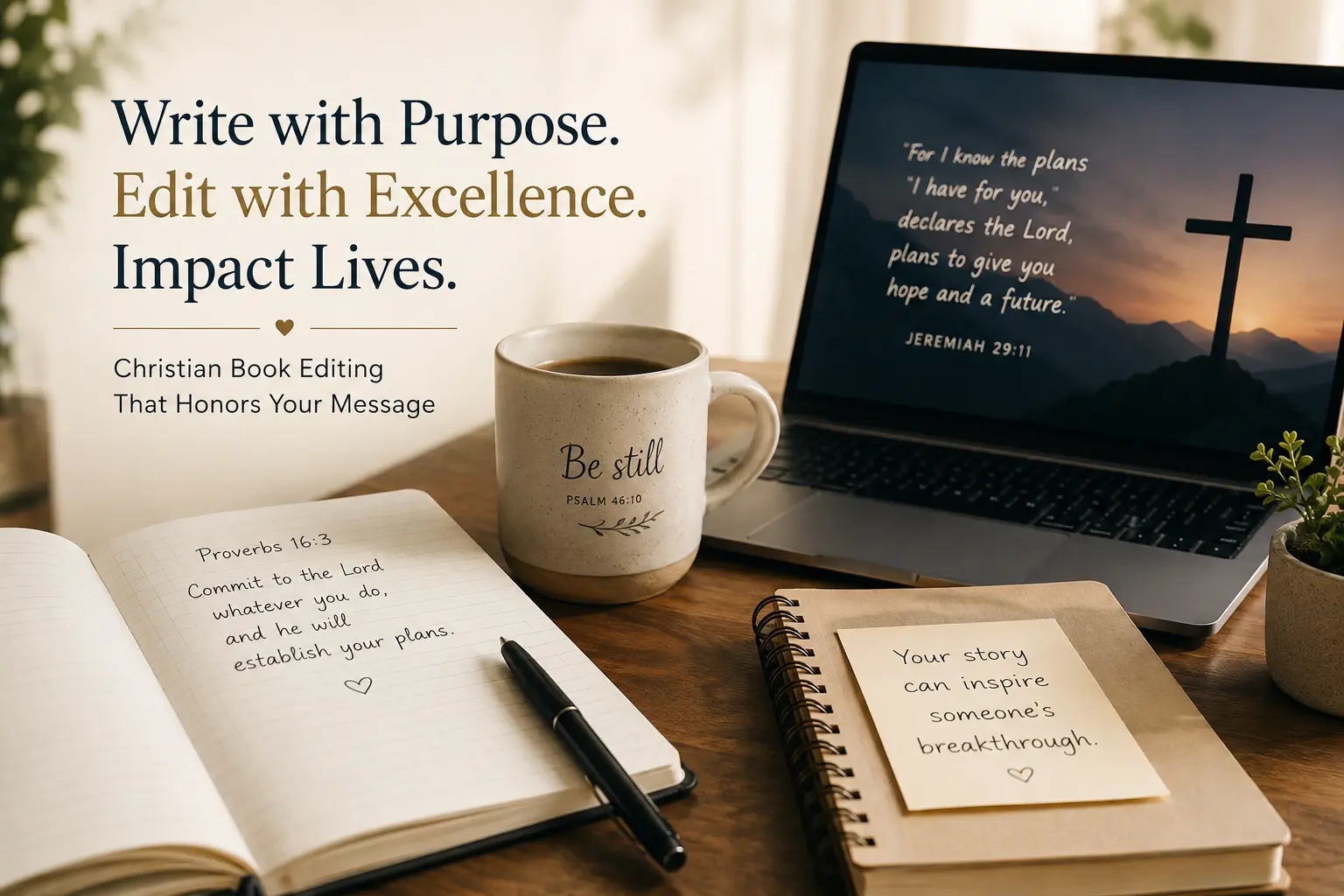
There is something that happens when you finish writing a Christian book. This specific kind of exhaustion mixed with relief mixed with something that feels almost like you just handed something sacred over and you are not entirely sure what happens next. I remember sitting at my desk after typing the last paragraph of my first manuscript and just staring at the screen for a long time. Eight months of early mornings, late nights, prayers over the keyboard, moments where I genuinely felt like I was writing things beyond my own ability to produce. And then I uploaded it to KDP, clicked publish, and moved on. Christian book editing was not even a phrase I had thought about seriously at that point. I did not know enough to know what I was skipping.
A Powerful Message Still Needs Clear Writing
The book was about grief. Specifically about the particular kind of grief that comes when you lose someone and your faith does not collapse but it does get very quiet for a while. About sitting in that silence and what God does there. I had lived every word of it and I thought that living it was what qualified me to write it. In some ways it did. But living an experience and communicating it clearly to a stranger on a page are two completely different skills and I only had one of them developed at that point.
The Difference Professional Editing Made
The reviews came in slowly and they were kind in the way reviews are kind when people can feel how much something cost you personally. But a few of them said the same thing in different ways. Hard to follow in places. Felt like it jumped around. Lost me in the middle section. I read those and felt that particular sting that comes not from being attacked but from being accurately described. They were right. I knew they were right. And I also knew that the message in that book deserved better than what I had given it by rushing it out without proper editing.
Getting it professionally edited and relaunching it changed things in ways I still think about. The testimony stayed the same. The scripture remained unchanged. What also stayed intact was the raw, honest account of what that season truly felt like. But this time people finished it. This time they sent it to friends.
Why You Cannot Just Hand Your Manuscript to Any Editor
After that first experience I felt ready. I knew I needed an editor, I had learned that lesson, and I hired someone with a genuinely impressive list of credits. Long career, well reviewed clients, sharp instincts. I felt good about it.
When Good Editing Misses the Purpose
What I had not thought through carefully enough was that her frame of reference and mine were fundamentally different. She was not a Christian. She was not hostile to faith, not at all, but she read my devotional the way someone reads any manuscript, looking for what would make it work for the widest possible audience. And her feedback reflected that. One suggestion was to pull back on the scripture specificity. Another recommendation was to soften some of the explicitly theological language. She also felt that the passages where I addressed the reader directly as a fellow believer were limiting, arguing that the book could reach a broader audience by making its faith content more universal and less denominationally grounded.
Finding the Right Editorial Perspective
I sat with her notes for almost two weeks. And what I kept coming back to was this uncomfortable feeling that she was trying to help me write a different book. A better crafted book maybe, in certain technical respects, but a book that was no longer actually trying to do the thing I wrote it to do. A devotional for Christian women walking through loss is not trying to be something for everyone. It is trying to be exactly the right thing for a specific someone. And that requires an editor who understands from the inside why that specificity is not a limitation but the entire point.
That is the thing about Christian book editing when it is done by the right person. It is not just a craft service. It is a collaboration between two people who both care about what the book is trying to accomplish in a reader’s life and who share enough of a foundation to evaluate honestly whether it is actually getting there.
Understanding What Kind of Editing Your Manuscript Actually Needs
I genuinely did not know for the longest time that editing was not one thing. I thought you gave someone your manuscript and they fixed it. The reality is more layered than that and understanding the difference between the types of editing saves you a lot of confusion and wasted money.
Developmental Editing
This is where you start and it is the biggest conversation. A developmental editor is not reading your sentences. They are reading your whole book and asking whether it works as a whole. Consider whether the structure holds together from beginning to end. Think about whether the argument or narrative arc leads the reader to a satisfying destination. Pay close attention to the pacing as well, especially through the middle third of the manuscript, since that is where many books begin to lose readers.
For a Christian nonfiction book this means looking at whether your theological foundation is laid clearly enough in the early chapters to support everything you build on top of it later. Whether your application points feel earned by the teaching that precedes them. Whether the reader arrives at the end of each chapter with something they can actually carry into their day or whether they arrive vaguely moved but not quite sure what just happened.
This is the editing that can require real rewrites. Whole chapters restructured, sections moved, things cut that you loved but that were not serving the book. It is uncomfortable and it is also the most valuable thing that can happen to a manuscript before it goes public.
Line Editing
After the structure is sorted a line editor gets close. Sentence by sentence, paragraph by paragraph, looking at how ideas are expressed rather than just whether they are present. They are paying attention to your voice, making sure it stays consistent across chapters that were maybe written months apart. They are looking at transitions between ideas, at whether your prose has rhythm or whether it reads flat in places, at whether the moments that are supposed to carry emotional weight are actually landing.
For Christian writing this is where the pastoral tone gets protected. Where the warmth of your personal testimony does not accidentally tip over into something that feels rambling. Where the teaching sections have the clarity and authority they need without becoming cold or lecture-like.
Copy Editing
Copy editing is the detail layer and it matters more for Christian manuscripts than most people initially assume. Grammar and punctuation obviously. But also consistency in how you cite scripture throughout the book. Check whether they use the same translation consistently or explain any changes clearly when switching between versions. Make sure their references to biblical figures and historical church events are accurate. Consistency in theological terminology also matters, since key terms should be used correctly throughout the manuscript.
Readers who know their Bibles well notice these things immediately. An error in a scripture reference or a sloppy handling of a doctrinal term does not just look careless. It quietly damages the reader’s trust in everything else you are saying. The detail layer of editing protects that trust.
Proofreading
Proofreading is the very last thing, after all the editing is done and the book has been laid out for publication. A proofreader is hunting for anything that slipped through everything else. Typos, doubled words, spacing irregularities, formatting inconsistencies. It is not glamorous work but skipping it is something readers notice even when they cannot articulate exactly what feels slightly off about a book.
A reader who puts your book down in chapter four because the structure lost them never receives what you wrote chapter nine to give them. That is not a spiritual problem but it has spiritual consequences. Professional Christian book editing is part of being a good steward of what you were given to say.
What I Actually Look for When I Am Trying to Find the Right Editor
I have gone through this process enough times now to have strong opinions about it. The things that matter are not always the things that look most impressive on a website.
Faith That Is Real Not Just Familiar
There is a difference between an editor who grew up around Christianity and an editor who is a practicing believer with a genuine theological life. I want the second one. Not because I am gatekeeping but because the difference shows up in the work in ways that are hard to fake.
An editor who shares your faith can tell you when a theological statement is not just unclear but actually slightly off from a biblical standpoint. They can engage with your scriptural interpretation meaningfully rather than just checking that you cited it correctly. They understand why you made certain choices in how you framed a doctrinal point and they can tell you whether those choices are serving your reader or potentially confusing them.
When I reach out to a potential editor now I ask about their faith background directly. I ask what tradition they come from. I ask whether their theological commitments might create any friction with the perspective my book takes. Every good Christian editor I have worked with has welcomed those questions without hesitation.
Experience That Actually Matches What You Wrote
Christian publishing covers more ground than most people outside it realize. The editorial skills required for a fast paced Christian thriller are genuinely different from what a contemplative prayer book needs. A Bible study guide for small groups has completely different structural demands than a pastoral memoir. An apologetics text requires a different kind of theological engagement than a devotional for new believers.
When you are looking at an editor’s portfolio do not just look for the Christian label. Look for books that are actually close to yours in genre, tone, length, and theological depth. The closer the match, the more relevant their experience is to your specific manuscript.
Do the Sample Edit Before Anything Else
Every time. Without exception. Before any contract, before any deposit, ask for a sample edit of your first fifteen to twenty pages. Every reputable editor will do this and what you learn from it cannot be replaced by any amount of reference checking.
Pay attention to what they flag and what they leave alone. Notice whether their suggestions make the writing stronger while preserving your voice, or if they push it in a direction that no longer feels authentic. Their comments should feel collaborative rather than making you feel like your work is being graded. It is also worth seeing how they engage with the theological content, because a thoughtful editor should treat it as an important part of the manuscript instead of merely background material. The answers will tell you almost everything you need to know.
The Spiritual Question Behind the Practical One
I want to sit with this for a minute because I think it matters and I have not always seen it addressed directly. A lot of Christian authors feel an unspoken resistance to editing that is actually theological at its root. The thinking goes something like: God gave me this message. The Holy Spirit was present when I wrote it. Who is a human editor to come in and change what God put there?
I felt this. I did not say it out loud because it sounded presumptuous even to me but it was there underneath my reluctance to seek editing help early on.
Here is what I have come to believe about it. The message is God’s. The manuscript is mine. And my manuscript, however sincerely written, carries all my limitations as a human writer, my blind spots, my underdeveloped craft, my inability to see what a first-time reader needs because I already know everything the book contains. Submitting that manuscript to a skilled editor is not questioning the message. It is taking responsibility for delivering it faithfully.
A reader who puts your book down in chapter four because the structure lost them never receives what you wrote chapter nine to give them. That is not a spiritual problem but it has spiritual consequences. Professional Christian book editing is part of being a good steward of what you were given to say.
The Mistakes That Cost Authors the Most
Using Your Community as Your Editorial Team
Your people are going to love your book. Your pastor, your small group, your closest friends, they are going to tell you it moved them and that you should publish it and that God is going to use it. They mean every word and they are probably right about God using it. What they cannot give you is what they do not have, which is the trained ability to identify structural problems, pacing issues, unclear theological arguments, and prose that needs significant work. Love is not the same as editorial skill and mixing them up costs authors more than almost any other mistake I have seen.
Thinking the Message Excuses the Craft
A powerful message is a reason to invest more in how it is delivered, not a reason to invest less. The message being important means the craft needs to be good enough to carry it all the way to the last page. A brilliant sermon in an incomprehensible structure does not save anyone. It just leaves people feeling like something important almost happened.
Endless Self Revision Instead of Outside Eyes
I spent almost two years doing this with my second manuscript before I finally sent it to an editor. I kept thinking one more pass and it will be ready. One more round of changes and I will feel confident enough to let someone else see it. What actually happened was that I got increasingly unable to read my own writing clearly because I had read it so many times. An editor seeing your complete honest draft for the first time brings something you genuinely cannot give yourself no matter how many times you revise alone.
Where to Start Looking for the Right Person
Professional Christian Editing Directories
The Christian Editors Network and the Christian PEN are both organizations built specifically for this. They maintain directories of editors who work in faith based publishing and who have been vetted for both editorial skill and Christian commitment. Starting there means you are already filtering for people who understand what your manuscript is trying to do.
Christian Writing Conferences
Christian writing conferences are worth the investment if you can get to one. The American Christian Fiction Writers conference, the Serious Writer Academy, Inspire Christian Writers. These events put you in the same room as editors, agents, and other authors who are navigating exactly what you are navigating. The conversations you have in the hallways at those conferences are sometimes more useful than any session on the schedule.
Online Christian Author Communities
Author communities online, Facebook groups for Christian writers, forums for indie Christian publishers, are genuinely good sources of personal recommendations. Someone in those spaces has almost certainly worked with an editor who is exactly right for the kind of book you are writing. A personal recommendation from an author who shares your genre and your theological tradition is worth more than almost any other kind of referral.
Your book has something in it worth reading. Something that came from real faith and real experience and real time on your knees asking God to help you say it right. Getting it properly edited is not the final hurdle before publication. It is the act of respect your manuscript deserves before it goes out to do the work you wrote it to do.