


27 Apr 2026
Last year a friend of mine published her first nonfiction book. She had spent almost eighteen months on it, hired an editor, paid for a proper cover, ran a small launch campaign and got decent sales. A few months later she texted me saying her book had basically stalled. I asked her if she had an audiobook version out yet. She said she had been meaning to look into the best audiobook services but kept putting it off because she did not know where to start and the whole thing felt complicated. That text sat in my head for a while because I knew exactly what she was leaving on the table.
So I helped her figure it out. And now I want to save you the same back-and-forth she and I went through, because the landscape in 2026 is genuinely different than it was even three years ago and authors who know how to navigate it are quietly building audiences that text-only authors simply cannot reach.
Audiobooks Are Not a Bonus Format Anymore
Here is something I noticed personally. I used to read on my commute. Actual reading, screen or paper. Then somewhere around 2022 I stopped doing that and started listening instead, and I realized I was getting through roughly twice as many books. Not because I was smarter or had more time. Just because audio fits into moments that reading cannot.
I am not unique in this. That behavioral shift happened across millions of people and the publishing industry felt it in sales data pretty fast. The portion of book revenue coming from audio has been climbing steadily and the listener base keeps expanding outward into demographics that never considered themselves readers at all.
What this means for you as an author is not complicated. There are people out there who would genuinely connect with your book if it existed in a format they could hear while driving or walking their dog. Right now those people cannot find you because the audio version does not exist. That is the problem the services below exist to solve.
ACX and Why Amazon’s Platform Is Still the Loudest Name in the Room
I want to be upfront that ACX gets mentioned first in almost every conversation about audiobooks and there is a real reason for that, not just because Audible is huge but because the platform actually works well for a specific type of author situation.
ACX is the marketplace Audible built so authors and narrators can find each other. You put your book up, voice actors audition by actually reading a sample of your pages, and you pick whoever fits. That audition process is genuinely one of my favorite things about the platform. You are not hiring based on someone’s demo reel of completely different material. You hear their voice reading your words. That matters more than I can explain without going into a long tangent about how a technically skilled narrator can still completely misread the emotional register of a book.
“You are not hiring based on a demo reel of different material. You hear their voice reading your actual words. That changes everything about how you evaluate the fit.”
The part that requires careful thought is the exclusivity question. ACX will give you significantly better royalty rates if you agree to sell your audiobook only through Audible, Amazon, and iTunes. A lot of authors accept that trade without really thinking about what they are giving up, and then two years later they wish they could be on Spotify or in library systems and they are stuck waiting for their exclusivity period to expire.
My honest take: if your readers live mostly on Amazon and Audible already, the exclusivity might make sense. If you have any ambition beyond that ecosystem or if you care about libraries, think twice before signing.
Findaway Voices for People Who Want Their Book Actually Everywhere
Findaway Voices was the platform I pointed my friend toward first because her situation called for it specifically. She wanted to reach as wide an audience as possible and was not particularly attached to Audible as a platform.
Findaway distributes to over 40 platforms. Spotify, Apple Books, Kobo, Scribd, a bunch of library systems, international retailers. The list is long enough that your audiobook does not live in one company’s garden. It lives in the actual world.
The narrator connection side of Findaway works similarly to ACX. You browse profiles, listen to samples, request auditions. Where it differs in a meaningful way is the royalty structure, which is genuinely transparent in a way that audiobook platforms are not always known for. You can read what you are agreeing to without needing a lawyer to translate it.
Worth knowing: Spotify bought Findaway a couple years back. For most authors that just means the Spotify distribution pipeline is particularly solid, which is valuable considering how many people use that app daily for everything audio related.
Authors Republic Is the One Nobody Mentions Enough
Here is a platform that does not come up first in most blog posts about audiobooks but probably should. Authors Republic is not really in the business of helping you produce your audiobook. What it does exceptionally well is take a finished audio file and distribute it everywhere.
If you have already recorded your audiobook, whether you did it yourself, hired a narrator independently, or worked with a production service and own the files outright, Authors Republic is worth serious consideration. Drop your finished files in, set your pricing, and they handle getting it onto retail platforms and library systems without making you sign exclusivity deals or wait in production queues.
For authors who want to handle production separately from distribution, and there are good reasons to do things that way, Authors Republic is quietly one of the best audiobook services in the market right now for the distribution side of the equation.
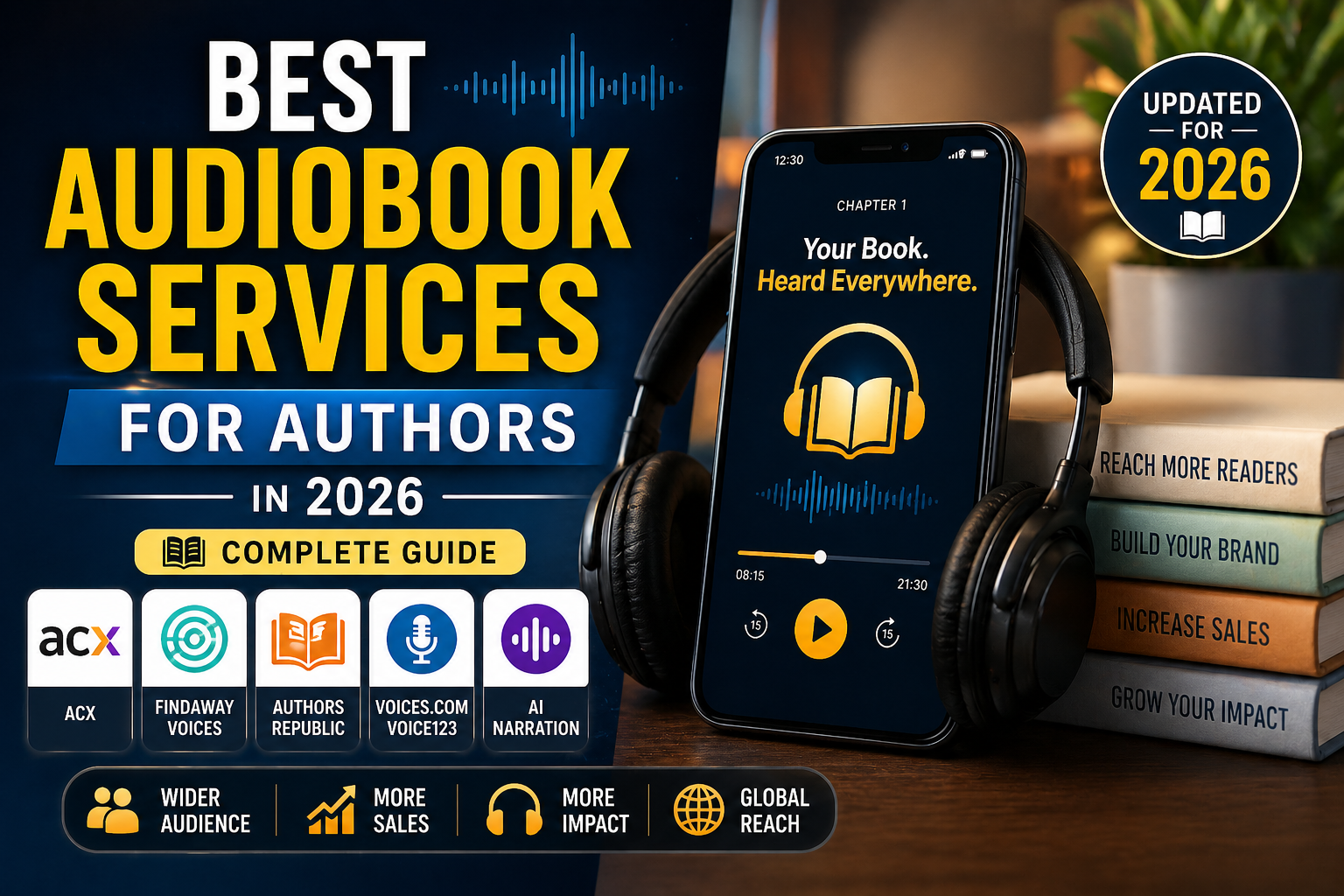
📋 Quick Platform Snapshot
- ACX: Best for Amazon-first authors who want an integrated audition and distribution system
- Findaway Voices: Best for wide reach across 40+ platforms including libraries and Spotify
- Authors Republic: Best for authors with finished files who just need broad distribution fast
- Voices.com / Voice123: Best for authors who want full file ownership and maximum narrator choice
- AI Narration Services: Best for nonfiction authors working with tight budgets or timelines
Voices.com and Voice123 When You Want to Own Everything
Both of these platforms operate on a fundamentally different model than everything listed above. They are hiring marketplaces, not audiobook services in the full sense. You post your project, set your budget, voice actors submit auditions, you hire whoever you want, you pay them, you get the files, and then you do whatever you want with those files.
No ongoing royalty splits. No platform exclusivity. No one else has a financial stake in your audiobook after the recording is done.
The talent pool on both platforms is genuinely impressive. These are people who do this professionally. You can filter by audiobook experience, genre background, voice characteristics, even accent. If you spend an hour on either platform you will come away with a solid shortlist of real candidates who have actually done this kind of work before.
The honest catch is that this model requires you to handle more yourself. After you have your files you need to figure out distribution independently, which is where combining this approach with Authors Republic makes a lot of sense. Pay Voices.com for a great narrator, own your files outright, distribute through Authors Republic, and you end up with both quality and long-term flexibility.
The AI Narration Question That Every Author Has in 2026
I would be doing you a disservice if I skipped this because AI narration is not a fringe option anymore and the conversation around it has genuinely shifted over the past couple of years.
Two years ago I would have told most authors to skip AI narration because the quality was not there for anything a listener would pay for. That is no longer the accurate answer. The technology has moved far enough that AI voices can produce audiobooks that sound clean, paced correctly, and professional enough for plenty of content types.
Nonfiction is where AI narration holds up best right now. Business books, self-help titles, practical guides, educational content. The listener is there for information and the voice is a delivery mechanism. In those contexts a well-produced AI narration is something a real person can sit with for hours without it pulling them out of the experience.
Where AI still falls short in a noticeable way is anything with heavy emotional texture. A memoir about grief. A novel where characters need to feel like distinct real people. Literary fiction where tone and subtext carry meaning that a voice needs to actually interpret, not just deliver. In those cases the flatness that still lives in AI narration is not a technicality, it is an artistic problem.
✅ AI Narration Works Well For
- Nonfiction and practical how-to books
- Business and self-help titles
- Testing the market before a full budget commitment
- Secondary titles where cost control matters more
- Authors with very tight production timelines
❌ Human Narration Still Wins For
- Literary fiction and character-driven stories
- Memoir and deeply personal narratives
- Books where emotional tone carries the meaning
- Authors building a serious long-term audio brand
- Premium titles targeting discerning listeners
The Thing That Trips Authors Up More Than Anything
I have seen authors go through the whole process of picking a service, setting up an account, even getting partway through auditions, and then stall out because they had not thought through one specific thing: what they actually want the narrator to feel like.
Not sound like. Feel like.
There is a difference between a technically good audition and one that makes you think yes, that is my book. The technical stuff you can evaluate pretty quickly. Clarity, pacing, pronunciation. The fit question is harder and more personal and you will know it when you hear it, but only if you are actually listening for it.
When you request auditions, give the narrator a passage that has some texture to it. Not the opening paragraph if that paragraph is mostly scene setting. Give them something with a character moment or an emotional beat or a shift in tone. That is where you find out whether they actually get what you made.
So Which One Do You Actually Use
The answer depends on three things and if you are clear on those three things the right service becomes pretty obvious.
First, where do your readers already buy or listen to audiobooks? If they are Audible people, ACX makes a lot of sense. If they are scattered across platforms or you want to grow somewhere new, Findaway or Authors Republic is probably more useful.
Second, do you want the platform to manage the narrator relationship or do you want to hire independently? ACX and Findaway both handle the matchmaking. Voices.com and Voice123 put you in the driver’s seat completely. Neither approach is better in some universal sense, they just fit different personalities and situations differently.
Third, how do you feel about exclusivity? This one matters more than people realize when they are first signing up for something. Read whatever you are agreeing to and understand what you are giving up before you commit to anything.
✅ Three Questions to Ask Before You Choose Any Service
- Where does my specific audience already listen to audiobooks?
- Do I want the platform to handle narrator matchmaking or do I want to hire directly?
- Am I comfortable trading exclusivity for a better royalty rate long term?
- Do I need library and international distribution or mainly major retail platforms?
- Does my launch window allow enough time for production lead time at this service?
- Will I own my audio files outright after production or does the platform retain anything?
The best audiobook services are not the ones with the most features or the biggest brand name. They are the ones that match how you work, where your readers are, and what level of control you want to keep over your own book long after the recording is finished. That combination looks different for every author and that is completely fine.
Your book deserves to be heard. Literally.