




05 Oct 2026
Two hours. That’s genuinely how long I sat there one night last winter, blank document open, cursor just blinking at me, trying to start a short story that flat out refused to cooperate. I finally gave up and started googling story writing tips at like midnight, half convinced I’d forgotten how to write entirely. Every sentence I typed sounded like I was auditioning to be a writer instead of just, you know. Writing. If you’ve rewritten your opening line five times and hated all five versions equally, yeah. You get it.
I write on and off. Have for years. Mostly short fiction, plus a drawer full of stuff nobody’s ever going to read and honestly probably shouldn’t. Somewhere in all that mess I stumbled onto a few things that actually help when I hit a wall. Not the “just write every day!!” advice plastered across every single writing blog on earth. Actual stuff.
The Beginning Is Usually Where Everything Falls Apart
Every writer I know says some version of the same thing. Starting is the worst part. You’ve got this idea in your head, sometimes even a whole scene playing out clear as day, and then you try typing it and somehow it just… doesn’t work anymore. The image was so clear thirty seconds ago.
Here’s a thing I didn’t get for way too long. Your first draft doesn’t need to be good. At all. I used to sit there for an hour trying to perfect one opening paragraph before letting myself write anything else, which in hindsight was possibly the dumbest habit of my entire writing life. Total momentum killer.
What actually fixed it, weirdly, was telling myself to write badly on purpose. Not “try your best and hope it’s fine.” Actually bad. The second I stopped chasing “good,” the words showed up way faster. And usually when I reread it later, it wasn’t even that bad. Kind of annoying how that works.
Some nights nothing helps though. You just close the laptop. That’s allowed too.
Skip to the Middle If the Start Won’t Cooperate
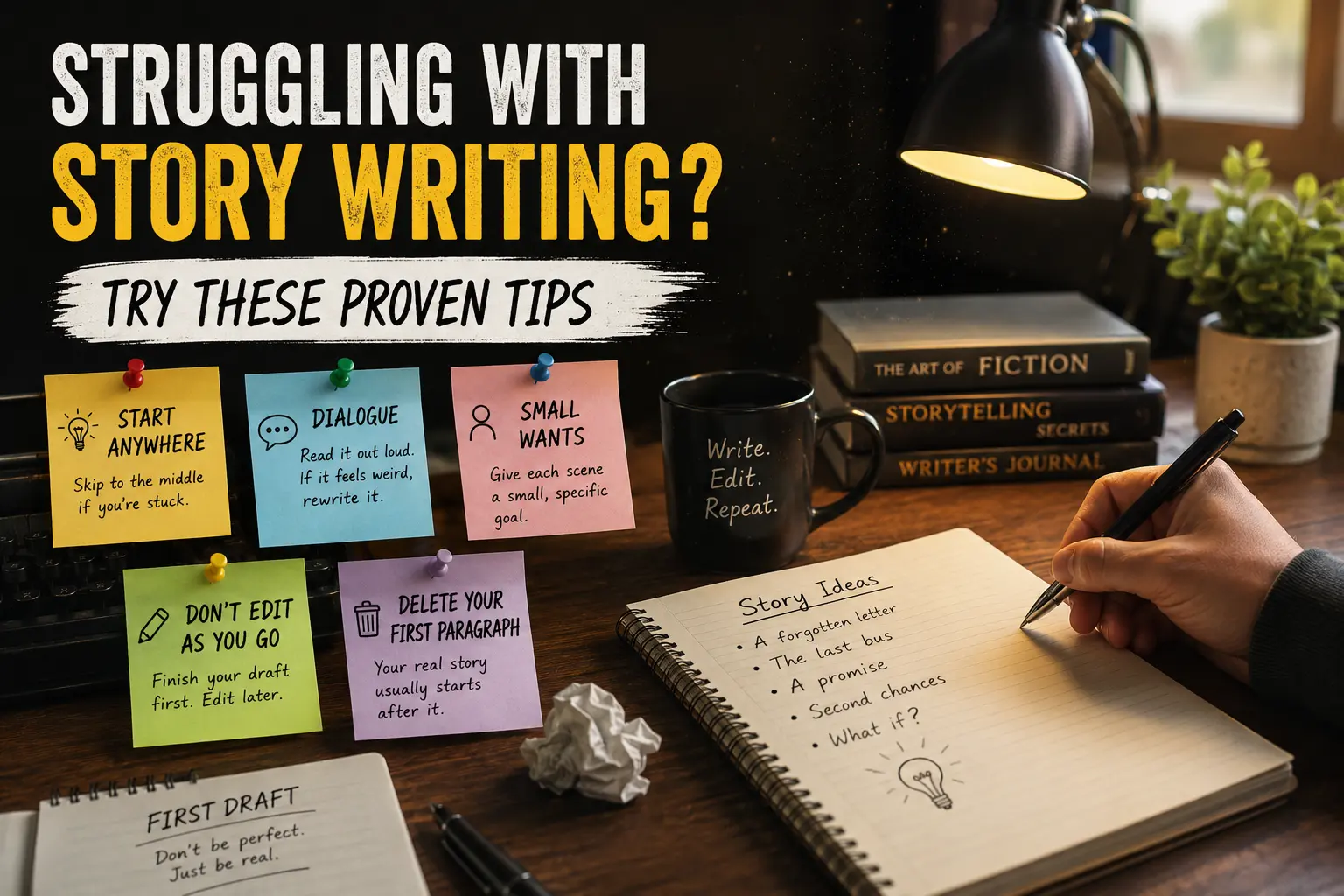
My favorite trick, hands down. Stuck on an opening? Don’t write it. Jump straight to whatever scene is clearest in your mind right now, even if that’s chapter five, or the ending, doesn’t matter. Come back for the opening once you actually know your story better.
Did this with something I was stuck on for nearly a month. Kept trying to introduce my main character and it kept coming out clunky and wrong. So I gave up on the intro completely and wrote a middle scene instead, purely to have something on the page. Went back to the beginning afterward and it took like fifteen minutes. I understood her by then. Simple as that.
Quick tip: if the opening won’t come, skip it entirely and write whatever scene feels clearest first. You can always circle back once you know the story better.
Some Story Writing Tips That Genuinely Help
Okay, beyond just getting unstuck at the blank page, here’s a few habits that stuck with me.
Read dialogue out loud. Yeah I know how that sounds. Do it anyway. If it feels weird coming out of your mouth it’ll feel weird on the page, every time, no exceptions I’ve ever found.
Give characters a small, specific want per scene instead of one giant want for the whole book. Nobody cares that your character wants world peace. Everybody cares that she wants to get through Thanksgiving without her mom mentioning the ex. Small and specific wins.
And this one hurt to accept honestly. Delete your first paragraph once the draft’s done. Most writers, me very much included, use that first paragraph to warm up, like throat clearing before you actually say something. The real start is usually a few sentences down. Sometimes a page down. Cut it and reread. Almost always better.
Stop Editing While You’re Still Drafting
Learned this one the hard way, over years honestly, longer than I’d like to admit. Stopping every three sentences to fix a word choice means you’ll never actually finish a draft. Editing and drafting live in totally different parts of your brain and hopping between them constantly just wrecks you.
So now I write straight through. Leave ugly little notes mid paragraph like “fix later, this line’s bad, keep going.” Felt wrong the first few times, leaving obvious garbage just sitting there on the page unfixed. But a finished messy draft has taught me more about my own stories than three perfectly polished paragraphs ever have.
When You’ve Got Nothing to Say at All
Sometimes it’s not a technique problem. Sometimes there’s just nothing there, or it feels that way anyway, which is its own weird kind of stuck. When that happens I stop trying to force anything and just go collect small odd details instead. Something overheard at a coffee shop. A weird local headline. Sitting somewhere crowded for twenty minutes just watching people, no phone.
These little scraps become entire stories more often than seems reasonable. Once overheard a woman at a laundromat mutter, completely to herself, that her sister “always ruins holidays on purpose.” That single sentence became the whole spine of a story I wrote three months later. You never know what’s useful until you’re actually paying attention.
Stuck for ideas? Stop forcing it and start collecting small real details instead, overheard lines, odd headlines, people watching. The good stuff usually shows up sideways.
Consistency Over Motivation, Always
Motivation just isn’t reliable. Some days the words show up easy. Other days, nothing, no matter how long you sit there. Waiting for motivation before writing means you’ll write way less over a year than you’d expect.
A small repeatable habit works better. Fifteen minutes before bed. Lunch break. Doesn’t need to be some huge word count either, some days it’s two hundred words, some days it’s two thousand and I lose the whole afternoon. What matters is showing up. That’s usually when the actual good ideas show up too, like they were waiting to see if you meant it.
That Voice That Says It’s Bad
Nearly every writer deals with some version of this voice. Doesn’t fully go away with time either, at least not for me. What changes is how much you let it talk during drafting.
I ignore it completely while drafting now. It gets a turn during editing, where it’s actually useful. During drafting though, zero say. Splitting those two mentally changed more than anything else on this list, honestly, probably more than everything combined.
Reading Other Writers, Sort Of Accidentally
Didn’t expect this to matter as much as it did but reading more, specifically noticing how other writers move between scenes, quietly rewired something in my brain over time. Not studying it. Just noticing. How’d they jump scenes without it feeling jarring. How’d they end a chapter so you keep reading past your bedtime.
Started jotting notes on my phone whenever a book made me pause and go, huh, how’d they pull that off. Forgot to actually revisit half of them. Didn’t matter. Something still sank in anyway.
Final Thoughts
If you’re stuck just getting words on a page, every writer’s hit this same wall, even the ones who look effortless about it. These story writing tips won’t make things magically easy. Wish they did. But they make the whole thing feel less impossible than staring at nothing, waiting for a perfect sentence to just show up on its own.
Write messy. Skip the hard part and circle back once you understand the story better. Read dialogue out loud even if you feel silly doing it alone in your kitchen. And just keep showing up, even on the bad days. That’s really the whole secret. One rough sentence at a time.